 Bellingham
 Why Decks in Blaine Take a Beating
Blaine sits right on the water, at the top of Whatcom County where Semiahmoo Bay meets the Strait of Georgia and the Canadian border. That location is part of what makes it a great place to live, but it's also tough on outdoor structures. Salt-laden air drifts in off the water and settles into every exposed joint, fastener, and cut end on a deck. Add in driving rain that comes in sideways during winter storms, and a moss season that can run from October through May in a shaded, humid climate like this one, and you have a recipe for decks that age faster here than they would in a drier inland town.
We repair decks throughout Blaine and the surrounding parts of Whatcom County, and the damage patterns we see are consistent: fastener corrosion, soft or delaminating boards near the ground or in shaded corners, and framing that's held moisture longer than it should have. None of that means a deck in Blaine can't last for decades — it just means repairs need to account for the environment, not just patch what's visible on the surface.
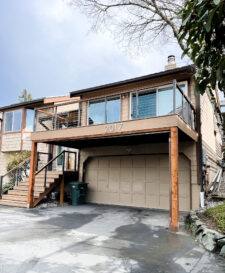
How Salt Air, Rain, and Moss Actually Damage a Deck
Salt Air and Metal Fasteners
Salt in the air accelerates corrosion on nails, screws, joist hangers, and structural connectors. A fastener that would hold up for 20 years in a drier, inland climate can start rusting and losing grip strength much sooner near the water. Once a fastener corrodes, it stops doing its job — boards work loose, hangers pull away from ledgers, and the deck starts to feel spongy or shifty underfoot long before the wood itself is actually rotten.
Driving Rain and Water Intrusion
Wind-driven rain doesn't just fall straight down — it gets pushed sideways and upward into gaps, seams, and the underside of ledger boards and stair stringers. Over time, water finds its way into places a dry-climate deck would never see moisture: behind rim joists, under flashing that's starting to fail, and into end grain on cut boards that were never sealed after installation.
Moss, Algae, and Trapped Moisture
Whatcom County's long, damp, and often shaded winters are ideal for moss and algae growth on horizontal deck surfaces. Beyond being slippery and unattractive, moss holds moisture directly against the wood or composite surface for extended periods. That constant dampness is what leads to soft spots, surface rot, and premature wear on boards that would otherwise have plenty of life left in them.
Signs Your Blaine Deck Needs Repair
Most deck problems don't show up as one dramatic failure — they show up as a handful of small warning signs that get worse over a season or two. Here's what we look for during an inspection:
- Boards that feel soft, spongy, or slightly bouncy when you walk on them
- Visible rust streaks around screws, nails, or metal connectors
- Gaps opening up between the ledger board and the house
- Railings or stair posts that wobble or feel less rigid than they used to
- Persistent moss or dark staining on the same boards year after year
- Cracking or splintering concentrated near board ends or fastener locations
- A musty smell coming from underneath the deck
- Visible gaps or sagging in the skirting or under-deck framing
Any one of these on its own might be minor. Several of them together, especially in the same area of the deck, usually point to a moisture problem that's been developing for a while.
What a Correct Deck Repair Actually Involves
A lot of "deck repair" jobs we get called out for are actually redo work — a board or two was swapped out previously without anyone checking what was underneath it. A proper repair starts below the surface, not at it.
Structural Inspection First
Before we touch a single board, we check the ledger board connection to the house, the condition of the joists and beams, post bases, and any flashing. In a coastal climate like Blaine's, this is where problems most often hide — a deck can look fine on top while the framing underneath has been absorbing moisture for years.
Isolating the Real Cause
Replacing a rotted board without fixing what let water get to it in the first place just buys you a year or two before the same spot fails again. If the cause is a missing or failed flashing detail, poor drainage, or a fastener type that's not holding up to salt exposure, we address that as part of the repair, not as a separate conversation later.
Matching Materials and Fasteners Correctly
Repairs need hardware rated for the actual exposure the deck sees. That generally means stainless steel or high-grade coated fasteners and connectors near the water, proper flashing tape at the ledger, and framing lumber that's rated for ground contact or exterior use where it belongs. Mixing incompatible metals — for example, the wrong fastener with certain treated lumber or flashing — can actually speed up corrosion, so getting this detail right matters more than it might seem.
Repair or Replace? What We Actually Look At
Not every deck problem calls for a full rebuild, and not every deck is worth patching indefinitely. We base the recommendation on the framing, not just the surface boards, since framing is what determines whether the deck is safe and worth investing in further.
| Factor | Usually Points to Repair | Usually Points to Replacement |
|---|---|---|
| Framing & ledger condition | Solid, dry, properly attached | Soft, rotted, or improperly flashed |
| Extent of damage | Isolated boards or fasteners | Widespread rot or corrosion across the structure |
| Deck age | Under 15-20 years, built to code | Older, undersized, or built before current standards |
| Railing & stair safety | Solid, meets current spacing/height | Loose posts, unsafe spacing, structural give |
| Moisture pattern | One or two known problem spots | Recurring issues in multiple areas over time |
If the framing is sound, targeted repair is almost always the more cost-effective path. If the framing itself has been compromised, patching the surface is a short-term fix that will cost more in the long run than addressing it properly the first time.
Materials We Use for Repair Work
For repairs, we typically match the existing deck's material where it makes sense — pressure-treated lumber for framing repairs regardless of the surface material, and either wood or composite boards depending on what's already installed and what the homeowner wants going forward. In a climate like Blaine's, we're honest about the trade-offs of each:
- Pressure-treated wood: Lower upfront cost, needs periodic sealing or staining to hold up against driving rain and salt air, and is more prone to moss growth if not maintained.
- Cedar: Naturally more rot-resistant and a good look for this region, but still benefits from regular sealing near the water.
- Composite decking: Higher upfront cost, essentially immune to rot, and much more resistant to moss staining, but it's still only as good as the framing and fasteners underneath it — composite boards on rotten joists is still a failing deck.
We don't push one material over another as a blanket rule. What matters is that whatever goes back on the deck is installed correctly for this climate, with the right fastener spacing, gapping, and flashing details.
Our Deck Repair Process
- On-site inspection — We check framing, ledger, fasteners, railings, and drainage, not just the visible surface.
- Honest assessment — We explain what's actually wrong, what caused it, and whether repair or replacement makes more sense.
- Written estimate — Clear scope of work and pricing before anything starts.
- Repair work — Framing and moisture-source issues are corrected first, then surface repairs and finish work.
- Walkthrough — We go over what was done and what maintenance will keep it in good shape going forward.
Keeping a Repaired Deck in Good Shape
A good repair should last, but Whatcom County's climate means decks here need a bit more upkeep than they would somewhere drier. A short annual routine goes a long way:
- Sweep debris and standing water off the surface regularly, especially in fall
- Clean moss and algae off with a deck-safe cleaner before it gets a foothold
- Check fasteners and railings for movement once a year
- Reseal or restain wood decking on the manufacturer's recommended schedule
- Keep gutters and downspouts clear so runoff isn't draining onto the deck
- Trim back vegetation that's keeping sections of the deck shaded and damp
Why It Matters to Hire a Crew That Works in Blaine
A contractor who mostly works inland doesn't see the same failure patterns we see routinely in Blaine — corrosion on fasteners that "shouldn't" be failing yet, framing damage hidden by moss on the surface, or flashing details that hold up fine in a drier climate but fail here. Working this area regularly means we know which parts of a deck fail first in this environment and build the repair around that, not around a generic checklist.
If you're seeing soft spots, corrosion, moss buildup, or a deck that just doesn't feel as solid as it used to, we're happy to take a look and give you a straightforward, no-pressure estimate on what it would take to fix it right.