 Bellingham
 If you're re-siding a home in Bellingham, you'll eventually land on the same fork in the road every homeowner here does: vinyl siding or James Hardie fiber cement. Both are legitimate, widely installed products. Both have decades of track record. But they behave very differently once they're on a house in Whatcom County, where salt air off Bellingham Bay, driving rain, and a moss season that can run eight months a year all work on your exterior at once. This page lays out what each product actually does over time, where the real trade-offs are, and why we standardized our installs on James Hardie.
What Vinyl Siding Gets Right
Vinyl earned its market share honestly. It's inexpensive to buy and quick to install, which keeps labor costs down. It doesn't need painting, it won't rot, and the color runs through the material rather than sitting on top of it, so surface scratches don't show white through a darker color the way some coatings can. For a budget-driven remodel or a rental property where upfront cost is the main driver, vinyl is a rational choice, and we're not going to pretend otherwise.
It also handles moisture in the sense that the panel itself doesn't absorb water or rot. Water that gets behind vinyl is supposed to drain back out through the weep holes at the bottom of each course, which works fine as long as the drainage path stays clear and the installation was done correctly.
Where Vinyl Struggles in This Climate
Whatcom County's climate is the part vinyl wasn't really designed around. A few specific issues show up repeatedly on vinyl-sided homes here:
- Moisture management behind the panel: Vinyl is a "rain screen" product by design — it's not a water barrier itself, it relies on the weather-resistive barrier and flashing behind it doing all the work, plus a clear drainage path. With Bellingham's rain volume and duration, any gap in that system (a poorly lapped house wrap, a missed flashing detail) tends to get found out over a wet winter rather than a dry one.
- Heat and impact sensitivity: Vinyl softens in direct summer sun and gets brittle in cold snaps. It expands and contracts more than fiber cement, which is why installers have to leave nail heads slightly loose and gaps at trim — done wrong, panels buckle or rattle in wind, which we get plenty of off the Sound.
- Salt air and UV fading: Homes closer to the water or in exposed spots take more UV and airborne salt than an inland lot. Vinyl's color is baked through the material, but darker colors especially can chalk and fade unevenly over the years, and there's no practical way to refinish it — fading means replacement, not repainting.
- Moss and organic growth: Vinyl's slightly textured, low-gloss surface holds moisture and organic debris in shaded, north-facing walls — extremely common here under mature Douglas fir and cedar canopy. It can be pressure washed, but repeated washing over the years is one more maintenance task that never really ends in this climate.
What James Hardie Fiber Cement Does Differently
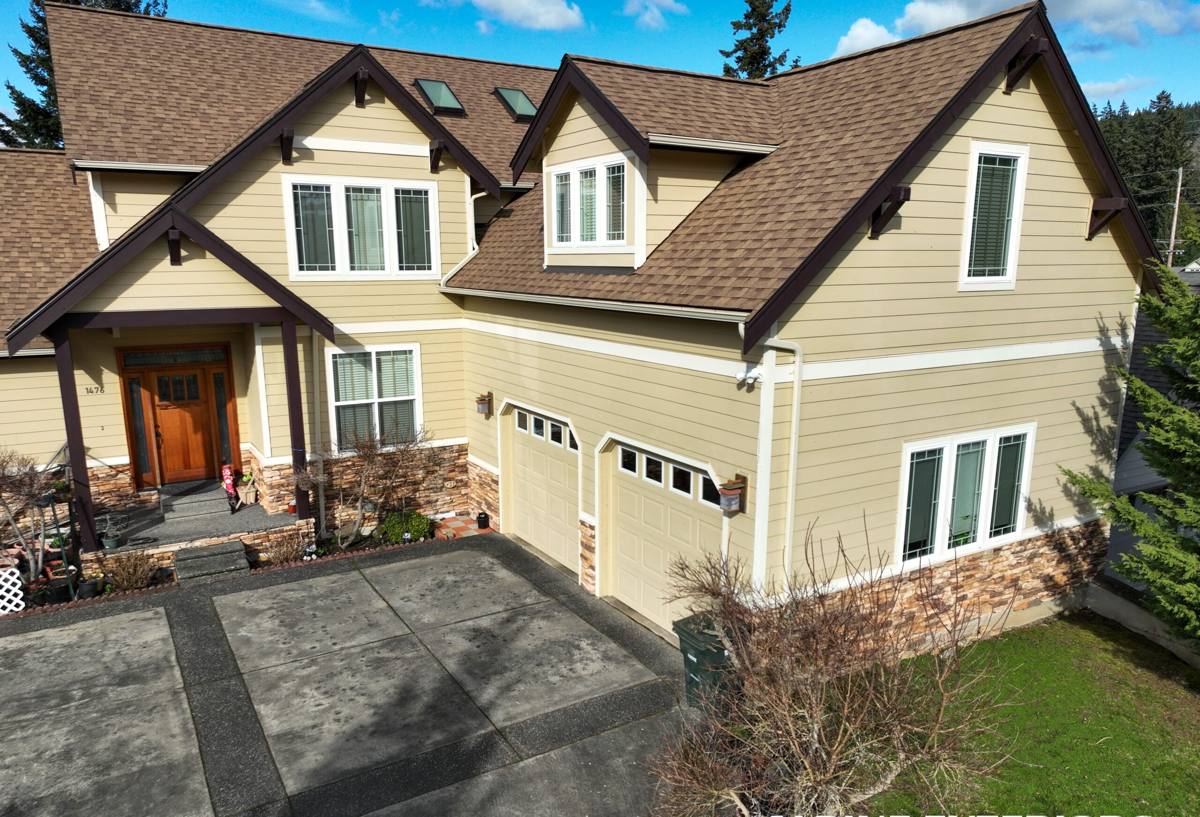
James Hardie siding is made from cement, sand, and cellulose fiber, engineered into a rigid board that's non-combustible and dimensionally stable — it doesn't expand and contract with temperature swings the way vinyl or wood do. That stability matters more than it sounds like: it means seams stay tight, fasteners stay put, and the siding doesn't telegraph every hot afternoon or cold snap into visible movement.
Hardie also makes a version of this product specifically for the Pacific Northwest. Their HZ5 product line is engineered for climates with sustained moisture exposure — the kind Bellingham gets from October through May. It's not a marketing label; the moisture-resistance formulation is different from what Hardie sells in dry Southwest markets.
ColorPlus: The Other Half of the Equation
A lot of the real-world durability difference comes down to the finish, not just the substrate. James Hardie's ColorPlus finish is baked on in a factory-controlled process — multiple coats, cured under controlled conditions — rather than field-painted on site. That gives you a harder, more UV- and salt-stable finish than most site-applied paint jobs, and it's backed by its own separate finish warranty on top of the product warranty. Field-painted fiber cement is still fiber cement, but the finish is only as good as the weather conditions and prep work on install day; ColorPlus removes that variable.
Side-by-Side: The Factors That Actually Matter Here
| Factor | Vinyl Siding | James Hardie (HZ5 + ColorPlus) |
|---|---|---|
| Fire resistance | Combustible (melts, can contribute to fire spread) | Non-combustible |
| Dimensional stability | Expands/contracts noticeably; can warp or buckle | Minimal movement across temperature swings |
| Moisture behavior | Relies entirely on drainage plane behind it | Engineered moisture resistance in the board itself |
| Finish life / fading | Color throughout, but chalks/fades with no refinish option | Factory-cured ColorPlus finish, separately warrantied |
| Impact resistance | Cracks or punctures under impact, especially when cold | Resists impact and denting significantly better |
| Moss/algae resistance | Textured surface holds organic growth | Smoother factory finish sheds growth more readily |
| Upfront cost | Lower | Higher |
| Warranty structure | Manufacturer warranty, often prorated and not transferable | Long-term product warranty, transferable to a new owner |
Installation Sensitivity: Why the Installer Matters as Much as the Product
Neither product performs well if it's installed wrong, but the failure modes are different. Vinyl installed too tight, with nails driven flush instead of left to float, will buckle the first hot week we get. Hardie installed without correct fastener spacing, without the right clearance at grade, or with caulking used in place of proper flashing details will trap moisture at the exact seams it's designed to shed.
This is really the point of this whole page: the product choice matters, but so does the installer's discipline around manufacturer specification. We install exclusively James Hardie for a simple reason — we'd rather stand fully behind one system, installed correctly every time to Hardie's published specs, than split our crews' expertise across several product lines with different rules, different failure points, and different long-term outcomes.
Cost Over the Life of the Siding
Vinyl wins on day-one price, and we won't dress that up. But the comparison that actually matters to a homeowner isn't install-day cost, it's cost over the 20-30 year window most people own a home. Vinyl doesn't get repainted (it can't be, practically), so when it fades, cracks, or a section is damaged, the realistic fix is replacement of that section or the whole run if you can't match the faded color exactly. Hardie with a ColorPlus finish is designed to go a long time without repainting, and if a section is ever damaged, replacement boards are far more likely to match because the finish hasn't been fading unevenly under UV for a decade.
What to Check Before You Decide
- How exposed is the specific wall — direct salt air off the water, prevailing wind-driven rain, or a shaded north face that stays damp most of the year?
- Are you planning to stay in the home long-term, or is this a resale/rental play where lowest cost wins?
- Does your homeowners' insurance or HOA have any requirements around non-combustible exterior materials?
- What's the manufacturer warranty's actual transfer policy if you sell the home in 10 years?
- Is the contractor bidding vinyl the same crew that installs it daily, or a generalist crew working outside their core product?
Where We Land
We don't install vinyl siding, LP SmartSide, or the other fiber cement alternatives on the market. That's not a knock on every homeowner who has vinyl on their house — plenty of vinyl installations hold up fine for a long time. It's that we'd rather put our name behind one product system we know inside and out, engineered for this specific climate, with a factory finish and a warranty structure that holds up over decades of Bellingham weather, than offer a menu of products with different risk profiles. For Whatcom County's combination of rain, salt air, and moss, James Hardie's HZ5 line with ColorPlus is what we believe gives a homeowner the best outcome ten and twenty years out, not just on the day it goes up.
If you're weighing siding options for a home in Bellingham or anywhere in Whatcom County, we're happy to walk your property, talk through what your specific exposure looks like, and give you a straight, no-pressure estimate — use the form below to get started.