 Bellingham
 A roof in Bellingham works harder than a roof almost anywhere else in the state. Between the marine air rolling off Bellingham Bay, the driving rain that comes sideways off the Strait in winter storms, and the shaded, damp conditions that make moss season last most of the year, Whatcom County roofs age differently than roofs inland. Knowing what "normal wear" looks like versus what actually means it's time for a new roof can save a homeowner thousands of dollars — either by avoiding a premature replacement or by catching a failing roof before it damages the decking, framing, and siding underneath it.
Signs Your Roof Needs Replacing, Not Just Repairing
Most roofs don't fail all at once. They send warning signs for months or years before a leak actually shows up inside the house. The trick is recognizing which signs point to a patchable problem and which ones mean the whole system is nearing the end of its service life.
Age is the first filter
Standard three-tab asphalt shingles are typically rated for 20-25 years, and architectural (dimensional) shingles for 25-30 years, but real-world lifespan in Whatcom County tends to land on the shorter end of those ranges because of the constant moisture exposure. If a roof is past 20 years old and starting to show any of the issues below, replacement is usually the more cost-effective path over another round of repairs.
Physical signs worth checking
- Shingles that are curling, cupping, or losing granules in large patches (check the gutters for granule buildup)
- Cracked or missing shingles after wind events, especially near ridges and valleys
- Soft, spongy decking felt underfoot when walking the roof
- Daylight visible through the roof deck from inside the attic
- Dark streaking or heavy moss growth across north-facing slopes
- Rusted, lifted, or missing flashing around chimneys, vents, and skylights
One or two of these in isolation might mean a targeted repair. Several at once, especially combined with an aging roof, usually means the underlayment and decking are compromised too — and patching over that just delays a bigger bill.
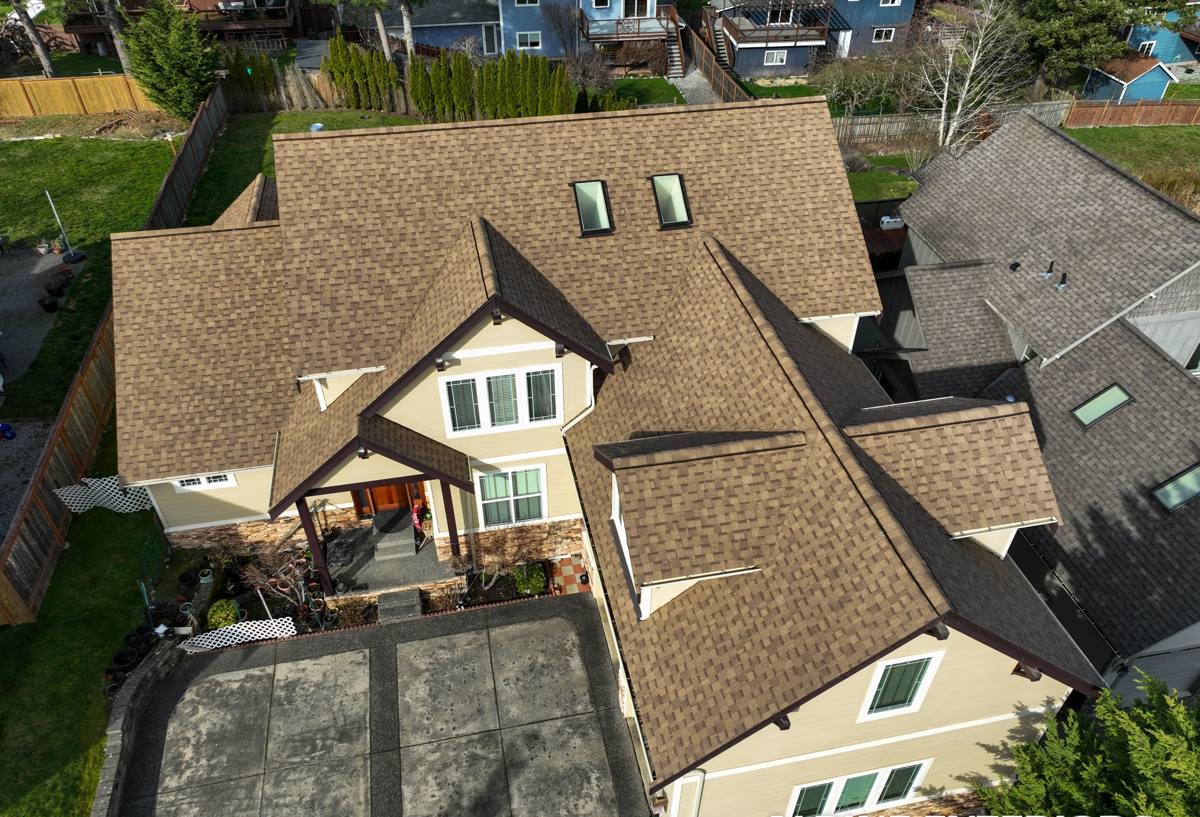
Why Bellingham's Climate Is Hard on Roofs
Whatcom County doesn't get extreme heat or heavy snow loads most winters, but it gets something arguably tougher on roofing materials: near-constant low-grade moisture. The combination of salt-laden marine air, frequent driving rain, and long stretches of shade and dampness creates conditions that accelerate three specific failure modes.
Moss and organic growth
Moss doesn't just look bad — its root structure lifts shingle edges and holds moisture directly against the roofing material, which speeds up granule loss and rot in the decking below. Roofs under tree cover or on shaded north- and west-facing slopes in Bellingham neighborhoods tend to need moss treatment every year or two, and heavy, long-neglected moss growth is one of the more common reasons a roof that's only 12-15 years old already needs replacing.
Wind-driven rain
Storms coming off the Strait of Georgia don't just drop rain straight down — they push it sideways and under shingle edges, flashing laps, and vent boots. This is why proper underlayment, ice-and-water shield at vulnerable transitions, and correctly lapped flashing matter more here than in drier climates. A roof installed to a lower standard may look fine for years and then leak the first time a real windstorm hits it at the wrong angle.
Salt air corrosion
Homes closer to Bellingham Bay and the water see faster corrosion on any exposed metal — nail heads, flashing, gutter fasteners, and vent stacks. Galvanized components that would last decades further inland can start rusting and failing years earlier in a salt-air environment, which is a detail worth asking about when comparing roofing bids.
Roofing Material Options for Whatcom County Homes
There's no single "best" roofing material for every home — it depends on budget, roof pitch, architectural style, and how much maintenance a homeowner is willing to keep up with. Here's how the common options compare for a marine, high-moisture climate like Bellingham's.
| Material | Typical Lifespan | Moss/Moisture Resistance | Relative Cost |
|---|---|---|---|
| 3-Tab Asphalt Shingle | 15-20 years locally | Fair — needs regular moss treatment | Lowest |
| Architectural Shingle | 20-25 years locally | Good — thicker profile sheds debris better | Moderate |
| Standing Seam Metal | 40-50+ years | Excellent — moss struggles to root on metal | Highest upfront |
| Cedar Shake | 20-30 years with upkeep | Poor without consistent treatment | High |
| Synthetic/Composite Shingle | 30-40 years | Good — engineered for moisture, doesn't absorb water like wood | Moderate-High |
Architectural asphalt shingle remains the most common choice for Bellingham homes because it balances upfront cost with a meaningfully better moisture and moss resistance than basic three-tab. Metal and synthetic options cost more initially but can make sense for homeowners planning to stay long-term, since they cut the replacement cycle roughly in half.
The Replacement Process: What Actually Happens
A proper reroof is more than swapping old shingles for new ones. In a climate like this, the layers underneath the visible shingle are what actually keep water out over the long run.
Tear-off and deck inspection
Old roofing material comes off down to the bare deck, which is the only point where a contractor can actually see the condition of the plywood or plank sheathing underneath. Any soft, delaminated, or rotted decking should be identified and replaced here — covering over damaged decking with new shingles just hides the problem for a future homeowner to deal with.
Underlayment and water barriers
A synthetic underlayment goes down across the full deck, with self-adhering ice-and-water shield reinforcing the vulnerable spots — eaves, valleys, and around every penetration (chimneys, skylights, vent pipes). Given how much wind-driven rain this area sees, this layer is doing real work, not just serving as a formality.
Flashing and ventilation
New step flashing, counter-flashing, and vent boots get installed rather than reused, and ridge and soffit ventilation gets checked to make sure the attic can actually breathe. Poor attic ventilation traps moisture, which shortens shingle life from underneath — a slower, less visible version of the same damage that rain causes from above.
Shingle installation and cleanup
Shingles go down in the manufacturer's specified pattern and nailing schedule (which affects wind and warranty ratings), followed by a full site cleanup including a magnetic sweep for stray nails in the yard and driveway.
Roof Replacement Is a Good Time to Check the Siding, Too
Once scaffolding or a crew is already up at the roofline, it's worth a look at the condition of the siding, trim, and fascia in the same areas — because roof and siding failures tend to show up together at eaves, rakes, and wall-roof transitions where water concentrates. If trim boards near the roofline are soft, delaminating, or showing paint failure, that's usually a moisture problem that started at the roof edge and worked its way into the wall assembly.
This is also the point where we'll be straightforward with homeowners: we install James Hardie fiber cement siding exclusively, and we don't install vinyl, LP SmartSide, or primed wood siding, even though those products have their place in the market. The reason ties directly back to the same climate factors that wear out roofs here. Vinyl can warp and gap under sustained wind-driven rain and temperature swings, wood trim needs ongoing paint maintenance to resist the moisture this area throws at it, and engineered wood products are more sensitive to the kind of prolonged dampness Bellingham's moss season creates. Hardie's fiber cement is non-combustible, holds its factory-applied ColorPlus finish far longer than field-painted materials, and its HZ5 product line is engineered specifically for marine, high-moisture climates like this one. It's not the cheapest option on day one, but it's the standard we're willing to put our name behind for the long haul.
What Drives Roof Replacement Cost
Roofing quotes can vary widely between contractors for reasons that aren't always obvious from the number alone. The factors below explain most of the spread.
Roof size and complexity
Square footage is the starting point, but roof pitch, number of valleys, dormers, and penetrations all add labor time. A steep, cut-up roof with multiple skylights costs more per square than a simple gable roof of the same size.
Material choice
As the comparison table above shows, material alone can shift the budget significantly — metal and premium synthetic products cost more upfront in exchange for a much longer service life.
Tear-off scope
Removing one layer of old shingles is standard; removing two or three layers (common on older homes that were reroofed without a full tear-off in the past) adds disposal cost and labor.
Decking repair
This is the wildcard in any bid. A contractor can estimate decking replacement as a likely range going in, but the actual amount isn't known until the old roofing comes off and the deck is visible. A trustworthy contractor will document any decking replacement with photos and a per-sheet price agreed on before the work happens, not after.
Access and site conditions
Steep pitches, limited driveway access for dumpsters, and multi-story homes all add time and equipment cost.
Choosing a Roofing Contractor in Whatcom County
Roofing has a low barrier to entry, which means the range of contractor quality in any given area is wide. A few checks up front filter out most of the risk.
- Verify active Washington state contractor licensing and check for any complaints on file
- Confirm current liability insurance and workers' compensation coverage — ask for a certificate directly from the insurer, not just a claim
- Ask whether the contractor pulls a building permit for full reroofs (required in most Whatcom County jurisdictions and a sign they're not cutting corners)
- Get the manufacturer and product line specified in writing, not just "architectural shingle"
- Ask about their nailing pattern and ventilation approach — a contractor who can explain this clearly usually knows what they're doing
- Get a written warranty that separates the manufacturer's material warranty from the contractor's workmanship warranty, and know how long each lasts
- Request local references from jobs at least a year or two old, so weather has had a chance to test the work
Be cautious of storm-chasing crews that show up after a wind event offering fast, deeply discounted work — they're often not local, won't be around for warranty service, and may not pull permits.
Keeping a New Roof in Good Condition
A properly installed roof in this climate still needs some ongoing attention to hit its full expected lifespan.
Moss control
Zinc or copper strips near the ridge, combined with an annual soft wash or moss treatment on shaded slopes, keeps growth from taking hold in the first place — far cheaper than dealing with moss damage after the fact.
Gutter maintenance
Clogged gutters back water up under the shingle edge at the eaves, one of the more common causes of localized rot in older Bellingham roofs. Clearing gutters at least twice a year, more often under mature trees, protects both the roof edge and the fascia behind it.
Periodic inspection
A quick visual check after major windstorms and once a year otherwise — looking for lifted shingles, damaged flashing, or new moss growth — catches small problems while they're still small.
If your roof is showing its age, or you're just not sure whether what you're seeing is a repair or a replacement situation, we're happy to take a look and give you a straight answer. Reach out for a free, no-pressure estimate using the form below.