 Bellingham
 Exterior Contractor Serving Ferndale, Washington
Ferndale sits at the north end of Whatcom County, close enough to Bellingham Bay and the Salish Sea that homes here deal with a specific mix of weather most inland Washington towns don't see as often: salt-tinged air, driving rain that comes in sideways off the water, and long stretches of gray, damp months that give moss and algae plenty of time to take hold on roofs and siding. Add in the industrial and agricultural surroundings, mature tree cover in a lot of neighborhoods, and temperature swings between marine-layer chill and summer heat, and you've got an exterior envelope that's working hard year-round whether the homeowner notices it or not.
We're based in the Bellingham area and treat Ferndale as core service territory, not an afterthought tacked onto a bigger city's route. That matters more than it sounds like it should. A crew that works this specific stretch of Whatcom County knows what a Ferndale roof looks like after five Pacific Northwest winters, knows which sides of a house take the worst of the wind-driven rain, and knows how fast moss re-establishes itself on a north-facing wall that never gets direct sun. That local pattern recognition shapes how we install, not just what we install.
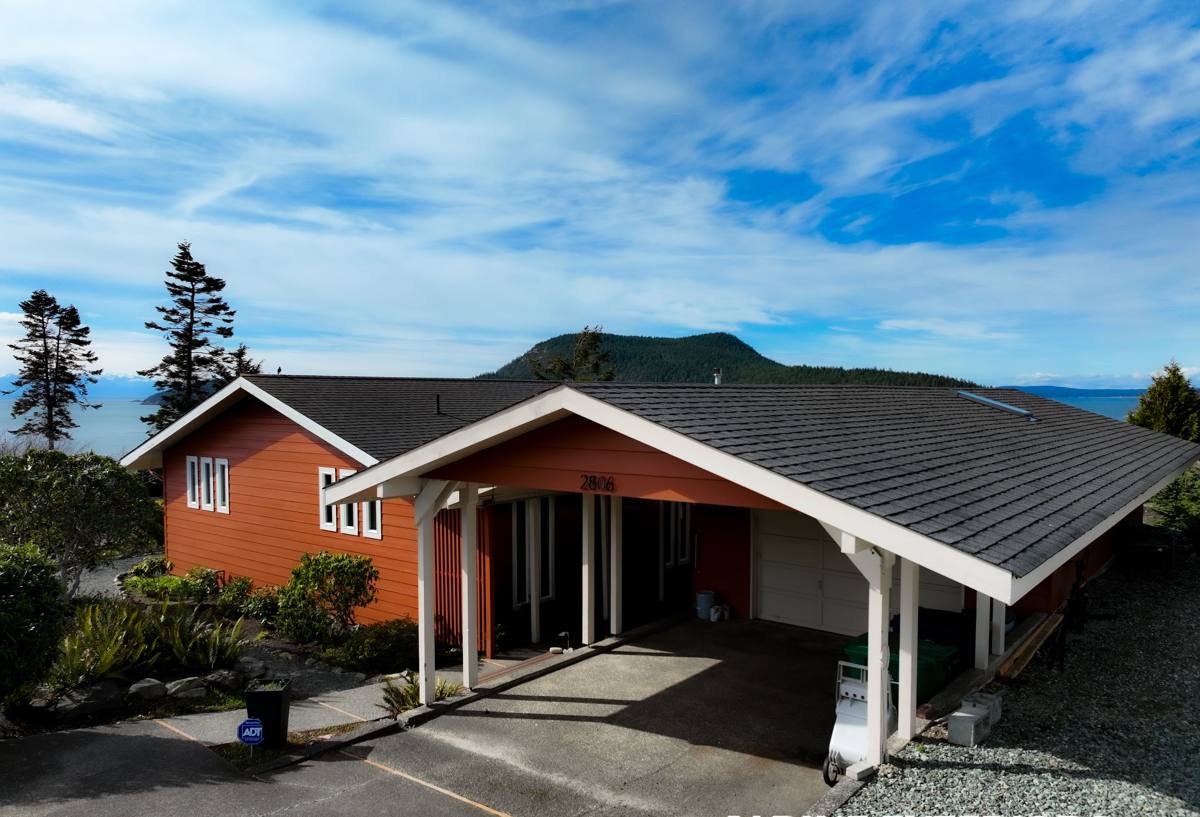
What Ferndale's Climate Actually Does to a House
Salt Air and Corrosion
Proximity to Bellingham Bay and the broader Salish Sea means a measurable amount of salt in the air, especially on breezy days. Salt air accelerates corrosion on fasteners, flashing, gutters, and any metal trim that isn't rated for coastal exposure. Over years, that shows up as rust streaks, pitted metal, and fasteners that fail well before their expected lifespan. It's a slow process, which is exactly why it gets overlooked until a repair is already needed.
Driving Rain
Whatcom County gets a lot of rain, but the bigger issue for exteriors isn't total rainfall — it's wind-driven rain that gets pushed sideways into wall assemblies, especially on west- and southwest-facing elevations. Siding, trim, and window flashing all have to manage water that's actively being pushed at the building, not just falling straight down. Gaps, poor caulking, or undersized flashing details that would be minor problems in a drier climate become real moisture-intrusion risks here.
Moss and Algae
Consistent moisture, moderate temperatures, and shaded lots (common in Ferndale's more wooded neighborhoods) add up to a long moss and algae season — often close to year-round on north-facing roof slopes and siding that doesn't get much sun. Moss holds moisture against roofing and siding surfaces, works into seams and laps, and can shorten the service life of materials that aren't built to resist it.
Siding for Ferndale Homes
We install James Hardie fiber cement siding exclusively. That's a deliberate standard, not a limitation on what we're capable of installing. Fiber cement handles the specific combination of salt air, driving rain, and sustained moisture that Ferndale throws at a house better than the alternatives we used to install, and we'd rather stand behind one product system we trust completely than offer a menu of options with very different long-term outcomes.
Why We Don't Install Vinyl Siding
Vinyl is inexpensive and easy to source, and for some climates and budgets it's a defensible choice. In a coastal, high-moisture environment like Ferndale's, though, vinyl's weaknesses line up poorly with local conditions. It expands and contracts significantly with temperature swings, which stresses seams and fastening over time. It's also more vulnerable to wind damage in gusty conditions off the water, and it doesn't hold paint, so once the factory color fades or you want a different look, your only real option is replacement. We won't install a product where the honest answer to "how do I refresh it in fifteen years" is "you don't."
Why We Don't Install LP SmartSide, Cemplank, Allura, or Wood Siding
LP SmartSide is an engineered wood product — it performs reasonably well in the right conditions, but wood-based siding is inherently more moisture-sensitive than fiber cement, and moisture is the one thing Ferndale doesn't run short of. Cemplank and Allura are both fiber cement, and reasonable competitors to Hardie on paper, but we've standardized on one manufacturer so we can guarantee consistent quality control, factory finish, and warranty support rather than juggling multiple supply chains and product specs. Primed spruce and cedar are beautiful materials, and we understand the appeal, but both require an ongoing maintenance commitment — recoating, caulking, and moisture monitoring — that's a tough ask in a climate where the wet season doesn't leave much of a maintenance window.
Why James Hardie
Hardie fiber cement is non-combustible, dimensionally stable across our temperature swings, and resistant to moisture intrusion, pest damage, and rot in a way wood-based products can't match. The ColorPlus factory finish is baked on under controlled conditions and backed by a substantial finish warranty, which means the color stays consistent through the Pacific Northwest's wet, low-light winters instead of chalking or fading unevenly. Hardie also engineers regional product lines (HZ5, for example) specifically for climates like ours, which is a level of climate-specific engineering the other products on this list don't offer.
Siding Comparison at a Glance
| Material | Moisture Resistance | Maintenance | Coastal/Salt Air Durability | Refinishing |
|---|---|---|---|---|
| James Hardie Fiber Cement | Excellent | Low | Strong, HZ lines built for it | Can be repainted |
| Vinyl | Good, but seams are vulnerable | Low | Moderate; can warp/crack in wind | Not paintable |
| Engineered Wood (LP SmartSide) | Moderate; sensitive to sustained wet | Moderate | Moderate | Can be repainted |
| Cedar / Primed Wood | Requires diligent upkeep | High | Weak without regular maintenance | Requires recoating |
Roofing in a Moss-Heavy, High-Moisture Area
Roofs in Ferndale earn their keep. Beyond wind and rain exposure, moss growth is one of the biggest long-term threats to roof longevity here, particularly on shaded or north-facing slopes. Moss holds water against the roofing surface and can work under shingle edges over time, which shortens the effective life of the roof and increases the odds of a leak showing up somewhere you can't easily see it. Proper roof installation in this climate means attention to underlayment quality, ventilation, flashing details at every penetration and valley, and edge details that shed water instead of trapping it. We also talk with homeowners honestly about moss management as part of ongoing roof care — it's a maintenance issue, not a one-time fix.
Windows and the Marine Layer
Window performance in a marine climate is mostly about two things: sealing against wind-driven rain and managing condensation from temperature and humidity swings. Poorly sealed or aging windows in Ferndale tend to show it first as fogging between panes, drafts on windy days, or soft trim around the frame from slow water intrusion. When we replace windows as part of a broader exterior project, we treat flashing and integration with the siding system as part of the same weatherproofing plan — a window is only as good as how well it's tied into the wall around it.
Decks: Built for Wet Ground and Wet Air
Outdoor living in Whatcom County means building for a deck that will spend a good part of the year damp, shaded, and slow to dry. That affects material selection, fastener choice (corrosion resistance matters here too), and structural details like joist spacing and ledger flashing that keep water from pooling against the house. A deck built without those details in mind tends to show soft spots, rust stains, or slippery moss growth well before it should.
Why a Local Crew Matters Here
- We know which elevations in Ferndale neighborhoods take the worst wind-driven rain and detail flashing accordingly
- We understand how fast moss re-establishes on shaded, north-facing surfaces in this specific microclimate
- We account for salt-air corrosion in fastener and flashing selection, not just standard-spec hardware
- We're close enough to respond quickly for warranty work, follow-up questions, or storm-related concerns
- We've seen how James Hardie siding actually performs on Whatcom County homes over years, not just on a spec sheet
What to Expect From a Project Here
Assessment
We start by looking at the actual condition of your siding, roof, windows, or deck — what's original, what's been patched, where moisture has already found a way in — before recommending anything.
Honest Scoping
Not every project needs a full replacement. Sometimes targeted repair and better maintenance buys real time. We'll tell you which situation you're in.
Installation to Spec
Fiber cement siding, in particular, is only as good as its installation — proper clearances, fastening patterns, caulking at joints, and flashing integration all matter more in a wet climate than a dry one. We install to manufacturer specification because cutting corners here is exactly what shows up as a callback three winters later.
Simple Checklist: Signs Your Ferndale Home Needs an Exterior Look
- Moss or dark streaking building up on roof slopes or siding, especially shaded sides
- Soft, discolored, or bubbling siding, particularly near ground level or window trim
- Rust staining around fasteners, flashing, or gutters
- Drafts, fogging, or visible gaps around window frames
- Soft or spongy spots on deck boards or ledger connections
- Paint that's chalking, peeling, or fading unevenly across different elevations
If you're noticing any of that on a home in Ferndale, or you're just planning ahead for a siding, roofing, window, or deck project, we're happy to take a look and give you a straightforward, no-pressure estimate. Use the form below to get started.