 Bellingham
 A Company Standard, Not a Sales Pitch
Homeowners sometimes ask why we don't offer a menu of siding brands the way some contractors do. The honest answer is that we looked at what actually holds up on homes in Whatcom County over ten, twenty, and thirty years, and we narrowed our installs to one product line: James Hardie fiber cement siding. This isn't a marketing angle. It's a decision driven by what we see when we tear old siding off houses in Bellingham, Fairhaven, and out toward Lynden and Ferndale — and what we don't want to be doing again in five years.
Bellingham sits in a specific climate niche. We get salt-laden air off Bellingham Bay and the Strait of Georgia, driving rain that comes in sideways off Puget Sound storms, and a moss season that can run eight months out of the year in shaded, north-facing exposures. Siding here doesn't just need to look good on installation day — it needs to survive repeated wet-dry cycling, resist organic growth, and hold paint or factory finish without cracking or delaminating. That combination rules out more products than people expect.
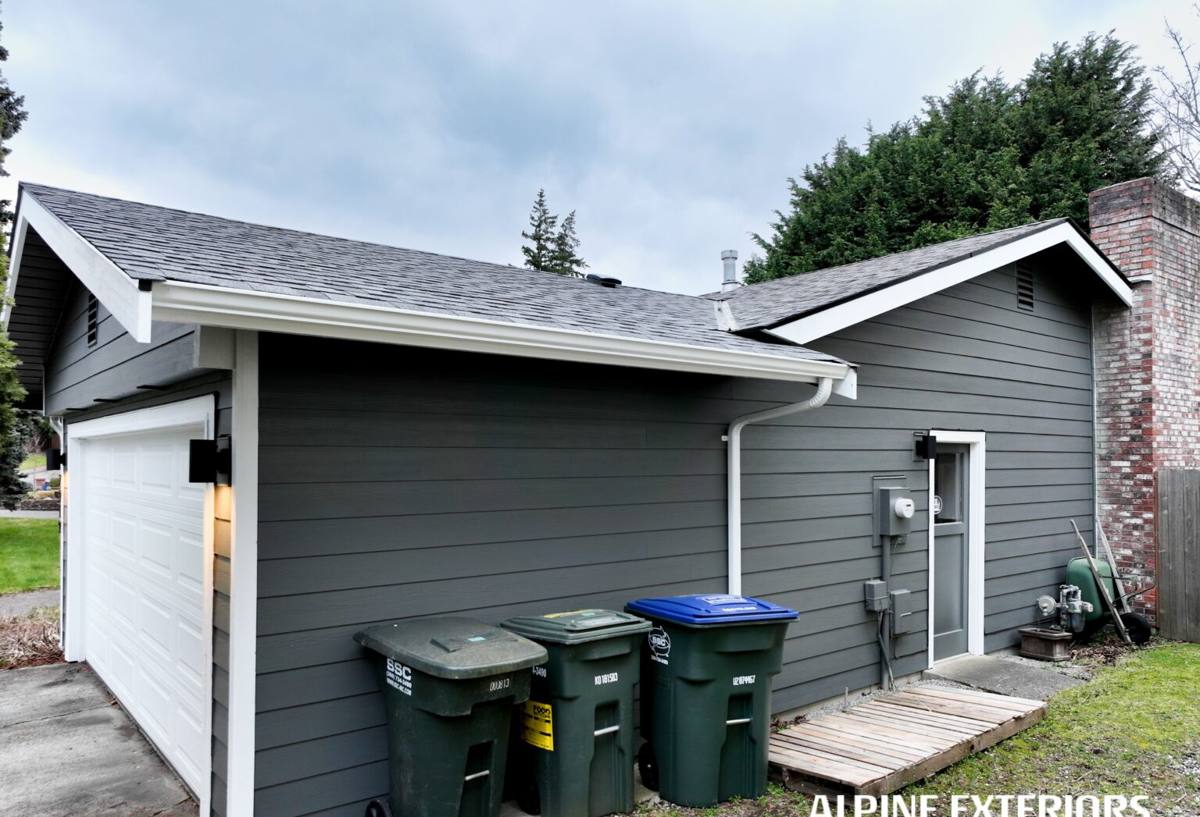
What We're Actually Comparing
To be fair to the alternatives, each one has a legitimate use case somewhere. Vinyl siding is inexpensive and low-maintenance in mild, dry climates. LP SmartSide and other engineered wood products perform reasonably well when detailing is perfect and moisture never gets behind them. Primed spruce and cedar have real aesthetic appeal and a long tradition in the Pacific Northwest. None of these are "bad" products in the abstract. The issue is how they behave specifically under Whatcom County conditions, applied by real crews, on real houses, over real decades.
Vinyl Siding
Vinyl's biggest weakness here isn't the material failing outright — it's what happens around it. Vinyl expands and contracts significantly with temperature swings, which loosens fastener tolerances over time and creates gaps where wind-driven rain can work its way behind panels. In a marine climate with near-constant humidity, any moisture that gets trapped behind vinyl has nowhere to dry out quickly. We also see vinyl chalk, fade, and go brittle under UV exposure faster than most homeowners expect, and it cannot be painted to refresh it without specialized paint and prep — most people just replace it instead.
LP SmartSide and Engineered Wood
Engineered wood siding relies on a resin-treated wood strand substrate with a factory finish, and it performs fine as long as every cut edge, seam, and penetration is sealed correctly and stays sealed. The problem is that this margin for error is thin, and it doesn't forgive Bellingham's wet season. Once moisture gets into an unsealed edge or a nail hole that wasn't caulked, the wood-based substrate can swell, and swelling doesn't reverse itself. We've pulled off engineered wood siding that looked fine from the street but had soft, swollen bottom edges from years of moss and standing moisture at the ground line — a very common failure point in shaded, wet yards.
Primed Spruce and Cedar
Solid wood siding is the most maintenance-intensive option of the group, full stop. It needs repainting or restaining on a real schedule — often every 5 to 8 years in this climate, sooner in shaded or north-facing walls where moss and mildew take hold fastest. Cedar has natural rot resistance that primed spruce lacks, but both are organic material, and organic material in a climate with our rainfall and moss season needs ongoing homeowner attention that most people don't want to sign up for after the first repaint.
Why James Hardie Fits This Climate
James Hardie fiber cement is made from cement, sand, and cellulose fiber, which makes it fundamentally non-combustible and dimensionally stable — it doesn't expand and contract the way vinyl or wood-based products do, so seams and caulk joints stay tighter for longer. It's also inorganic, meaning moss and mildew can grow on its surface (they'll grow on almost anything left damp long enough) but they can't feed on the material itself the way they can on wood substrate. That distinction matters a lot in a county where moss growth is a near-constant maintenance topic.
Hardie's ColorPlus factory finish is baked on under controlled conditions and backed by a real finish warranty, which means the color coat isn't something we're hoping our crew nails perfectly on a wet Tuesday in November. It arrives consistent, and it's engineered to resist the fading and chalking that hits field-applied paint jobs first.
HZ5 and Climate Engineering
James Hardie makes region-specific product formulations rather than one universal board. Whatcom County falls into their HZ5 climate zone designation, engineered for moisture and freeze-thaw conditions typical of the Pacific Northwest. That's a meaningfully different product than what gets installed in Arizona or Florida, and it's part of why we specify HZ5 product for every install here rather than treating fiber cement as a one-size-fits-all material.
Installation Sensitivity — the Part Nobody Advertises
Every siding product, including Hardie, is only as good as its installation. Fiber cement in particular is unforgiving of shortcuts: incorrect nailing patterns, missing flashing at windows and butt joints, insufficient clearance from grade or roof lines, and unsealed cut edges will all cause problems regardless of how good the base material is. This is true of any siding, but it's worth saying plainly because it's the main reason product comparisons online can be misleading — a poorly installed Hardie job and a well-installed Hardie job are not the same product in practice.
- Correct nail penetration and spacing per Hardie's published fastening schedule
- Weather-resistant barrier installed and lapped correctly behind every panel
- Flashing at all windows, doors, and horizontal trim intersections
- Minimum clearance maintained from grade, roofing, and decks
- All factory and field-cut edges sealed or back-primed per manufacturer spec
- Proper caulking at butt joints using a Hardie-compatible sealant
This is also why we don't subcontract Hardie installs out to whoever's available — our crews are trained specifically on fiber cement detailing, because the manufacturer's warranty and the material's real-world performance both depend on it being done right the first time.
Cost and Longevity, Honestly
Fiber cement costs more upfront than vinyl and is generally comparable to or somewhat above engineered wood, depending on the specific product lines and trim package. We won't pretend otherwise. The way to think about it is total cost over the time you'll own the house, not just the installed price.
| Factor | Vinyl | Engineered Wood | Solid Wood | James Hardie Fiber Cement |
|---|---|---|---|---|
| Typical repaint/refinish cycle | Not paintable easily | Factory finish, 15+ yrs typical | 5-8 yrs in this climate | Factory ColorPlus, 15+ yrs typical |
| Moisture vulnerability | Trapped moisture behind panels | Substrate swells if seals fail | Rot risk without upkeep | Inorganic, no rot risk |
| Fire resistance | Combustible | Combustible | Combustible | Non-combustible |
| Moss/mildew concern | Surface growth possible | Surface growth possible | Surface growth, feeds on wood | Surface growth possible, no material breakdown |
| Installed cost (relative) | Lowest | Moderate | Moderate-High | Moderate-High |
The Warranty Question
James Hardie backs their siding with a non-prorated, transferable limited warranty on the substrate, and a separate finish warranty on ColorPlus products. Transferability matters more than people initially think — if you sell the house within the warranty window, that coverage moves to the next owner, which is a real selling point in a market where buyers are increasingly asking about siding age and condition. Vinyl and engineered wood warranties exist too, but they're frequently prorated after the early years, and coverage can be voided by installation errors that are hard for a homeowner to detect after the fact.
What Correct Installation Looks Like on Your House
If you're evaluating any siding bid — ours or someone else's — these are reasonable questions to ask before signing anything:
- What nailing schedule and fastener type will be used, and is it documented?
- Who is doing the flashing detail work at windows and roof lines, and how is it inspected?
- What weather-resistant barrier is specified behind the siding?
- How are cut edges treated in the field?
- Is the crew factory-trained on this specific product, or generally experienced with "siding"?
- What does the manufacturer warranty actually cover, and does it survive a resale?
Where This Leaves Bellingham Homeowners
None of this means every other siding product is wrong for every house in every climate. It means that after years of tear-offs, repairs, and warranty claims across Whatcom County's specific mix of salt air, driving rain, and long moss seasons, fiber cement installed to spec is the product we're willing to stand behind. That's why it's the only siding we install, and why our estimate conversations focus on Hardie product lines, color options, and correct detailing rather than a lineup of alternatives we'd be installing with reservations.
If you're weighing a siding replacement or new install and want a straight answer about what's actually going on with your current siding, we're happy to take a look. Reach out for a free, no-pressure estimate — no obligation, just an honest read on your home.