 Bellingham
 Vinyl Siding Isn't a Bad Product — It's Just Not Right for This Climate
We get asked about vinyl siding a lot, usually from homeowners comparing bids and wondering why our estimate doesn't include it. It's a fair question, and it deserves an honest answer instead of a sales pitch. Vinyl siding is inexpensive, it's fast to install, and for a lot of the country it's a perfectly reasonable choice. It doesn't rot, it never needs painting, and the upfront cost is hard to beat.
The problem isn't vinyl in general. The problem is vinyl in Bellingham. Whatcom County sits right on Bellingham Bay, which means salt-laden air moves through neighborhoods that would otherwise be considered "inland." Add in driving rain off the Strait, a moss season that can run eight or nine months of the year, and temperature swings between summer heat and winter cold snaps, and you've got a climate that exposes almost every weakness vinyl siding has. We've made a standard as a company to install only James Hardie fiber cement siding, and this page walks through why — plainly, without exaggerating what vinyl does wrong.
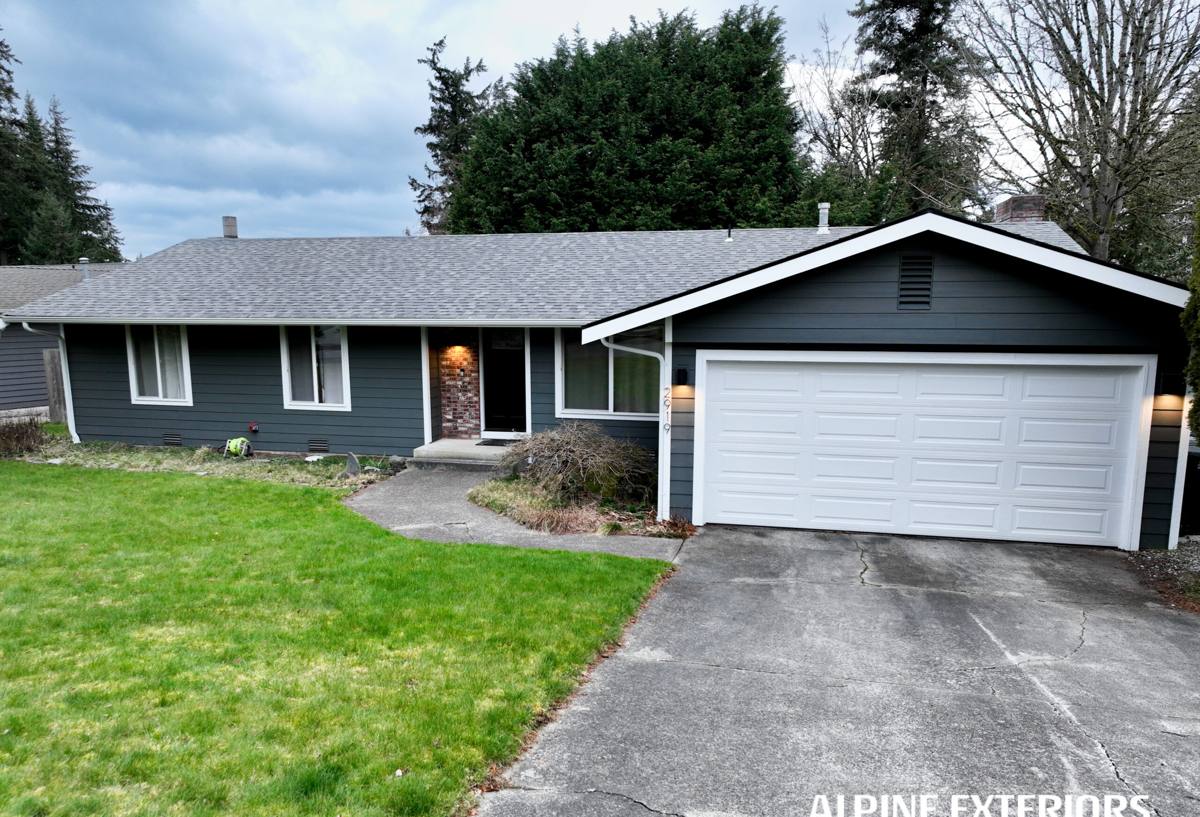
What Vinyl Siding Gets Right
Before getting into why we don't install it, it's worth giving vinyl credit where it's due:
- Low material cost. It's usually the cheapest siding option on a per-square-foot basis.
- No painting. The color is baked into the material, so there's no repainting cycle.
- Fast installation. Panels go up quickly compared to fiber cement, which can lower labor costs.
- Doesn't rot. Unlike wood, vinyl won't decay from moisture exposure the way untreated wood products do.
For a dry climate with mild temperature swings and no salt exposure, vinyl can hold up reasonably well for a long time. Bellingham just isn't that climate.
Salt Air and Coastal Exposure
Homes anywhere near Bellingham Bay, Chuckanut Bay, or the waterfront neighborhoods deal with salt-laden air on a regular basis, especially during winter storms when wind pushes moisture inland. Salt air doesn't just affect metal fasteners and flashing — it accelerates the breakdown of vinyl's plastic resin over time, particularly on south- and west-facing walls that catch the most weather. Vinyl panels in coastal exposure tend to fade, chalk, and become brittle faster than the same product would inland. Once vinyl gets brittle, it cracks easily from impact or even from being handled during a repair.
Why This Matters for Longevity
Manufacturers often quote vinyl siding lifespans in the 20-40 year range, but those numbers assume moderate climate conditions. Coastal exposure combined with UV and moisture cycling shortens that window. It's not a defect in the product — it's a mismatch between the material and the environment it's asked to perform in.
Driving Rain and Wind-Driven Moisture
Bellingham doesn't just get a lot of rain — it gets a lot of wind-driven rain, especially during fall and winter storm systems moving in off the Strait of Georgia. Vinyl siding is installed as an overlapping panel system that relies on gravity to shed water. It is not a sealed, watertight barrier by design; it's meant to let water run down and behind it to a drainage plane. That works fine in light rain. In sustained, wind-driven rain, water can get pushed sideways into seams, around window trim, and behind panels in a way the system wasn't built to handle as often as our weather demands.
Once water gets behind vinyl siding repeatedly over years, the risk shifts to the wall sheathing and framing underneath — problems you don't see until there's already damage. Fiber cement isn't immune to bad flashing or poor installation either, but the material itself doesn't feed mold growth or trap moisture against manufactured panel seams the same way.
Moss, Mildew, and the Long Wet Season
Anyone who's lived in Whatcom County for a winter knows moss doesn't stay on the roof — it works its way onto siding, fence lines, and anything north-facing that stays shaded and damp for months at a time. Vinyl's textured surface and panel seams give moss, algae, and mildew plenty of places to take hold, and because vinyl can't be painted or refinished, the only real fix once staining sets in is pressure washing — which, done too aggressively, can crack aging panels or force water behind them.
James Hardie's factory-applied ColorPlus finish is baked on and far more resistant to the kind of surface staining that shows up on shaded, damp walls, and if it ever needs attention, fiber cement can be cleaned or repainted without replacing panels.
How Vinyl Actually Performs Over Time
Heat, Cold, and Material Movement
Vinyl expands and contracts significantly with temperature, more than fiber cement does. Installers have to leave room for that movement at every nail and panel overlap. Get it slightly wrong — and it's an easy mistake to make — and you end up with buckling, waviness, or panels that pop loose during a cold snap. It's one of the most common vinyl siding complaints nationally, and it's purely a function of the material's physical properties, not bad luck.
Impact Damage and Repairs
Vinyl cracks under impact, especially once it's aged and gotten brittle from UV and salt exposure. A stray baseball, a ladder bump, or hail can crack a panel, and matching an old, sun-faded panel with a new one is nearly impossible since vinyl fades unevenly over time. Fiber cement resists impact damage far better and, being non-combustible, doesn't carry the same fire-related concerns that come up with plastic-based siding products.
Vinyl Siding vs. James Hardie Fiber Cement
| Factor | Vinyl Siding | James Hardie Fiber Cement |
|---|---|---|
| Material cost | Lowest upfront cost | Higher upfront cost |
| Salt air / coastal exposure | Fades, chalks, and becomes brittle faster | Engineered HZ lines built for wet, coastal climates |
| Moisture handling | Overlapping panels, gravity-drained | Rigid panels, less prone to wind-driven intrusion at seams |
| Moss and algae staining | Hard to clean without cracking; can't be repainted | Factory ColorPlus finish resists staining; can be repainted |
| Impact resistance | Cracks when brittle or cold | Resists impact damage well |
| Fire rating | Combustible plastic-based material | Non-combustible |
| Warranty | Varies, often prorated | Strong transferable manufacturer warranty |
| Resale perception | Seen as a budget upgrade | Seen as a premium, durable upgrade |
The Installation Sensitivity Problem
Vinyl siding has a reputation as an easy, forgiving install, and in mild climates it mostly is. In our climate, small installation mistakes compound. Nailing too tight restricts the expansion vinyl needs and causes buckling. Flashing details around windows and doors matter enormously when rain is coming in sideways off the water. Because vinyl is a lower-cost, high-volume product, it often gets installed fast by crews who aren't accounting for the specific demands of a wet, salt-exposed coastal climate. That's not a knock on every vinyl installer — it's just a reality of how the product is typically priced and sold. We'd rather install one product correctly, to spec, every time, than offer a product where the outcome depends heavily on how carefully a particular crew handled the details that day.
What This Means for Resale and Long-Term Value
Siding is one of the first things a buyer or appraiser notices. In this region, fiber cement is increasingly viewed as the standard for a well-maintained, weather-resistant home, especially in neighborhoods closer to the water where buyers are aware of what salt air does to building materials over time. Vinyl siding is often perceived as the budget option — not necessarily a dealbreaker, but not something that adds much to a home's perceived value either. If you're planning to stay in your home for decades, that matters less. If resale is part of the equation, it's worth factoring in.
What We Install Instead: James Hardie Fiber Cement
We standardized on James Hardie because it's engineered specifically for climates like ours. Hardie's HZ10 product line is formulated for wetter, harsher climate zones — which fits the Pacific Northwest better than a general-purpose HZ5 formulation would. It's non-combustible, it holds paint and factory finish far longer than wood or vinyl, and the ColorPlus finish carries its own dedicated warranty separate from the substrate warranty. It's heavier and more labor-intensive to install correctly, which is part of why it costs more than vinyl — but it's also why we're comfortable standing behind it on homes that have to deal with salt air, driving rain, and moss season year after year.
A Practical Checklist If You're Comparing Siding Options
- Ask how the product performs specifically in coastal, high-moisture climates — not just its national average lifespan.
- Ask whether the product can be repainted or refinished, or whether staining and fading are permanent.
- Ask about the manufacturer's warranty terms, including whether it's prorated and whether it transfers to a new owner.
- Ask how sensitive the installation is to crew experience — what happens if fastening or flashing details are slightly off.
- Ask about impact and fire resistance, especially if you're near trees, wildland areas, or have kids and pets around the exterior.
- Get a written scope of work, not just a per-square-foot price, so you know exactly what's included.
If you're weighing your options for an upcoming siding project, we're happy to walk through what we'd recommend for your specific home and why — no pressure, no obligation. Reach out for a free estimate and we'll give you a straight answer.