 Bellingham
 Ferndale sits close enough to the water and open farmland that its homes take a different kind of weather beating than siding a few miles inland. Salt-laden air off the Strait, wind-driven rain that finds every gap in a wall system, and a moss season that can stretch from October through May all add up over the years. If you're planning a siding replacement in Ferndale, the material and the installation details matter more here than in a drier, more sheltered part of Whatcom County.
We install James Hardie fiber cement siding exclusively, and Ferndale is one of the areas we work in regularly. This page walks through what the local climate actually does to siding, what a correctly installed job looks like, and how our process is built around the conditions your home is dealing with year-round.
What Ferndale's Climate Does to Exterior Siding
Ferndale homes face a combination of exposures that not every Whatcom County neighborhood shares in equal measure:
- Salt air: Proximity to the Strait of Georgia and Bellingham Bay means airborne salt can accelerate corrosion on fasteners, flashing, and any metal trim that isn't rated for coastal exposure.
- Driving rain: Wind off the water pushes rain sideways into wall assemblies, not just straight down. This puts real pressure on lap joints, butt seams, and anywhere siding meets a window, door, or trim board.
- Long moss season: Cool, damp, and shaded conditions for much of the year let moss and algae take hold on north-facing walls and anywhere airflow is restricted, which keeps siding surfaces wet longer than they should be.
- Temperature swings: Even modest seasonal shifts cause siding materials to expand and contract, which is hard on any product that isn't dimensionally stable.
None of this means siding fails quickly here. It means the margin for error in material choice and installation is smaller than in a drier climate, and shortcuts that might not show up for years elsewhere tend to surface faster in Ferndale.
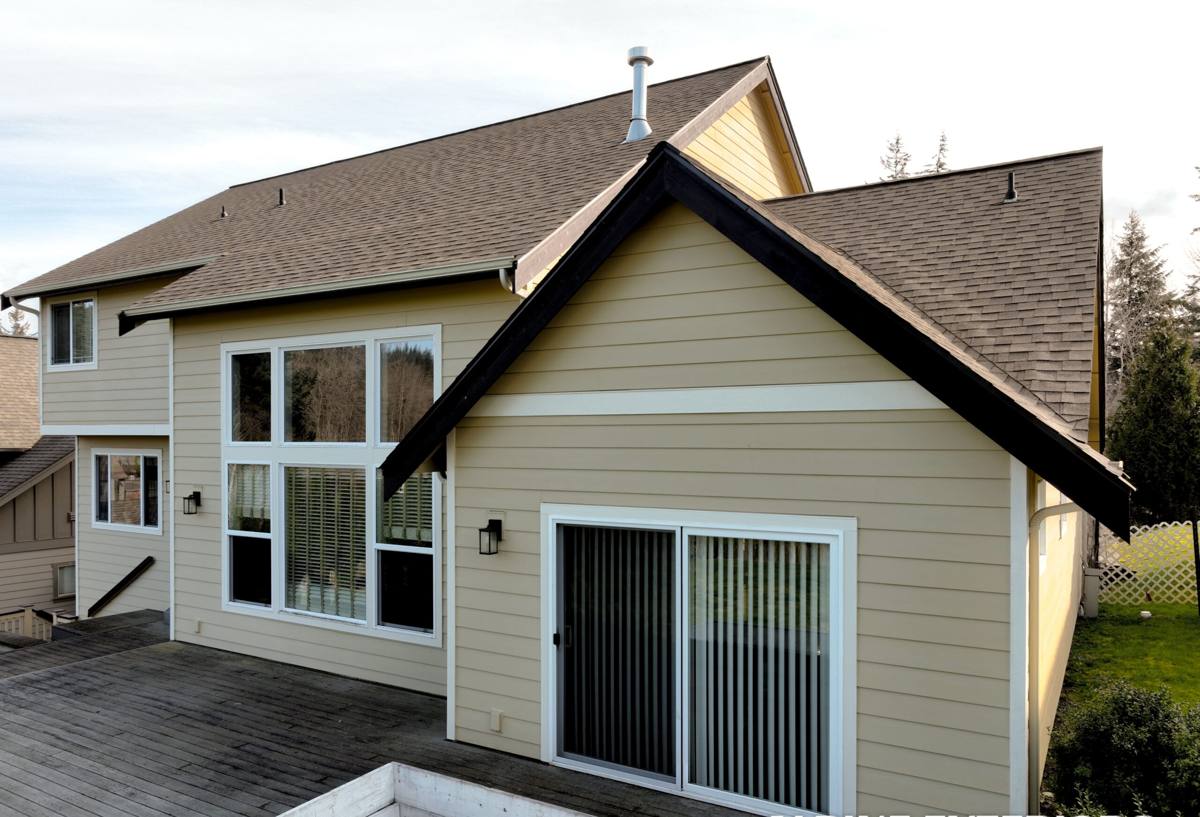
Why We Only Install James Hardie in This Area
We standardized on James Hardie fiber cement siding for every home we work on, and in a climate like Ferndale's the reasoning is straightforward:
Moisture Behavior
Fiber cement doesn't absorb and swell the way wood-based products can, and it doesn't trap moisture against the wall the way some engineered wood siding does. In an area with a long wet season, that matters. A siding product that stays dimensionally stable when it gets wet is going to hold paint, hold caulk lines, and hold its shape better over time.
Non-Combustible Material
James Hardie siding is fiber cement, not wood or wood-based, so it doesn't burn the way engineered wood siding can. That's a meaningful difference in wildfire-adjacent parts of Washington, and it's simply a sound material property anywhere.
Factory-Applied Finish
Hardie's ColorPlus finish is baked on in a controlled factory environment, not brushed or sprayed on-site. That finish holds color and resists fading, chipping, and cracking better than field-applied paint, which is a real advantage on the sun and salt exposure Ferndale's coastal-facing homes see.
Climate-Engineered Product Lines
Hardie makes region-specific HZ formulations engineered for different climate zones. The Pacific Northwest formulation is built around exactly the conditions Whatcom County deals with — sustained moisture, moderate temperatures, and long wet stretches — rather than being a one-size-fits-all product.
We don't install vinyl, LP SmartSide, primed spruce, cedar, or other fiber cement brands. Each of those products has legitimate uses and loyal customers elsewhere, but given what we've seen hold up in this specific climate over time, Hardie is what we're willing to put our name behind.
What Correct Siding Installation Actually Involves
The siding product is only part of the equation. Most siding problems we get called to look at trace back to installation shortcuts, not the material itself. A correct job on a Ferndale home includes:
Water-Resistive Barrier and Flashing
A properly lapped weather-resistive barrier behind the siding, with flashing integrated at every window, door, and horizontal transition, is what actually keeps wind-driven rain out of the wall cavity. Siding is the visible layer, but the drainage plane behind it is what does the real work.
Rainscreen Gap
Furring strips or a drainage mat behind the siding create a small air gap that lets any moisture that does get behind the boards drain and dry out instead of sitting against the sheathing. In a climate with Ferndale's rainfall and humidity, this detail is worth the extra step.
Fastener Spec
Corrosion-resistant fasteners, installed at the manufacturer's specified pattern and depth, matter more near the coast than inland. Overdriven or underdriven nails are one of the most common causes of premature siding failure, and it's an easy thing for a rushed crew to get wrong.
Proper Clearances
Hardie specifies minimum clearances from grade, roof lines, decks, and other transitions. Siding installed too close to the ground or to a roof surface stays wet longer and is more prone to moss and algae growth — a real issue during Ferndale's long damp season.
Caulking and Joint Treatment
Butt joints, corners, and trim transitions need to be sealed correctly, with the right sealant and the right technique, not just caulked over as an afterthought.
Comparing Siding Options for Ferndale Homes
| Factor | James Hardie Fiber Cement | Vinyl | Engineered Wood (LP SmartSide, etc.) |
|---|---|---|---|
| Moisture resistance | Does not absorb or swell | Doesn't absorb, but panels can warp with heat/cold cycling | Can swell or delaminate if moisture gets behind or into edges |
| Combustibility | Non-combustible | Combustible, can melt or deform in heat | Combustible, wood-based core |
| Finish durability | Factory-baked ColorPlus finish | Color molded through, can fade and chalk | Field-applied paint, needs recoating over time |
| Coastal/salt air performance | Engineered for PNW conditions with corrosion-resistant fastening | Generally holds up, but color and material can degrade | Edge sealing is critical; failures often start at cut ends |
| Typical lifespan when installed to spec | Multiple decades | Multiple decades, but appearance degrades sooner | Shorter than fiber cement, moisture-dependent |
Signs Ferndale Homeowners Should Watch For
If you're not sure whether your current siding is due for replacement, a few things are worth checking before winter sets in:
- Soft or spongy spots when you press on the siding, especially near the bottom courses
- Persistent moss or algae staining that comes back quickly after cleaning
- Visible gaps, cracking, or warping at seams and corners
- Paint that's peeling or bubbling rather than just fading
- Rising energy bills that might point to a compromised wall assembly behind the siding
- Visible rust streaking from fasteners or trim
Our Installation Process
When we take on a siding installation in Ferndale, the process generally runs like this:
- On-site assessment: We look at the existing siding, sheathing condition, and any problem areas — particularly around windows, decks, and grade transitions — before quoting anything.
- Tear-off and sheathing check: Old siding comes off and we inspect the sheathing underneath for rot or moisture damage before anything new goes on.
- Weather barrier and flashing: A new water-resistive barrier is installed with proper flashing at every penetration and transition.
- Rainscreen installation: Furring strips or a drainage mat go in to create the drainage gap behind the siding.
- Hardie siding installation: Panels or planks are installed to manufacturer spec, with correct fastener type, spacing, and clearances.
- Trim, caulking, and final detailing: Joints, corners, and trim transitions are sealed and finished.
- Final walkthrough: We go over the finished work with you before calling the job done.
Why Hiring a Crew That Works Ferndale Regularly Matters
A siding installer who mostly works drier, more sheltered areas may not think twice about rainscreen gaps or flashing detail at every transition — and in some climates, that's less consequential. In Ferndale, those details are the difference between siding that looks good for decades and siding that starts showing moisture problems in five or six years. A crew that regularly works this stretch of Whatcom County already knows which wall orientations need extra attention, how much moss pressure to expect on north- and west-facing elevations, and where wind-driven rain tends to concentrate on a typical Ferndale lot.
There's also a permitting and inspection side to this — local building department expectations and typical construction details in this part of the county are things a local crew already has dialed in, rather than learning on your job.
What to Ask Before Hiring Anyone for Siding Work
- Are you licensed and insured to do exterior work in Washington State?
- Will you provide a written scope that specifies fastener type, rainscreen approach, and flashing details — not just "install siding"?
- Do you install to the manufacturer's published installation instructions, and can you show me those specs?
- What's your warranty structure, and is it transferable if I sell the home?
- Can you walk me through how you'll handle the areas around windows, doors, and grade transitions specifically?
If your Ferndale home is due for a siding replacement, or you're just not sure whether what you have is holding up the way it should, we're happy to take a look. Request a free, no-pressure estimate using the form below and we'll walk the exterior with you and talk through what we'd actually recommend for your home.