 Bellingham
 Building a Deck That Actually Holds Up in Lynden
Lynden sits in a part of Whatcom County where the weather doesn't do a homeowner any favors. Winters bring long stretches of driving rain, spring and fall carry heavy dew and fog that never quite burns off some days, and the moss season here can run eight months or more depending on how much shade a yard gets. A deck built with generic, one-size-fits-all methods from a drier climate will show problems within a few years — soft spots, black staining, fasteners that bleed rust, railings that wobble because the posts were never properly isolated from ground moisture. A deck built for this region, on the other hand, is designed from the framing up to shed water fast and resist the slow rot that comes from constant dampness rather than sudden storms.
We build and replace decks for homeowners throughout the Lynden area, and the difference between a deck that lasts 10 years and one that lasts 25+ almost always comes down to decisions made before the first board goes down: how the ledger is flashed, how the joists are protected, what fasteners are used, and how the substructure is ventilated. This page walks through what that actually looks like.
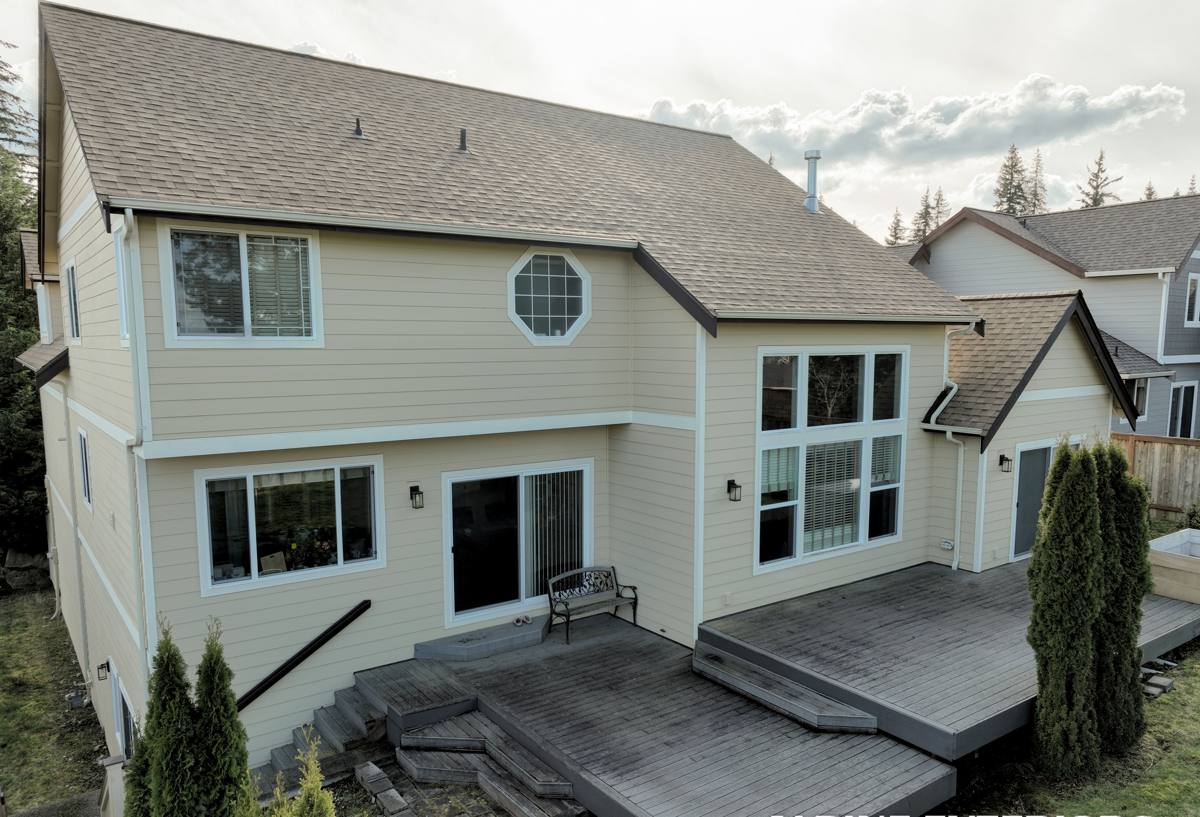
What Whatcom County Weather Does to an Ordinary Deck
It's worth being specific about the failure patterns we see, because they shape every recommendation below.
- Moss and algae growth on horizontal surfaces that stay shaded or don't get full sun exposure through the day, which holds moisture against the wood and accelerates decay underneath.
- Ledger board rot where a deck attaches to the house, caused by flashing that was skipped or installed incorrectly — this is one of the most common structural failures we find on older decks in this area.
- Fastener corrosion from standard hardware that wasn't rated for the moisture exposure and treated-lumber chemicals used here, leading to staining and eventually loose connections.
- Soft or spongy decking from long-term water absorption in lower-grade lumber that never fully dries out between rain events, especially on the north or shaded side of a house.
- Frost heave affecting post footings that weren't set below the local frost line, which shows up as a deck that shifts or develops uneven spots over a few winters.
None of these are dramatic, sudden problems. They're slow, cumulative issues that come from a deck being built to a generic standard instead of one that accounts for what this climate does to wood, metal, and concrete over time.
Decking Material Choices for This Climate
There's no single "best" decking material — there's a best material for a given budget, sun exposure, and how much upkeep a homeowner actually wants to do. Here's how the common options compare for a Lynden yard.
| Material | Moisture Resistance | Maintenance | Typical Lifespan Here |
|---|---|---|---|
| Pressure-treated pine/fir | Good if properly finished and re-sealed | Annual cleaning, re-staining every 2-3 years | 15-20 years with upkeep |
| Cedar | Naturally decay-resistant, but surface still needs care | Cleaning and oil/sealant every 1-2 years to hold color and resist moss | 15-25 years |
| Composite (capped) | Excellent — doesn't absorb water like wood | Periodic washing to prevent algae film on the surface | 25-30+ years |
| Uncapped composite (older style) | Fair — can absorb moisture at the core over time | Moderate; more prone to mold in shaded spots | 15-20 years |
We're honest with homeowners about the trade-offs. Composite decking costs more up front but largely takes moss and rot out of the equation, which matters a lot on shaded lots or homes near tree cover — common in and around Lynden. Cedar and treated lumber cost less initially and give a natural look many homeowners want, but only perform well if the finish is maintained on a schedule. We won't tell a customer a low-maintenance product will be maintenance-free, and we won't talk someone into composite if a wood deck genuinely fits their budget and they're willing to do the upkeep.
Framing and Substructure Materials
Whatever decking goes on top, the framing underneath matters more for long-term durability. We frame with pressure-treated lumber rated for ground contact where posts meet soil, use structural screws or hot-dip galvanized/stainless fasteners rated for treated lumber's chemical makeup, and install joist tape or a comparable moisture barrier along the top of every joist. That last detail is small, inexpensive, and it's one of the biggest reasons treated joists rot from the top down in this climate — rain sits in the fastener holes and never fully evaporates without a barrier.
Ledger Attachment and Flashing — The Detail Homeowners Never See
If a deck attaches to the house, the ledger board connection is the single most important structural and moisture detail on the entire project. Done wrong, water gets behind the ledger and works its way into the house's rim joist and sheathing — a repair that's far more expensive than the deck itself. Done right, it's engineered to shed water away from the structure entirely.
Our ledger installations include proper flashing integrated with the house's existing water-resistive barrier (not just caulked over it), a gap or capillary break between the ledger and siding where required, and lag bolts or through-bolts sized and spaced to current structural standards — not just nailed on. This is also where we check for and correct problems left by a previous deck, which is common on older Lynden homes where a deck was added or replaced without pulling the siding back to flash it correctly the first time.
Footings, Posts, and Drainage
Below the visible deck, the footings and post bases do the quiet work of keeping the structure stable through wet winters and freeze-thaw cycles. We set footings below the local frost depth and size them to the load the deck will actually carry — not a guess, but a calculation based on the deck's dimensions, decking material weight, and expected use (a hot tub or heavy furniture changes the math). Post bases are elevated off the concrete with a standoff bracket so the post end never sits in standing water, which is one of the most common rot points on decks that were built with the post set directly into or on top of wet concrete.
Grading and drainage around the deck footprint matter too. If water pools under a low deck instead of draining away, it keeps the underside of the joists damp far longer than normal rainfall alone would, which speeds up decay even on treated lumber.
Railings, Stairs, and Hardware
Railings and stairs take the most direct wear from foot traffic and weather combined, and they're also where a lot of older decks show their age first — wobbly balusters, rusted brackets, stair stringers that have started to check and split. We build railing systems to current code height and baluster-spacing requirements, using connection hardware rated for exterior exposure, and we pay particular attention to stair stringer material and support since stairs see more direct rain exposure than a covered or partially covered deck surface.
Our Deck Building Process
Every project runs through the same sequence, whether it's a full replacement or new construction:
- On-site assessment. We look at sun exposure, drainage, existing structure (for replacements), and how the space will actually be used before recommending materials or layout.
- Design and material selection. We walk through decking, railing, and framing options with honest cost and maintenance trade-offs for this climate — no upselling to a product that doesn't fit the home or budget.
- Permitting. Deck projects in Whatcom County typically require a permit depending on size and height; we handle that process rather than leaving it to the homeowner.
- Demolition (for replacements). We remove old decking and inspect the ledger, framing, and any hidden rot before proceeding, rather than building over problems.
- Framing and flashing. Ledger attachment, footings, posts, and joists go in first, with moisture barriers and proper fastener selection throughout.
- Decking, railing, and stairs. Final surfaces go on once the substructure is confirmed square, level, and properly fastened.
- Final walkthrough. We go over care and maintenance specific to the material installed, so the deck actually reaches its expected lifespan.
Signs an Existing Lynden Deck Needs Attention
Not every deck problem means a full replacement. Use this checklist as a starting point before deciding between repair and rebuild:
- Soft, spongy, or discolored decking boards, especially in shaded areas
- Visible gaps, staining, or rust streaks around the ledger board where the deck meets the house
- Wobble or movement when you push against the railing
- Persistent moss or algae film that returns quickly after cleaning
- Fasteners that are visibly corroded, backing out, or leaving rust streaks
- Stair stringers with visible cracking, splitting, or soft spots
- A deck surface that pools water instead of shedding it after rain
If it's mostly surface-level wear on solid framing, refinishing or a partial rebuild may be enough. If the ledger, joists, or posts show rot, a full rebuild is usually the more honest recommendation — patching a compromised structure just delays a bigger repair.
Why Local Experience on This Specific Job Matters
Deck building looks similar everywhere on paper, but the details that make a deck last in Whatcom County — frost line depth for footings, the level of ledger flashing needed against sustained rain, which fasteners hold up against this region's moisture rather than corroding within a few seasons — come from having actually built and repaired decks here, not from a generic national spec sheet. A crew that already works in and around Lynden has seen which details fail first in this specific climate and builds to avoid them from the start, rather than learning it on a homeowner's project.
If you're planning a new deck or need an honest look at whether an existing one is worth repairing, we're happy to come out, walk the site, and give you a straight answer along with a free, no-pressure estimate using the form below.