 Bellingham
 Why Barkley Homes Age Differently
Barkley sits close enough to the water and surrounded by enough mature tree cover that its homes take on a specific combination of punishment: salt-tinged air drifting in off Bellingham Bay, driving rain that comes in sideways during fall and winter storms, and a moss season that can run eight months or longer under shaded rooflines and north-facing walls. None of these factors is dramatic on its own. Together, over ten or fifteen years, they add up to siding that looks tired well before it should.
Salt air is corrosive to fasteners and finishes even a few miles inland, driving rain finds every gap in flashing and caulk that a calmer climate would never expose, and moss holds moisture against a wall surface for weeks at a time instead of letting it dry. Siding replacement in this neighborhood isn't just about swapping old material for new — it's about choosing a product and installation approach built for exactly this combination of stresses.
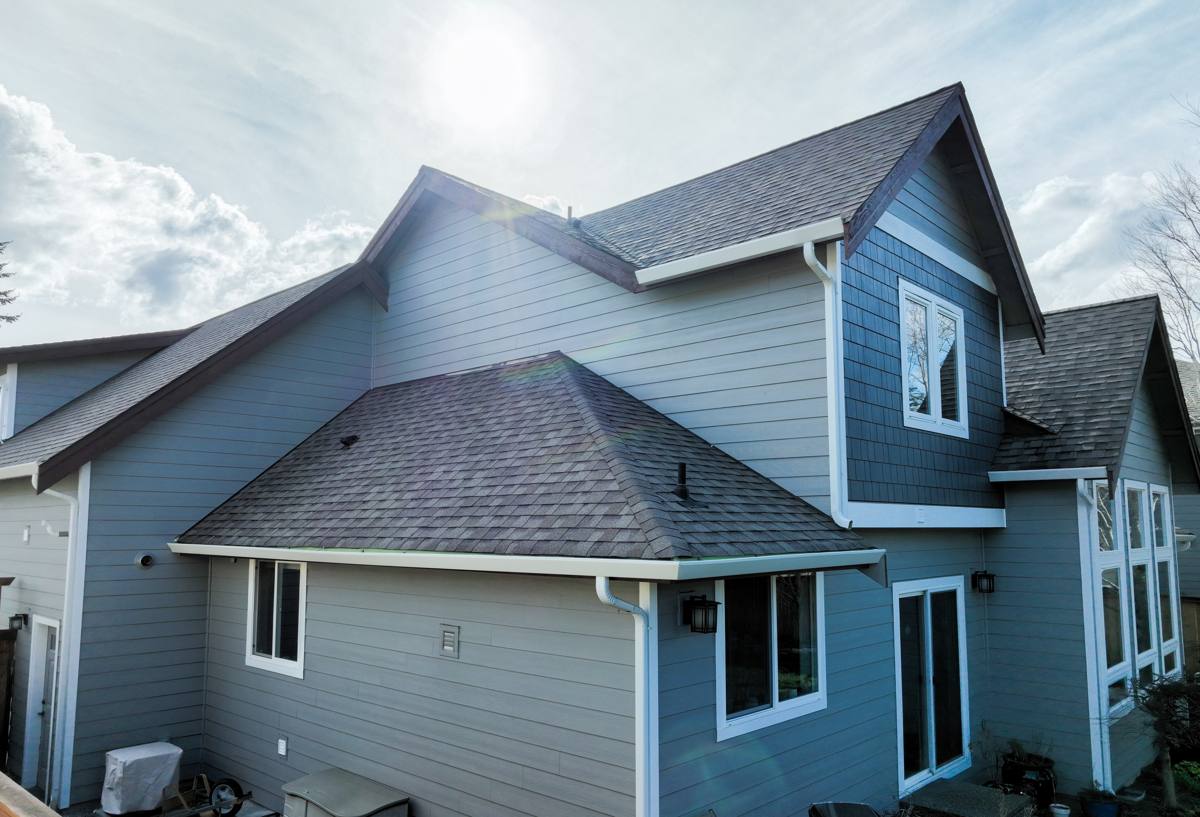
Signs Your Barkley Home Needs Siding Replacement
Some of these signs are obvious from the street. Others only show up once you know where to look, especially on the shaded or wind-facing sides of the house.
- Soft or spongy spots when you press on the siding, especially near the bottom courses
- Green or black staining that keeps returning within a season of being cleaned
- Paint that's peeling, bubbling, or chalking faster on one side of the house than the others
- Visible gaps, warping, or cupping in individual boards or panels
- Rising utility bills or drafts that suggest the weather barrier behind the siding has failed
- Caulk lines that have cracked or pulled away around windows, corners, and trim
- Siding that's original to a home built more than 20-25 years ago, particularly wood-based products
Any one of these on its own might be a repair. Several at once, especially combined with an older wood-based or composite product, usually means the underlying material has reached the end of what it can reasonably protect the house from.
What a Correct Siding Replacement Actually Involves
Tear-Off and Inspection
Replacing siding isn't just a facelift — it's the one point in a home's life when the sheathing, framing, and weather barrier underneath are fully exposed. A correct job starts with full removal of the old siding and a real inspection of what's behind it: soft sheathing, old insulation gaps, and areas where water has been getting in unnoticed all need to be addressed before anything new goes up. Covering over hidden rot with new siding just delays a much more expensive repair.
Weather-Resistive Barrier
In a climate that gets as much driving rain as Whatcom County, the water-resistive barrier behind the siding matters as much as the siding itself. This layer is what actually keeps bulk water out of the wall assembly if any gets past the cladding — which, in a house that will stand for decades, it eventually will. Seams, laps, and penetrations all need to be sealed and shingled correctly, not just stapled up and covered.
Flashing at Every Transition
Windows, doors, roof-to-wall intersections, and deck ledgers are where siding jobs fail. Proper step flashing, kick-out flashing, and window flashing direct water away from the structure instead of letting it pool behind the cladding. This is the detail work that separates a siding job that lasts 30-plus years from one that starts showing moisture problems in five.
Installation to Manufacturer Spec
Fiber cement siding has specific requirements for fastener type and placement, clearance from grade and roofing, gapping at butt joints, and caulking. Skipping these details doesn't just risk cosmetic issues — it can void the manufacturer's warranty entirely, which defeats the purpose of choosing a premium product in the first place.
Why We Install Only James Hardie Fiber Cement
We standardized on James Hardie fiber cement siding and don't install vinyl, LP SmartSide, Cemplank, Allura, or unfinished wood siding like primed spruce or cedar. That's not a marketing position — it's a decision made after weighing how each of these products actually performs over time in a wet, moss-prone Pacific Northwest climate like Bellingham's.
Fiber cement is non-combustible, which matters more each year as wildfire smoke and dry-season fire risk become a bigger part of Washington's summers. James Hardie's ColorPlus factory finish is baked on under controlled conditions rather than field-applied, which gives it more consistent coverage and a longer service life than site-applied paint. And Hardie engineers specific product lines — including HZ5 formulations — for regions with the freeze-thaw cycles, moisture exposure, and humidity that Whatcom County sees. The warranty on a correctly installed system is also transferable, which matters to Barkley homeowners who may sell before they've owned the house for 20 years.
Comparing Siding Options in a Wet, Mossy Climate
Every siding product has genuine strengths. The table below reflects how each one tends to perform specifically under the salt air, driving rain, and heavy moss exposure common in this part of Bellingham — not a universal ranking.
| Product | Moisture Behavior | Moss/Mildew Resistance | Maintenance Burden | Fire Rating |
|---|---|---|---|---|
| James Hardie Fiber Cement | Dimensionally stable, doesn't swell or rot | Factory finish resists staining longer | Low — occasional wash | Non-combustible |
| Vinyl | Can warp or crack in temperature swings | Prone to mildew in seams and laps | Low, but limited repair options | Combustible, can melt/deform |
| LP SmartSide (Engineered Wood) | Vulnerable at cut edges and joints if not sealed | Needs consistent maintenance to prevent moisture uptake | Moderate — repainting, edge sealing | Combustible |
| Cedar / Primed Spruce | Absorbs and releases moisture readily | High susceptibility without regular treatment | High — regular staining/sealing | Combustible |
None of this means the alternatives are poorly made products. It means that for a neighborhood dealing with salt air, sustained damp, and long moss seasons, we've found fiber cement gives homeowners the best long-term outcome with the least ongoing maintenance.
What Drives the Cost of a Siding Replacement
Every Barkley home is different, and we don't quote a job without seeing it, but the same handful of factors drive most of the variation in price from house to house.
| Factor | Why It Matters |
|---|---|
| Home size and wall complexity | More corners, dormers, and roof lines mean more cutting, flashing, and labor time |
| Condition of sheathing underneath | Rot or moisture damage found during tear-off adds repair scope before new siding goes up |
| Siding profile chosen | Lap, shingle, and panel styles all differ in material and installation labor |
| Trim and detail work | Window and door surrounds, corner boards, and fascia detailing add time |
| Access and site conditions | Tree cover, tight lot lines, and slope affect staging and scaffolding needs |
We'll walk through all of this on-site so you understand exactly what you're paying for, not just a bottom-line number.
Our Process From Estimate to Finished Job
We keep the process straightforward and communicate at each stage, since siding replacement is disruptive enough without added uncertainty.
- On-site estimate and inspection, including a look at the existing siding, trim, and any visible moisture damage
- A written scope and quote specific to your home — no generic packages
- Scheduling that accounts for Bellingham's wetter months, since siding work needs reasonably dry conditions
- Full tear-off, sheathing inspection, and repair of any hidden damage found
- Weather barrier and flashing installed correctly at every window, door, and transition
- James Hardie siding installed to manufacturer spec, with attention to fastening, gapping, and caulking
- Final walkthrough so you know exactly what was done and what warranty coverage applies
Why Hiring a Crew That Already Works Barkley Matters
A crew that's already worked in Barkley understands things a contractor coming from outside Whatcom County has to learn on your dime: how tree canopy over a lot affects drying time and moss pressure, how wind-driven rain off the bay behaves differently on exposed versus sheltered walls, and what kind of moisture problems tend to show up behind older siding in homes of this area's typical age and construction. That local pattern recognition shows up in fewer surprises during tear-off and a more accurate estimate from the start.
It also means shorter travel time for warranty visits, follow-up questions, or anything that comes up after the job is done — something worth factoring in alongside price when you're comparing bids.
If your Barkley home's siding is showing its age, or you just want an honest read on where it stands, we're happy to take a look. Fill out the form below for a free, no-pressure estimate.