 Bellingham
 Why Birch Bay Roofs Wear on Their Own Schedule
Birch Bay sits right on the water, open to the wind and spray coming off the bay. That changes how a roof ages compared to a home a few miles inland in Bellingham. Salt-laden air corrodes exposed metal faster — fasteners, flashing, vent caps, and drip edge all take the brunt of it. Add in wind-driven rain that gets pushed sideways into eaves and valleys, plus the deep shade and constant moisture that keeps moss growing most of the year, and you've got three separate aging processes working on the same roof at once.
None of that means a Birch Bay roof needs replacing sooner than one anywhere else in Whatcom County. It means the failure points are different, and a roof that looks fine from the ground can already have compromised flashing, saturated underlayment, or moss roots working into the shingle mat. Knowing what to actually look for — and where — is the difference between a replacement that lasts and one that starts leaking again in a few winters.
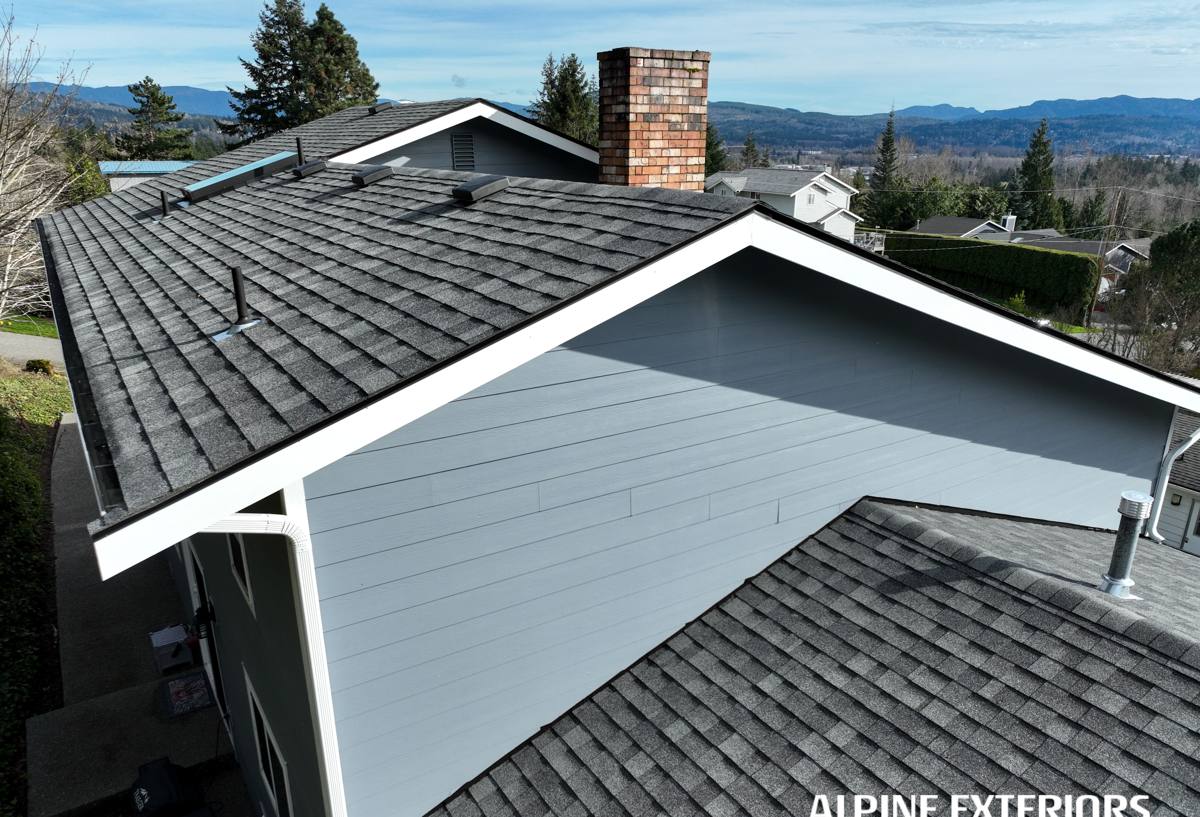
Signs a Birch Bay Roof Needs Replacing, Not Patching
Patching has its place, but on a coastal roof it can also mask a bigger problem. Before recommending a full replacement, we look for a pattern of issues rather than one isolated spot — a single fixable leak is not the same thing as a roof that's reached the end of its service life.
- Granule loss heavy enough that you can see bare, shiny patches on multiple shingles, not just one weathered slope
- Moss that has re-grown thick within a year of cleaning, especially on north-facing or shaded sections
- Curling, cupping, or cracked shingles concentrated on the side of the house facing the water
- Rusted or pitted flashing around chimneys, skylights, and roof-to-wall transitions
- Soft spots in the decking you can feel when walking the roof, or sagging visible from the ground
- Daylight visible through the attic roof boards, or insulation that's damp or matted
- Interior stains on ceilings or in the attic that reappear after every heavy rain, regardless of patch work already done
One or two of these on their own might mean a repair. Several together, especially on a roof already past 18-20 years for asphalt or showing widespread flashing corrosion, usually mean it's time to talk about full replacement instead of chasing leaks one at a time.
What a Correct Roof Replacement Actually Involves
Full tear-off, not a layover
We remove the existing roofing down to the deck rather than installing new shingles over old ones. A layover traps moisture that's already worked into the old material, hides deck damage, and voids most manufacturer warranties outright. On a coastal home where moisture is already the enemy, that's not a shortcut worth taking.
Deck inspection and repair
Once the old roofing is off, we check the sheathing for soft spots, delamination, or rot — common wherever a roof has been leaking slowly for a while without visible interior signs. Any damaged decking gets replaced before anything new goes down. Skipping this step is the single most common cause of a "new" roof failing early.
Underlayment built for wind-driven rain
Standard felt underlayment is fine in a lot of climates, but on a bay-facing roof we typically upgrade to synthetic underlayment and add ice-and-water shield along eaves, valleys, and roof penetrations — the spots where wind can push rain up and under the shingle line instead of letting it run off normally.
Flashing that matches the exposure
Every chimney, vent pipe, skylight, and wall intersection gets new flashing, not reused flashing. In a salt-air environment we pay close attention to metal choice here, since the wrong flashing material can corrode well before the shingles around it wear out.
Ventilation that actually balances
Intake at the eaves and exhaust at the ridge need to work together. Poor ventilation traps moisture in the attic, which speeds up deck rot from the inside and contributes to moss and mildew from the outside. We check and correct the balance as part of every replacement, not as an upsell afterward.
Choosing a Roofing Material for a Salt-Air, Moss-Prone Site
There's no single "best" roofing material for Birch Bay — there's a best material for your specific roof, budget, and how much upkeep you want to do. Here's how the common options actually compare under coastal, high-moisture conditions.
| Material | Salt-air durability | Moss resistance | Typical lifespan | Trade-offs |
|---|---|---|---|---|
| Architectural asphalt shingles | Good with corrosion-resistant fasteners and flashing | Moderate; benefits from copper or zinc strips | 20-30 years | Lowest upfront cost; needs periodic moss treatment |
| Standing-seam metal | Very good with marine-grade coatings; fasteners are the weak point if not spec'd correctly | Excellent — moss struggles to grip smooth metal | 40-50+ years | Higher upfront cost; installation sensitivity is high, so workmanship matters more than with shingles |
| Cedar shake | Natural material handles salt air reasonably well | Poor — moss and moisture are its biggest long-term threats | 20-30 years with diligent upkeep | Highest maintenance burden in this climate; we're honest with clients that it demands the most ongoing attention |
| Composite/synthetic shingle | Good; engineered to resist moisture absorption | Good, similar to asphalt with proper strips | 30-50 years depending on product | Mid-to-upper cost; fewer long-track-record data points than asphalt or metal |
We'll walk through these trade-offs with you in person rather than steering everyone toward one product. A lot of it comes down to how the roof is shaded, how steep it is, and how much moss maintenance you realistically want to do every year or two.
Our Process, Start to Finish
- On-site inspection: We get on the roof, not just in the yard with binoculars, and check decking, flashing, ventilation, and moss patterns before quoting anything.
- Written estimate: A clear scope of work and material options, with pricing broken out so you know what you're paying for and why.
- Scheduling around the weather: Coastal weather windows can be tight. We plan tear-off and dry-in timing to minimize the number of days your deck is exposed.
- Tear-off and deck repair: Full removal, deck inspection, and any necessary sheathing replacement, documented before we cover it back up.
- Underlayment, flashing, and ventilation: Installed to the specifications above, not the bare minimum code allows.
- Final roofing installation: Shingles, metal panels, or your chosen material installed to manufacturer spec, which protects your warranty.
- Cleanup and walkthrough: Magnetic sweep for stray fasteners, full site cleanup, and a walkthrough so you know what maintenance to expect going forward.
Why a Crew That Already Works Birch Bay Matters
Roofing a home in Birch Bay isn't identical to roofing one in downtown Bellingham, and it's worth working with a crew that's dealt with the difference firsthand. That means knowing which fastener and flashing grades actually hold up against salt air instead of learning it the hard way on your roof, understanding how wind exposure near the water affects shingle sealing and starter strip placement, and having a realistic sense of how fast moss comes back on a shaded, damp lot versus a sunny inland one.
It also means being straightforward about what your specific roof needs instead of applying a one-size-fits-all spec to every job in Whatcom County. A roof tucked back in the trees a few blocks off the water has different priorities than one facing the bay directly. We treat those as different jobs because they are.
Maintaining Your Roof After Replacement
A correct installation gets you most of the way to a long-lasting roof. The rest comes down to simple, consistent maintenance — especially around moss, which is the one threat that never really goes away in this part of Washington.
- Keep gutters clear so water isn't backing up under the shingle edge, especially after fall leaf drop
- Have moss treated or gently removed before it gets thick enough to hold moisture against the roofing material
- Trim back overhanging branches to cut down on shade and debris on north-facing slopes
- Walk the attic once or twice a year, or after major storms, and look for daylight, damp insulation, or new stains
- Have flashing and sealant checked every few years, since it typically wears out well before the field material does
- Avoid pressure washing shingles directly — it strips granules and shortens the roof's life instead of extending it
What Actually Drives the Cost of a Replacement
We don't publish flat prices because roof cost depends on real variables specific to your house, not a generic per-square rate. What we can tell you is what actually moves the number up or down.
| Factor | How it affects cost |
|---|---|
| Roof size and number of planes | More squares and more complex geometry mean more material and labor time |
| Pitch and access | Steep or hard-to-access roofs near the water often require additional safety setup and slow the work down |
| Deck condition underneath | Rot or delamination found during tear-off adds material and labor that can't be quoted until we're inside |
| Material choice | Asphalt, metal, cedar, and composite carry different material and installation costs, as shown above |
| Flashing and penetrations | Chimneys, skylights, and multiple vent pipes each add flashing work |
| Ventilation upgrades | Correcting an unbalanced system adds modest cost but protects the rest of the investment |
The only way to get an honest number is a real inspection. Anyone quoting a full roof replacement over the phone without getting on the roof is guessing, and on a coastal home that guess is more likely to be wrong.
Let's Take a Look at Your Roof
If you're in Birch Bay and dealing with recurring leaks, heavy moss, or a roof that's simply aging out, we're happy to come take an honest look — no pressure, no hard sell. Use the form below to request a free estimate, and we'll walk the roof, explain what we find in plain terms, and give you options that fit your home and your budget.