 Bellingham
 Birchwood's Climate Puts Real Stress on a Deck
Birchwood sits inland from Bellingham Bay, but it doesn't escape the marine air that rolls off the water and settles into Whatcom County's tree-covered neighborhoods. Salt-tinged moisture in the air, long stretches of driving rain from fall through spring, and shaded, established lots with mature trees all add up to a deck environment that's harder on materials than most homeowners expect. A deck here isn't just getting rained on — it's staying damp for days at a time, sheltered from direct sun by tree canopy, and picking up airborne salt that speeds up corrosion on fasteners and hardware.
That combination is exactly why so many Birchwood decks show problems years before a homeowner expects them to: soft boards, black staining in shaded corners, and hardware that's rusted even though the wood itself still looks okay. Composite decking was designed to handle a lot of this, but only when it's installed correctly for the site it's going on — not just dropped onto an old wood frame and called done.
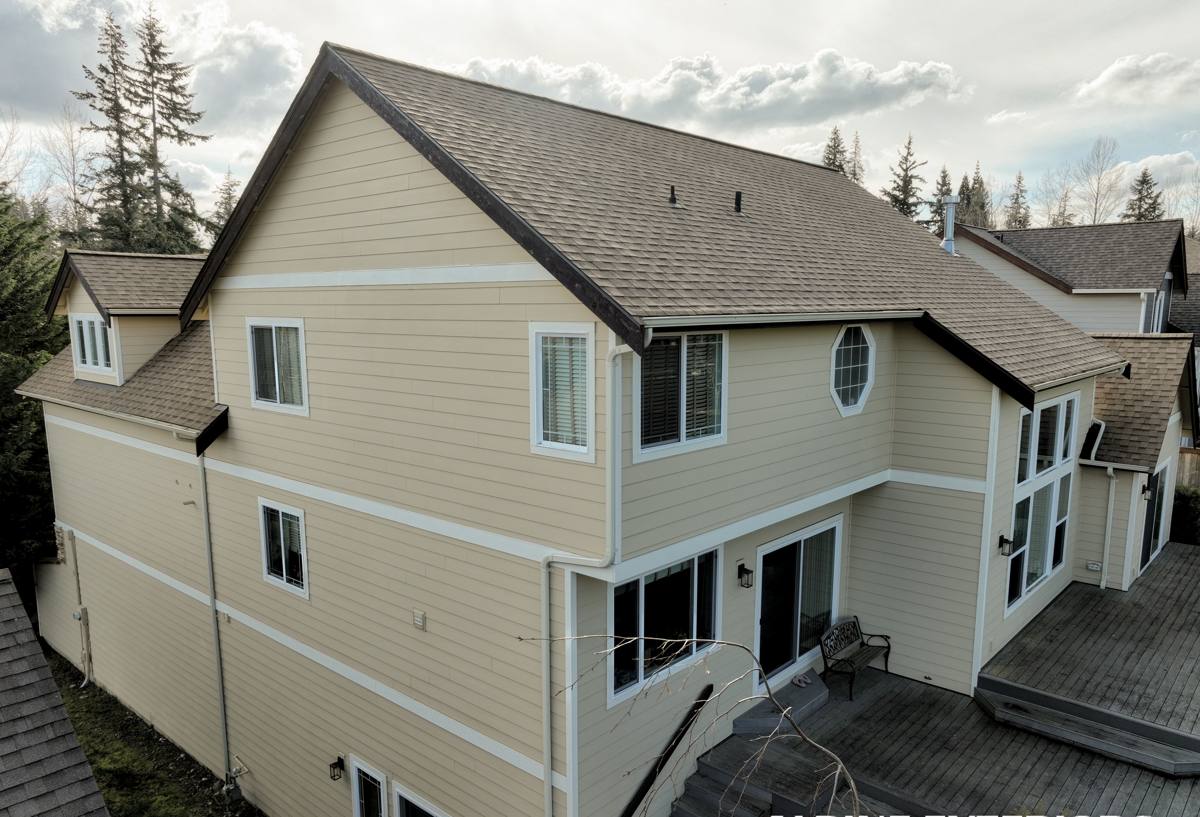
Signs an Existing Deck Is Telling You Something
Before talking about new composite decking, it's worth knowing what to look for on the deck you already have. In Bellingham's climate, these issues tend to show up earlier than homeowners think, especially on shaded or north-facing decks.
- Boards that feel spongy or flex underfoot, especially near the house or in shaded corners
- Green or black staining that comes back within weeks of cleaning it off
- Popped or rust-streaked fasteners, particularly around stair stringers and railing posts
- Visible gaps or cupping in boards where water has been sitting and drying repeatedly
- A railing that feels loose or wiggly when you lean on it
- Persistent moss in board gaps that never fully dries out, even in summer
Any one of these on its own might just mean a repair. Several together usually mean the structure underneath has been absorbing moisture for a while, and it's worth having someone look at the frame, not just the surface boards.
Why Composite Makes Sense for This Neighborhood
Composite decking is manufactured from a blend of wood fibers and plastic, and on most boards today that core is wrapped in a protective cap. That cap is the part that matters most in a climate like this one — it's what keeps moisture from soaking into the board the way it does with untreated or even pressure-treated wood. A composite board isn't going to splinter, and it won't rot the way wood fiber does when it stays wet for extended periods, which is a real advantage under Birchwood's tree cover and long wet season.
It's not a maintenance-free material, and we won't tell you it is. Composite still needs periodic cleaning, especially in shaded spots where algae and moss spores land and take hold. What it doesn't need is annual staining, sealing, or sanding down splintered boards — which is where it earns its keep over a 15- to 20-year span in a climate this wet.
Composite vs. Wood in Bellingham's Climate
| Factor | Composite Decking | Wood (Cedar / Pressure-Treated) |
|---|---|---|
| Moisture absorption | Capped boards resist water intrusion | Absorbs moisture, prone to swelling and rot |
| Moss and algae | Grows on surface only; cleans off | Can penetrate grain, harder to fully remove |
| Annual upkeep | Periodic wash-down | Staining or sealing every 1-2 years |
| Splintering | None | Common as wood ages and dries out |
| Upfront cost | Higher material cost | Lower material cost |
| Typical lifespan | 15-30 years depending on product tier | 10-15 years with consistent maintenance |
What a Correct Composite Install Actually Involves
The board itself is only part of the job. Most composite deck failures we get called out to inspect trace back to the substructure or the fastening details, not the decking material. A few things matter more here than they would in a drier climate.
Joist Spacing and Framing
Composite boards generally need tighter joist spacing than solid wood decking — most manufacturers call for 16 inches on center, and closer for angled or picture-frame layouts. Using wood-spec framing under composite boards is one of the most common shortcuts we see, and it leads to bounce and premature sagging.
Flashing and Moisture Management
Where the deck ledger meets the house is the single most important detail on the whole structure. Proper flashing, along with joist tape over the top of each joist, keeps water from wicking into the frame at the fastener points — which matters a great deal when a deck is going to spend half the year under a wet marine air pattern. Skipping joist tape to save a step is a shortcut that shows up as rot five to ten years later, right when it's hardest to trace back.
Drainage and Airflow Underneath
A deck that can't shed water or breathe underneath will stay damp longer than it should, even with composite boards on top. Correct slope away from the house, proper gapping between boards, and clearance underneath for airflow all reduce how long moisture sits against the structure — which is exactly the situation that lets moss and mildew get a foothold.
Moss and Shade Management Is an Ongoing Reality
Many established Birchwood lots have mature tree cover, which is part of what makes the neighborhood pleasant to live in — and part of what makes deck maintenance a little different than it would be on an open, sun-exposed lot. Shade means slower drying, more organic debris (needles, leaves, seed pods) landing on the deck, and more opportunity for moss and algae to take hold on the surface.
Composite doesn't rot from this the way wood does, but a build-up of organic debris in board gaps will hold moisture against the surface and can stain even a capped board over time if it's left there long enough. Keeping gaps clear and giving the deck an occasional rinse and soft-bristle scrub in shaded areas goes a long way. We size board gaps and layout with this in mind on shaded lots rather than using a one-size-fits-all spacing.
Choosing the Right Board for a Shaded, Wet Site
Not every composite product is the same, and the right choice depends on how much sun and shade a particular Birchwood deck gets. A few things worth weighing:
- Capped vs. uncapped composite — capped boards resist staining and moisture intrusion far better in a climate this wet; we generally steer homeowners toward fully-capped boards for anything with tree cover overhead
- Color — darker boards run hotter in direct sun but hide organic debris and pollen better in shaded, tree-heavy yards; lighter boards show less heat but need more frequent cleaning to avoid visible staining
- Surface texture — a textured, slip-resistant finish matters more here than in a dry climate, since a wet, mossy surface is a real slip hazard on stairs and ramps
- Fastening system — hidden clip fastening systems avoid the exposed screw heads that corrode fastest in salt-tinged air
Our Process for a Birchwood Composite Deck
We start with a site walk, not a sales pitch — looking at the existing structure (if there is one), drainage around the foundation, sun and shade patterns, and how the deck will actually get used. From there:
- Site assessment and measurements, including a check of the existing frame if we're replacing an old deck
- Design and board selection based on sun exposure, shade, and how the space will be used
- Permit handling through the City of Bellingham or Whatcom County, depending on the property's location
- Removal and responsible disposal of the old deck, if applicable
- Framing correction or rebuild where the existing structure doesn't meet current span and spacing requirements
- Installation of flashing, joist tape, and the composite decking and railing system
- Final walkthrough covering the board layout, railing stability, and basic care going forward
We don't skip the permit step even on straightforward replacements — deck permitting requirements are tied to height, size, and attachment to the house, and getting it wrong can cause problems later when you sell the home.
What Composite Decking Runs in This Area
Costs vary by deck size, height, board tier, and how much of the existing structure can be reused versus rebuilt. Rather than quote a single number that won't apply to your project, here's what actually moves the price:
| Cost Factor | Why It Matters |
|---|---|
| Deck size and shape | Larger footprints and angled or picture-frame layouts use more material and labor |
| Board tier | Entry-level capped composite vs. premium multi-tone boards can shift material cost meaningfully |
| Existing frame condition | A sound frame can sometimes be reused; rot or undersized framing means a rebuild |
| Height and stairs | Elevated decks and multi-flight stairs add railing, footings, and labor |
| Railing choice | Composite, aluminum, and cable railing systems carry different costs |
| Permit and engineering | Larger or elevated decks may need engineered plans depending on jurisdiction |
We'll walk your specific site and give you real numbers based on what's actually there, not a generic estimate.
Why It Matters That We Already Work in Birchwood
A crew that already works in this part of Bellingham knows the practical details that don't show up in a manufacturer's install manual: which lots tend to hold water longest after a heavy rain, how tree cover on a given street affects moss growth, and what the City of Bellingham and Whatcom County actually expect on permit applications for deck work in these neighborhoods. That familiarity shortens the guesswork on your project and helps avoid the delays that come from a crew learning local conditions on your dime.
It also means we're not disappearing after the last board is fastened down. Being local to Bellingham means we're available if a question comes up during the first wet season, not three states away from a warranty claim.
If you're weighing a composite deck for a Birchwood property — whether you're replacing a tired wood deck or building new — we're happy to walk the site and give you a straightforward, no-pressure estimate. Use the form below to get started.