 Bellingham
 Building Decks for South Hill's Particular Climate
South Hill sits close enough to Bellingham Bay that salt-laden air is a daily fact of life for anything built outdoors, and far enough into the Pacific Northwest's wet-season pattern that a deck here spends a good chunk of the year damp, shaded, and slow to dry. That combination is harder on a deck than either factor alone. Salt air accelerates corrosion on fasteners and hardware. Driving rain off the water pushes moisture sideways into places a flat roof or a south-facing deck would never see it. And a moss season that can stretch from October well into spring means anything horizontal — decking boards, stair treads, railing caps — is fighting a losing battle against organic growth unless it was designed to shed water and dry out fast.
A deck built without those specifics in mind will usually look fine for the first year or two. The problems show up later: soft spots around fastener heads, dark staining that won't pressure-wash out, joists that feel spongy underfoot, or a slick green film on the walking surface every fall. Building correctly the first time costs a bit more attention up front and saves years of maintenance headaches later.
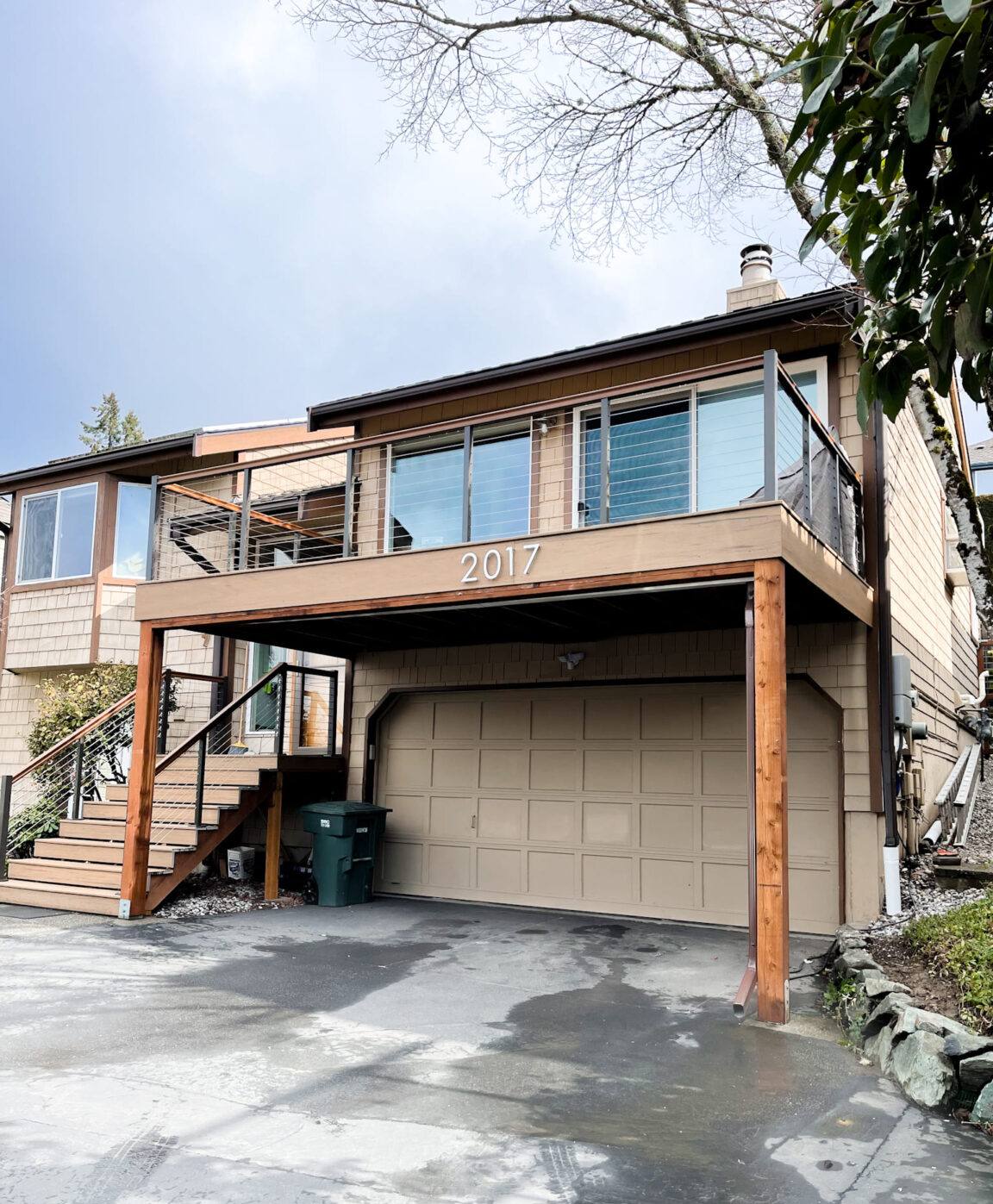
What a Correctly Built Deck Actually Involves
"Correct" isn't a marketing word here — it refers to a specific set of decisions that either get made right or don't. For Whatcom County's climate, the parts that matter most are usually invisible once the project is finished:
Ledger Attachment and Flashing
Where a deck attaches to the house is the single most common failure point on decks in this region, not because the framing is weak but because water finds its way behind the ledger board and sits there. A proper ledger installation uses flashing that directs water out and away from the house sheathing, not just a bead of caulk and a prayer. This is the detail we check first on any deck we're asked to repair, because it's the one most often skipped or done wrong.
Fastener and Hardware Selection
Salt air is corrosive to standard galvanized hardware faster than most homeowners expect. On South Hill projects we use fasteners and structural connectors rated for coastal exposure — stainless steel or heavy-duty coated hardware, not the cheapest box off the shelf. It costs more per piece, but a rusted joist hanger or a corroded ledger bolt is a structural problem, not a cosmetic one.
Joist Protection
Untreated joist tops absorb water every time it rains and hold it, which is exactly what accelerates rot underneath decking boards where you can't see it happening. Joist tape over the top of each joist, plus properly sized gaps between boards, keeps water moving through the structure instead of pooling in it.
Choosing a Decking Material for This Climate
There's no single "right" decking material — there's a right material for a given budget, look, and tolerance for maintenance. The table below reflects how each common option actually performs under Bellingham's wet, mossy, salt-air conditions, not just how it performs in a showroom.
| Material | How it handles the wet season | Maintenance burden | Typical lifespan here |
|---|---|---|---|
| Pressure-treated wood | Absorbs and releases moisture readily; needs to dry fully between rain events or it stays damp | Annual cleaning and re-sealing recommended | 10–15 years with upkeep |
| Cedar | Naturally rot-resistant but still needs sealing to resist moss and graying from constant damp exposure | Sealing every 1–2 years | 15–20 years with upkeep |
| Capped composite | Non-absorbent surface resists moss staining and doesn't take on water; still needs airflow underneath | Occasional washing, no sealing | 25+ years |
| PVC decking | Fully synthetic, doesn't absorb moisture at all; best resistance to staining and softening | Occasional washing | 25+ years |
We don't push one material over another as a default. A wood deck done right, with proper drying gaps and a realistic maintenance schedule, can serve a South Hill home well for a long time. Composite and PVC cost more up front but trade ongoing maintenance for upfront cost, which matters more to some homeowners than others. What we won't do is install a low-grade composite product on a full ground-level or shaded deck without airflow underneath — those conditions are exactly where cheaper composites are prone to trapping moisture at the substructure and causing problems the surface material can't fix.
The Substructure Is Where Decks Actually Fail
Most people evaluate a deck by looking at the decking boards. Most deck failures actually start below that surface — in the footings, the framing, and the connections that never get inspected because they're hidden. On sloped South Hill lots, this matters even more, since footing depth and post height often vary across a single deck.
- Footings sized and set below frost depth, not just poured to look adequate
- Posts anchored with post bases that keep wood off standing water, not buried directly in concrete
- Joist spacing sized for the actual decking material and expected load, not a generic spacing
- Beam and joist hardware rated for coastal, high-moisture exposure
- Cross-bracing on taller structures, since elevated decks on sloped lots see more lateral stress
None of this is visible on a finished deck, which is exactly why it's worth asking a contractor to walk you through it before the boards go down, not after.
Designing Against Moss, Algae, and Standing Water
A long moss season isn't something you fight after the fact with a pressure washer every spring — it's something you design around from the start. The goal is a deck surface and structure that dries quickly after rain instead of holding moisture in shaded, low-airflow pockets.
Practical measures that make a real difference on South Hill properties include a slight slope away from the house so water sheets off rather than pooling, consistent gapping between boards sized for the material, enough clearance under the deck for air to actually move, and keeping vegetation and structures from crowding the underside where sun and airflow are already limited by tree cover common in this area. On a deck built with these details, moss and algae growth slows considerably; on one built without them, no cleaning schedule fully keeps up.
How Our Process Works
- Walkthrough and assessment — we look at the site, the slope, sun exposure, drainage patterns, and how the deck will attach to the house before talking materials.
- Design and material selection — sizing, layout, railing style, and decking material chosen based on your budget and how much maintenance you actually want to take on.
- Permitting — we handle the permit application and inspections required by the City of Bellingham or Whatcom County, depending on the property's jurisdiction.
- Demolition and site prep — removal of any existing structure and grading as needed, with attention to drainage before new footings go in.
- Framing and structural work — footings, posts, beams, joists, ledger flashing, and hardware installed to the standards described above.
- Decking, railing, and finish work — surface material, railing systems, stairs, and any lighting or trim details.
- Final walkthrough — we go over the finished deck with you, including what maintenance (if any) it needs and on what schedule.
What Affects the Cost of a Custom Deck
Every deck is priced around its own specifics, but the factors below are the ones that move the number most on South Hill projects.
| Factor | Why it matters |
|---|---|
| Size and footprint | Larger decks need more footings, framing, and material — cost scales roughly with square footage but not perfectly linearly |
| Height and slope of the lot | Elevated decks on sloped South Hill lots need taller posts, more bracing, and often stairs, which adds labor and material |
| Decking material | Wood costs less upfront; composite and PVC cost more upfront but less over time in maintenance |
| Railing style | Cable, glass, and metal railing systems cost more than standard wood or composite balusters |
| Attachment method | A ledger-attached deck is typically less expensive than a freestanding structure, which needs its own full footing system |
| Permit and inspection requirements | Larger or higher decks generally require more inspection steps, which affects timeline more than raw cost |
We'll walk through these factors with you during the initial estimate so there's a clear picture of where the budget is going before any work starts.
Permits and Local Code
Most new decks and significant deck rebuilds in Bellingham and unincorporated Whatcom County require a building permit, particularly once height, size, or attachment to the house crosses certain thresholds. Requirements can vary depending on exactly where a property sits and whether it's inside city limits or the county's jurisdiction. We handle the permit application and coordinate required inspections as part of the project, so you're not tracking that down on your own — but it's worth knowing upfront that skipping permitting on a deck project is a real liability risk if the structure is ever sold or inspected later.
Why Working With a Crew That Already Knows South Hill Matters
A lot of deck problems in this area trace back to plans that were designed for a drier climate and never adjusted. Framing details that work fine in Eastern Washington or California don't hold up the same way three blocks from Bellingham Bay. A crew that already builds regularly in South Hill and the surrounding Whatcom County neighborhoods knows which lots drain poorly, which exposures get hit hardest by wind-driven rain, and which construction shortcuts cause callbacks two winters later. That's not something a generic national framework for deck-building accounts for — it comes from building here, repeatedly, and paying attention to what holds up and what doesn't.
It also means faster, more accurate estimates. When we're already familiar with typical lot conditions and permitting timelines in the area, we're not guessing at site logistics or discovering surprises mid-project that a crew unfamiliar with the region might miss during initial planning.
Keeping a South Hill Deck in Good Shape
Even a well-built deck needs some upkeep in this climate. The list below covers the basics that keep a deck performing the way it was designed to.
- Clear leaves and debris from between boards and off the surface regularly through fall, when moss growth accelerates
- Check the area under the deck once or twice a year for standing water or blocked drainage
- Inspect ledger flashing and any visible fasteners annually for corrosion or gaps
- Re-seal wood decking on the schedule appropriate to the product — don't wait until graying is severe
- Wash composite or PVC surfaces periodically to prevent algae film from building up, especially in shaded areas
- Address soft spots, loose railings, or squeaking boards early rather than waiting for them to worsen
If you're planning a new deck in South Hill or need an honest look at whether an existing one is holding up the way it should, we're happy to come take a look. Estimates are free, there's no pressure to move forward, and you'll get a straight answer about what your project actually needs.