 Bellingham
 Ferndale Roofs Take a Different Kind of Beating
Ferndale sits close enough to the water that roofs here deal with a combination most inland towns never see: salt-laden air rolling in off Bellingham Bay and the Strait, wind-driven rain that doesn't just fall straight down but gets pushed sideways under shingle edges and flashing, and a moss season that runs long and wet for most of the year. Any one of these on its own is manageable. Together, over years, they wear down roofing materials faster than the manufacturer's warranty numbers usually assume.
When a storm comes through — and in this part of Whatcom County, a "storm" is as likely to be a slow multi-day soaker with sustained wind as it is a single dramatic blow-through — the damage it leaves behind often isn't obvious from the ground. That's the core problem with storm damage on a Ferndale roof: the visible stuff (a missing shingle, a dented vent cap) is rarely the whole story.
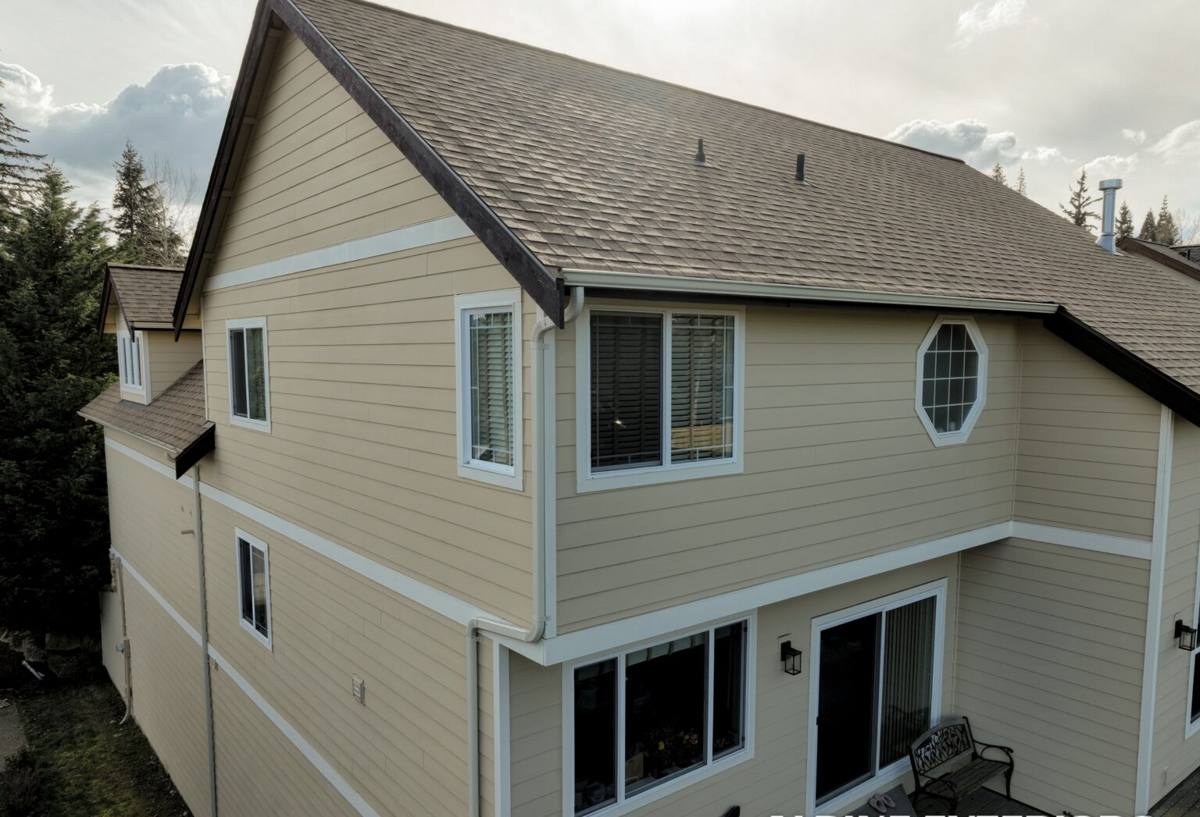
What Storm Damage Actually Looks Like Here
We're not a hail market, so most of what we're called out for after weather events falls into a few categories:
- Wind-lifted or creased shingles — the sealant strip breaks loose, and the shingle can lift, crack, or blow off entirely, especially on exposed gable ends and roof corners.
- Flashing pulled loose or bent — around chimneys, skylights, and roof-to-wall transitions, where wind uplift works flashing away from the surface it's supposed to seal.
- Limb and debris impact — cracked shingles, punctured underlayment, or dented metal from branches coming down in gusty weather.
- Granule loss — driving rain and wind erode the protective granule layer on asphalt shingles faster than normal weathering, leaving bald spots that age the roof prematurely.
- Moss intrusion after wind exposure — once wind opens a gap in a shingle course or ridge cap, moss and organic debris find their way in during the next wet stretch, and that combination causes damage far faster than wind alone.
That last point is the one we'd flag as most specific to this area. A wind event that would be a non-issue on a dry roof in a drier climate becomes a moisture entry point here, because Ferndale's roofs almost never get a long enough dry stretch to fully shed and dry out. Damage that starts as "cosmetic" in July can be a leak by the following February.
The Damage You Can't See From the Driveway
A storm damage inspection that only looks at the roof surface is an incomplete inspection. The parts of the system that actually cause interior damage are usually hidden:
Underlayment
If wind lifts shingles even briefly, the underlayment beneath is exposed to direct rain. Underlayment is a secondary barrier, not a roof — it's not built to take sustained weather on its own, and repeated exposure during storm season degrades it well before the shingles above show obvious wear.
Decking
Roof decking that's taken on moisture — through a lifted shingle, a failed flashing seam, or a small puncture — doesn't dry quickly in this climate. Soft or delaminating decking is one of the most common things we find once we pull back damaged shingles, and it's not something a homeowner can assess from the ground or even from a ladder at the eave.
Attic and Insulation
Slow leaks from storm-damaged flashing or ridge areas often show up first as damp insulation, staining on rafters, or a musty smell in the attic — sometimes weeks after the actual storm, once enough water has worked its way through.
How We Approach a Storm Damage Inspection
Our process is built around the fact that storm damage is often more extensive than what's visible from the ground, and that a rushed assessment is how homeowners end up with a second, bigger repair six months later.
- Ground-level and full-roof walk: we check every slope, not just the side facing the storm — wind damage in Ferndale often shows up on the leeward side too, where turbulence lifts shingles from unexpected angles.
- Flashing and penetration check: chimneys, vents, skylights, and roof-to-wall junctions get inspected individually, since these are the most common failure points in wind events.
- Attic inspection: when accessible, we check decking, insulation, and rafters from the inside for moisture staining or soft spots that don't show from outside.
- Photo documentation: useful for your own records and for insurance purposes if you're filing a claim.
- Plain-language findings: we tell you what's actually damaged, what's just cosmetic wear, and what we'd genuinely recommend versus what's optional — not a padded list.
Repair or Replace? What Actually Drives That Decision
Not every storm-damaged roof needs a full replacement, and not every roof can be safely patched. The honest answer depends on a few concrete factors, not a sales pitch either direction.
| Factor | Favors Repair | Favors Replacement |
|---|---|---|
| Age of roof | Under 10-12 years, otherwise sound | Nearing or past expected service life |
| Extent of damage | Isolated area, few shingles or one flashing point | Widespread lifting, multiple slopes affected |
| Decking condition | Dry, solid decking under the damage | Soft, delaminated, or repeatedly wet decking |
| History | First significant damage event | Repeated storm repairs in recent years |
| Moss/organic buildup | Light, surface-level, easily cleared | Established growth already lifting shingles and holding moisture |
We'll always tell you honestly which side of that table your roof falls on. A well-maintained roof with a couple of storm-damaged sections doesn't need to come off — but a roof where the storm just exposed problems that were already building underneath usually needs a more honest conversation.
What a Correct Storm Repair Involves
A quality storm repair isn't just replacing what's visibly broken. It means matching materials appropriately, re-sealing correctly for this climate, and checking that the repair won't fail again in the next wind event. That includes:
- Removing and replacing damaged shingles with a matched or compatible product, not just the closest thing on the truck
- Re-securing or replacing flashing with proper overlap and sealant, not just a bead of caulk over the old failure point
- Checking and repairing underlayment in the affected area, not only the shingle layer above it
- Clearing moss and debris from the repair area and surrounding courses before closing the roof back up
- Verifying decking is dry and sound before new material goes down over it
Skipping any of these steps is how a "fixed" roof leaks again during the next storm. Given how often Whatcom County gets consecutive wet weather systems, a repair that only addresses the surface layer rarely holds up for long.
If You're Filing an Insurance Claim
Many storm damage repairs are covered under homeowner's insurance, depending on your policy and the cause of damage. We're not your insurance company and won't promise a specific outcome, but we can provide a clear, photo-documented assessment of the damage that you can submit with your claim, and we're glad to walk an adjuster through what we found if that's helpful. Getting an independent inspection soon after a storm — rather than waiting — also matters, since some damage (like a small lifted shingle) gets worse with every subsequent rain event and is easier to document while it's fresh.
After a Storm: A Quick Checklist
- Check the attic (if accessible) for new staining, dampness, or a musty smell
- Look for granules collecting in gutters or downspouts — a sign of accelerated shingle wear
- Note any visible missing, cracked, or curled shingles from the ground with binoculars — skip the ladder
- Check around chimneys and vents for anything that looks bent, lifted, or misaligned
- Document the date of the storm and any damage you notice, for your own records or a claim
- Get a professional inspection before the next wet system moves through, especially if anything looks off
Why It Matters That We Already Work in Ferndale
A roof crew that regularly works Ferndale and the surrounding Whatcom County area already knows what the salt air does to fasteners and flashing over time, how fast moss reestablishes itself in this specific microclimate, and which storm patterns tend to hit which parts of the roof hardest. That's not something you get from a general regional inspection — it comes from repeatedly seeing how local roofs actually age and fail. We're not driving in from out of the area to give you a generic estimate; we're working roofs a few miles from your own on a regular basis, in the same weather your roof deals with.
If a recent storm has you wondering about your roof — whether it's a specific leak, a few shingles you can see are out of place, or just wanting a second set of eyes after a rough weather stretch — we're happy to come take a look. Estimates are free, there's no pressure, and we'll give you a straight answer about what does and doesn't need attention.