 Bellingham
 Building Decks for Happy Valley's Climate
Happy Valley is one of Bellingham's established residential neighborhoods, and like most of the city it sits under heavy tree cover with a mix of older homes and newer infill construction. That combination — mature trees, close-set lots, and Whatcom County's wet season — creates a specific set of problems for outdoor decks that a generic deck design doesn't solve. Shade from the canopy keeps surfaces damp longer after rain. Fine organic debris from overhanging trees collects in board gaps and ledger flashing. And because Bellingham sits close enough to the water for salt-laden air to reach inland neighborhoods, fasteners and connectors that aren't rated for coastal exposure corrode faster than homeowners expect.
None of this means a deck in Happy Valley has to be high-maintenance or short-lived. It means the build has to account for moisture and organic growth from the framing up, not just at the surface. That's the difference between a deck that looks good for one summer and one that's still structurally sound and low-hassle a decade later.
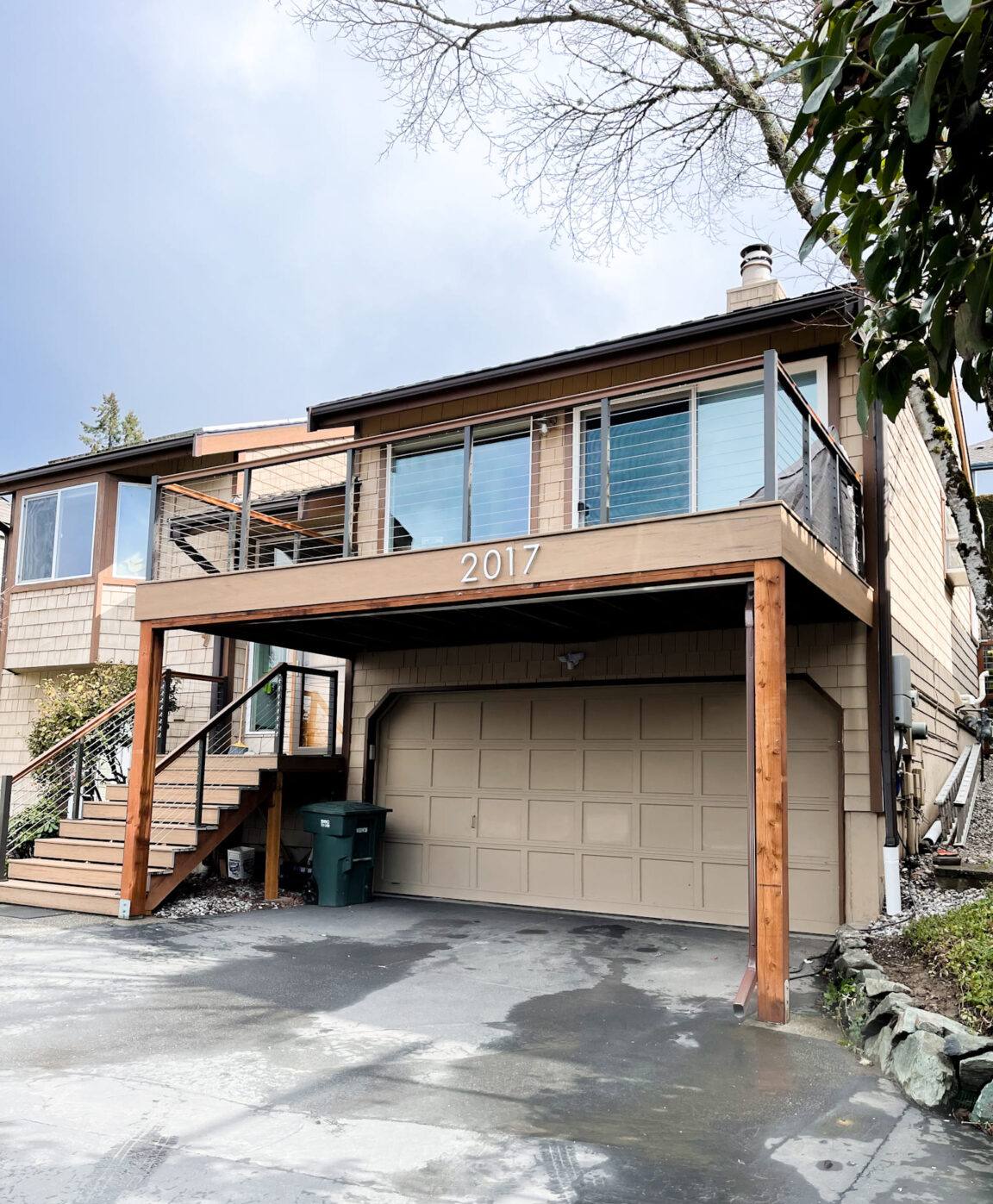
What Local Homes Actually Need From a Deck
Most of the deck problems we get called out for in this part of Bellingham trace back to the same handful of causes: undersized or poorly flashed ledger connections, decking installed tight against siding or foundation walls with no drainage gap, and fastener hardware that wasn't rated for the moisture load. None of these are visible defects when a deck is new — they show up two, five, or ten years later as soft framing, black streaking, or a ledger board that's pulling away from the house.
A deck built for Happy Valley's conditions needs to manage three things well:
- Water shedding off every horizontal surface, including under the decking itself, not just off the top
- Airflow underneath and between boards so wood and composite materials can actually dry between rain events
- Corrosion-resistant fasteners and structural connectors rated for coastal or high-moisture exposure
- A surface material and finish that resists moss and algae without demanding constant scrubbing
- Ledger and post-base connections that keep water away from end grain and hidden framing
Get those five right and the rest — railing style, board pattern, stairs — is really just a matter of preference and budget.
Decking Material Choices for a Shaded, Wet Lot
There's no single "best" decking material — there's a best material for a given lot's sun exposure, budget, and how much upkeep the homeowner actually wants to do. In a shaded neighborhood like Happy Valley, moss and algae resistance matters more than it would on an open, sun-exposed lot, because shaded wood surfaces simply stay wet longer.
| Material | Moss/algae resistance | Maintenance | Typical lifespan | Relative cost |
|---|---|---|---|---|
| Pressure-treated wood | Low — needs regular cleaning and sealing | Annual wash, re-seal every 2-3 years | 15-20 years with upkeep | $ |
| Cedar | Moderate — natural oils help, fade without finish | Cleaning, occasional oil/stain | 15-20 years | $$ |
| Capped composite | High — non-porous surface resists growth | Periodic rinse, no sealing needed | 25-30 years | $$$ |
| PVC decking | High — fully synthetic, non-porous | Low — occasional wash | 25-30+ years | $$$$ |
We don't push any one product as the "right" answer for every job. Pressure-treated and cedar cost less up front but ask more of the homeowner in ongoing care — that's a fair trade for some budgets and a bad one for others. Capped composite and PVC cost more initially but hold up better in shaded, damp conditions with far less scrubbing, which is often the better fit for a heavily treed Happy Valley lot. We'll walk through the actual trade-offs for your specific yard rather than defaulting to whatever's easiest to install.
A Note on Uncapped Composite
Older-style uncapped composite decking is still sold, and it's worth understanding why we generally steer clients away from it in this climate. Without a protective cap layer, the wood-plastic blend absorbs moisture at the surface, which gives moss and mildew something to root into — exactly the problem we're trying to design around. It's not that the product is defective; it's that it wasn't built for constant shade and rain, and we'd rather set that expectation up front than have a client unhappy in year three.
What's Underneath Matters More Than What's On Top
The decking boards are the part everyone sees, but the framing underneath is what determines whether the deck is still safe in fifteen years. In a wet climate, we pay particular attention to:
Ledger Attachment
Where a deck attaches to the house is the single most common failure point we find on older decks in this region. Proper ledger flashing — installed correctly, in the right order relative to the house's water-resistive barrier — keeps water from tracking behind the siding and rotting the rim joist. A deck that's structurally attached to a house with a compromised ledger connection is a safety issue, not just a maintenance one.
Joist Protection
Joist tape or an equivalent flashing over the top of every joist keeps fastener penetrations from becoming entry points for water. It's a small material cost that adds real years to framing life, and it's easy to skip if a crew is moving fast.
Hardware and Fasteners
We use corrosion-resistant, exterior-rated structural connectors and fasteners throughout — this matters more here than it would inland, given how far salt air can travel with the coastal weather patterns that move through Whatcom County. Mismatched or under-rated hardware is a slow, invisible failure that eventually shows up as a wobbly rail post or a loose beam connection.
Post Bases and Ground Contact
Posts set in standing water or buried in soil without a proper base connector rot from the bottom up. Elevated, non-corrosive post bases keep structural wood off wet ground and out of standing moisture after heavy rain.
Moss and Algae: Managing It by Design, Not Just Cleaning
Bellingham's long moss season is a fact of life for any exterior surface, decks included. The goal isn't to eliminate moss risk entirely — that's not realistic under a tree canopy — it's to design the deck so moss doesn't get a foothold in the structural parts that matter and stays manageable on the surface.
That means proper board spacing for drainage and airflow, decking run in a direction that sheds water away from the house rather than pooling against it, and — where the site allows — enough clearance between the deck surface and grade or roofline runoff that debris doesn't collect and stay wet against the boards. On heavily shaded lots we'll also talk through realistic expectations: a north-facing deck under mature trees will always need more attention than a south-facing one in the open, regardless of material.
Our Process, Start to Finish
- Site visit and assessment — we look at sun exposure, drainage patterns, existing structure (for replacements), and how the deck ties into the house
- Design and material walkthrough — honest comparison of material and layout options against your budget and maintenance preferences
- Permitting — most new and replacement decks in the City of Bellingham require a building permit, and we handle that process as part of the job
- Demolition and disposal, if replacing an existing deck
- Framing — ledger flashing, joist protection, corrosion-resistant hardware, proper post bases
- Decking, railing, and stairs installed to code and to the drainage/spacing details discussed at design
- Final walkthrough so you understand what the deck needs from you going forward — which, done right, isn't much
We don't skip the permitting step, and we don't cut corners on flashing or hardware to hit a lower number — those are exactly the shortcuts that turn into costly repairs a few years down the line.
Permits and Local Requirements
New decks, and most deck replacements involving structural work, need a permit from the City of Bellingham. Requirements can touch on guardrail height, stair geometry, footing depth, and setback from property lines, and they can vary depending on the deck's height above grade and its attachment to the house. We factor permitting into the timeline and cost from the start rather than treating it as an afterthought, so there are no surprises mid-project.
Maintaining a Deck in a Wet, Shaded Climate
Whatever material you choose, a little seasonal attention goes a long way in this climate. A realistic maintenance checklist for a Happy Valley deck:
- Sweep leaves and debris out of board gaps regularly during fall, especially under tree cover
- Rinse or lightly scrub the surface in late winter/early spring before moss establishes for the season
- Check and clear any debris from around ledger flashing and post bases once or twice a year
- For wood decking, plan on cleaning and re-sealing every two to three years; composite and PVC need only occasional rinsing
- Watch for soft spots, discoloration, or movement at the ledger connection and have it inspected if you notice any
- Keep gutters and downspouts near the deck clear so roof runoff isn't dumping extra water onto or under the structure
Why Local Deck-Building Experience Matters Here
A crew that mostly builds decks in drier climates will often use the same details everywhere — because those details work fine somewhere else. In Bellingham, and particularly on shaded, established lots like the ones common in Happy Valley, that approach shows up as ledger rot, moss-blackened boards, and corroded hardware years earlier than it should. Working this neighborhood regularly means knowing which lots hold moisture longer, which yards get heavier moss pressure, and which framing details actually hold up through a Whatcom County winter — not guessing at it project by project.
If you're planning a new deck or replacing one that's showing its age, we're glad to come take a look and talk through what makes sense for your yard specifically. Reach out for a free, no-pressure estimate using the form below.