 Bellingham
 Why Decks in Puget Wear Out Faster Than the Manufacturer's Warranty Suggests
Most decking products are rated and warrantied against conditions that don't really exist here. A composite board tested for UV fade in a dry climate, or a pressure-treated joist rated for "exterior use" in a general sense, is being asked to do something different in Puget: sit under a low winter sun, get rained on for days at a stretch, and dry out slowly in cool, humid air that never fully clears the moisture out. Add proximity to saltwater, and every metal fastener, hanger, and post base on the structure is exposed to airborne salt that accelerates corrosion well beyond what the hardware's rating assumes.
None of that means decks here are doomed. It means a deck built or replaced without accounting for this specific combination — salt air, driving rain, and a moss season that can run five or six months — will show problems years before a deck built with those conditions in mind. Replacement is the point where you get to fix that, not just swap old boards for new ones in the same configuration that failed the first time.
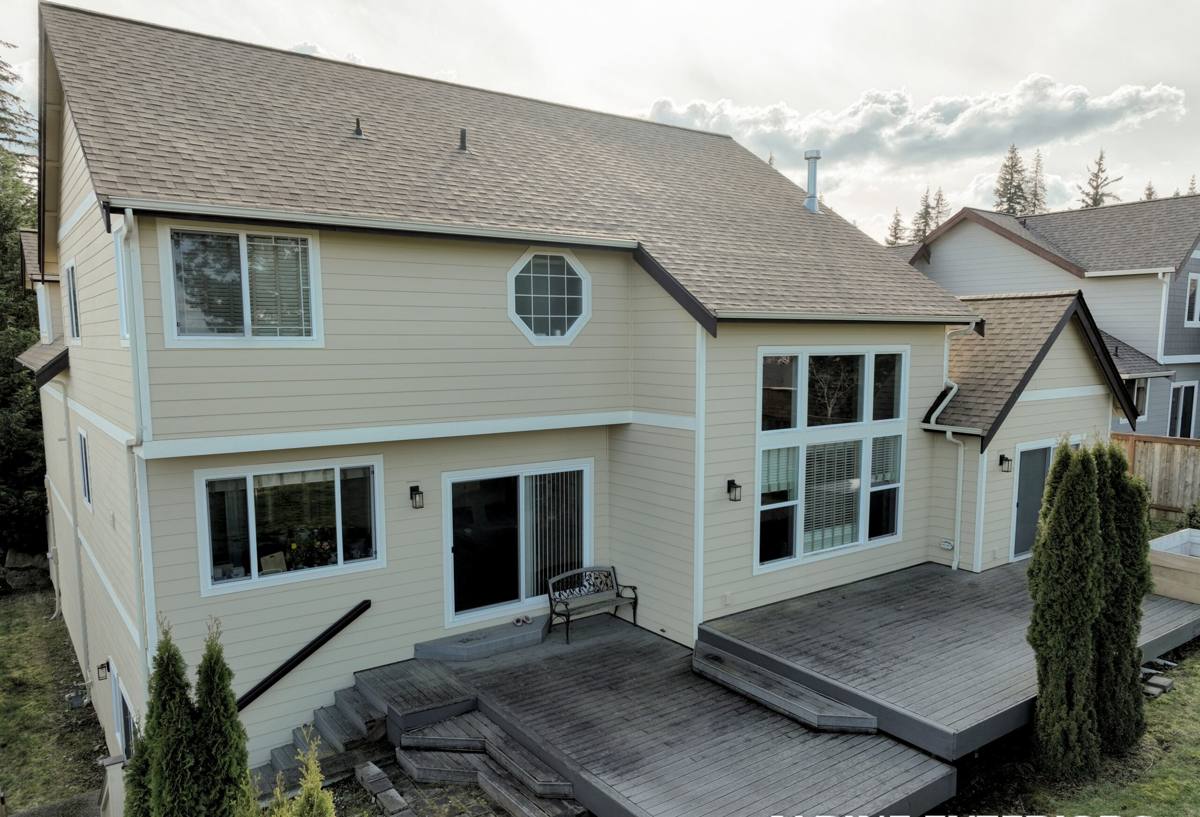
Signs Your Deck Needs Replacement, Not Another Repair
Repair makes sense when the problem is isolated. Replacement makes sense when the problems are structural, repeated, or hidden in places you can't spot-fix. Here's how to tell which situation you're in.
- Soft, spongy, or springy spots in the decking or framing when you walk across it
- Visible rot, dark staining, or crumbling wood at the ledger board (where the deck attaches to the house)
- Rust streaks running down from screws, bolts, or joist hangers
- Persistent moss or algae film that comes back within weeks of cleaning, even in the shoulder seasons
- Gaps that have widened, boards that cup or twist, or railings that flex under light pressure
- A deck more than 15–20 years old that has never had its ledger flashing or fasteners upgraded
- Footings you can see are cracked, heaving, or sitting in standing water after rain
Any one of these on its own might be repairable. Several together, especially anything involving the ledger board or footings, usually means the deck's problems are systemic rather than cosmetic — and that's when full replacement is the more honest recommendation, not just the bigger job.
What a Correct Deck Replacement Actually Involves Here
Ledger Board and Flashing
The ledger board — the piece bolted to your house that the whole deck hangs from — is where most deck failures in wet climates actually start. Water gets behind it, the house's sheathing and framing rot from the inside, and by the time anyone notices, the damage has been happening for years. A correct replacement means removing the old ledger entirely, inspecting the house framing behind it for hidden rot, and installing proper step flashing and a water-resistant membrane before the new ledger goes back on. This is the single most important thing separating a deck that lasts from one that quietly rots from the inside.
Footings and Post Bases
Wood that sits directly on concrete or in contact with soil stays wet longer and rots faster. We use elevated post bases that keep the post end above grade and away from standing water, and we check that footings are sized and depths meet code for this soil and frost conditions — not just "however the last deck was built."
Ventilation and Drainage
Trapped moisture under a deck is a slow-motion problem in a climate that rarely gets a long dry stretch to reverse it. Correct framing leaves airflow underneath, decking boards are gapped to shed water and let air move between them, and the whole structure is sloped slightly away from the house so water doesn't pool against the foundation.
Choosing Decking Material for Salt Air and a Long Moss Season
There's no single "best" decking material — there's a best fit for your budget, your maintenance appetite, and how much shade and moisture your specific site sees. Here's how the common options actually perform under Puget conditions.
| Material | Upfront Cost | Moss/Algae Resistance | Maintenance | Typical Lifespan Here |
|---|---|---|---|---|
| Pressure-treated lumber | Lowest | Low — needs regular cleaning and sealing | Annual cleaning, re-sealing every 1–2 years | 10–15 years |
| Cedar | Moderate | Moderate — natural oils help but fade over time | Cleaning plus periodic staining/sealing | 15–20 years |
| Composite (wood-plastic) | Higher | Good — but capped boards outperform uncapped | Occasional washing, no sealing/staining | 25–30 years |
| PVC/capped composite | Highest | Best — fully sealed surface resists moisture uptake | Low — soap and water | 25–30+ years |
We'll be direct about the trade-off with wood: it's cheaper up front, but the maintenance schedule that keeps it performing well in this climate is real work, and skipping a season of sealing is exactly how moss gets a foothold. Composite and PVC products cost more initially but remove most of the moisture-related maintenance burden, which matters more here than in a drier climate. Neither choice is wrong — it depends on whether you'd rather pay in dollars now or in upkeep over the years.
Fasteners and Hardware: The Part Nobody Sees Until It Fails
Salt-laden air corrodes standard fasteners faster than most homeowners expect, and a rusted-through hanger or screw is a hidden failure point — you won't see it until a board comes loose or a railing feels wobbly. On every replacement, we use stainless steel or heavy hot-dip galvanized fasteners and hardware rated for coastal or high-moisture exposure, not the standard exterior-rated hardware that's fine for drier inland conditions but undersized for salt air. It costs more per fastener. It's not a place to save money, because replacing a deck's fasteners means tearing the deck apart again.
Permits and Code Requirements
Deck replacement in Whatcom County typically requires a permit once you're rebuilding structural framing, footings, or anything attached to the house — not just swapping surface boards on an otherwise sound structure. Permits exist for good reason here: they trigger an inspection of the framing, footings, and ledger attachment, which is exactly the part of the job most likely to be hidden and most likely to cause problems if done wrong. Guardrail height, baluster spacing, and stair rise/run also have to meet current code, which may be stricter than whatever your existing deck was built to years ago. We handle the permit process as part of the job rather than leaving it to the homeowner to sort out.
Our Deck Replacement Process
- On-site inspection — we check the ledger, framing, footings, and existing hardware to confirm replacement is the right call and identify any hidden rot before work starts
- Written scope and estimate — clear on what's being replaced, what materials are being used, and why
- Permit and inspection scheduling — pulled before demolition begins
- Tear-off — full removal of old decking, framing, and ledger as needed
- Framing inspection — house sheathing behind the old ledger is checked for hidden moisture damage
- Ledger flashing and reattachment — proper membrane and step flashing installed before the new ledger goes up
- Framing, footings, and post bases — built or upgraded to current code with corrosion-resistant hardware
- Decking, railing, and stairs installed — with proper board spacing for drainage and airflow
- Final walkthrough and inspection sign-off
What Deck Replacement Typically Costs and What Drives the Price
Every deck is different, but the cost of replacing one is driven by a fairly consistent set of factors. Understanding them helps you see why two decks that look similar in size can come in at very different prices.
| Cost Factor | Why It Matters |
|---|---|
| Deck size and height above grade | More framing, taller footings, and additional bracing for elevated decks |
| Decking material chosen | Pressure-treated wood, cedar, composite, and PVC span a wide price range |
| Condition of the existing ledger and framing | Hidden rot found during tear-off can add scope once it's exposed |
| Railing style and stair count | Custom railing and multiple stair runs add labor and material |
| Permit and inspection requirements | Larger or structurally significant decks require more inspection steps |
| Site access | Tight side yards or elevated lots slow demolition and material staging |
We give a written estimate after seeing the deck in person — not a phone quote — because the framing and ledger condition usually can't be assessed accurately until someone's actually looked underneath.
Why a Crew That Already Works Puget Matters
A deck built by someone unfamiliar with this climate will often look fine for the first couple of years — the problems that show up from wrong flashing, standard-grade fasteners, or poor drainage take time to surface. A crew that's replaced decks throughout Bellingham and the surrounding Puget Sound area knows where that failure pattern starts, because we've torn enough old decks apart to see it: rot concentrated at the ledger, corrosion at the fastener heads, moss holding moisture against boards that never got enough airflow to dry between rain events. Building around those specific failure points isn't a generic best practice — it's what this specific stretch of coastline requires, and it's baked into how we frame, flash, and fasten every replacement from the start.
If your deck is showing soft spots, rot, persistent moss, or you're just not sure whether it's a repair or a replacement, we're happy to take a look and give you an honest read — no pressure, no obligation. Fill out the form below for a free estimate.