 Bellingham
 Why Sehome Decks Wear Out Faster Than Homeowners Expect
Sehome is one of Bellingham's older, established neighborhoods, with a mix of homes ranging from mid-century builds to more recent additions and remodels. A lot of the decks we get called out to see in this part of town were built to the standards and materials common at the time of construction, and haven't been touched since. That's a problem in Whatcom County, because our climate is genuinely hard on exterior wood structures — not in a dramatic way, but in a slow, cumulative way that homeowners often don't notice until a board flexes underfoot or a railing post feels soft.
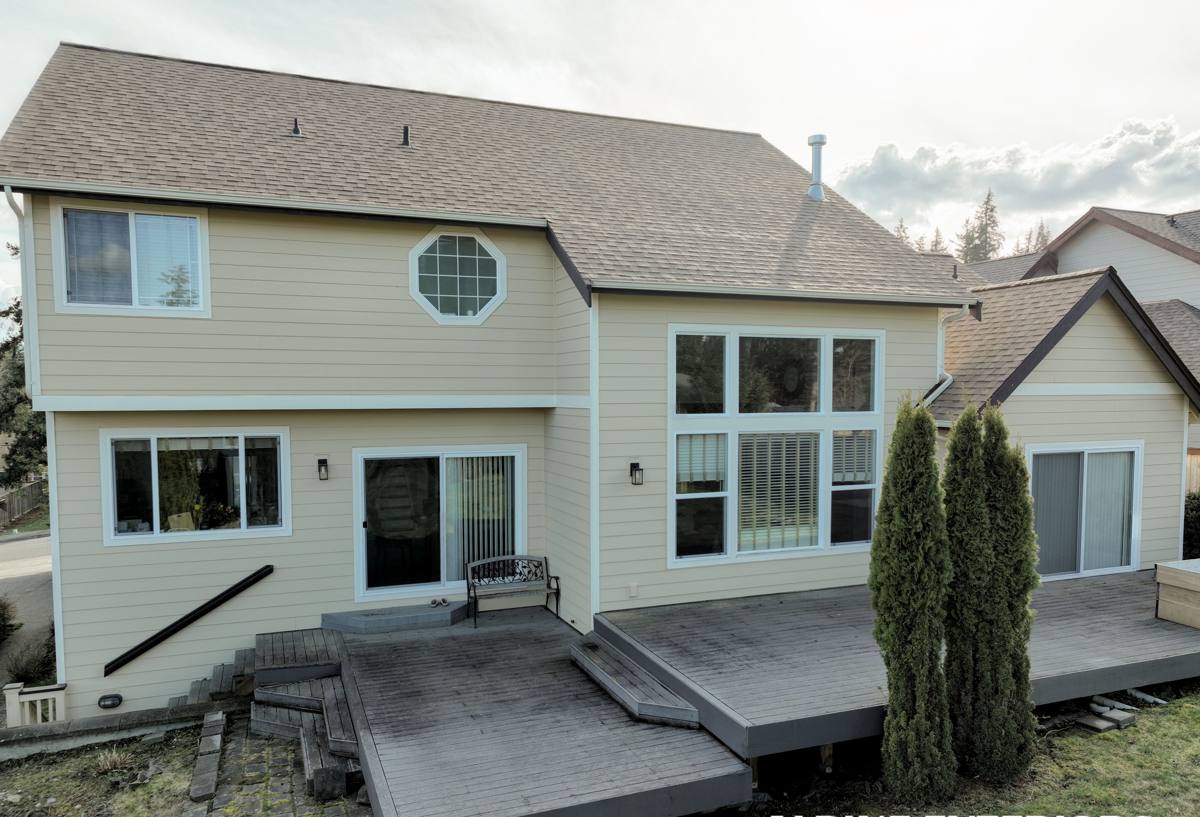
Sehome's terrain adds to this. Many lots in the neighborhood slope, sit under mature tree cover, or are shaded for a good part of the day, all of which slow down drying time after our long wet season. A deck that looks fine from a distance can be hiding rot in the framing, corroded fasteners, or a ledger connection that's been slowly failing for years. Deck replacement isn't just about fresh boards on top — it's about correcting whatever allowed the old deck to fail in the first place, so the new one doesn't repeat the same slow decline.
What Bellingham's Climate Does to a Deck, Board by Board
Whatcom County sits close enough to Bellingham Bay that salt-laden air is a real factor for a lot of homes, even ones that aren't waterfront. Combined with near-constant moisture for much of the year, that's a tough combination for fasteners, flashing, and any metal hardware holding a deck together.
Salt Air and Metal Corrosion
Coastal air accelerates corrosion on nails, screws, joist hangers, and post bases. Once a fastener starts rusting, it loses holding strength long before it looks obviously bad. On older Sehome decks, this is one of the most common hidden problems we find — hardware that looks intact on the surface but has lost real structural integrity underneath.
Driving Rain and Trapped Moisture
Pacific Northwest rain doesn't always fall straight down — wind-driven rain gets pushed sideways into ledger connections, under railings, and into any gap where two pieces of wood meet. If a deck wasn't flashed and sealed correctly when it was built, water finds its way into the framing and stays there, because our air rarely gets dry enough, long enough, to fully evaporate it back out.
Moss, Algae, and the Long Wet Season
Bellingham's moss season stretches from fall through spring, and shaded, sloped lots like many in Sehome are especially prone to it. Moss and algae hold moisture directly against decking boards and stair treads, which speeds up rot and turns walking surfaces slick and dangerous. A deck that isn't cleaned and maintained through this stretch of the year ages noticeably faster than one that is.
Repair or Replace? Signs It's Time
Not every tired-looking deck needs full replacement — sometimes a repair, a partial reframe, or a resurface is the honest answer. But there are signs that point toward replacement rather than patching, especially once the structure itself is compromised.
- Boards that feel spongy, springy, or noticeably different underfoot from one section to another
- Visible rot, soft spots, or discoloration at the ledger board where the deck meets the house
- Railing posts that wobble or flex when pushed — a safety issue, not just cosmetic
- Rust streaks around fasteners or joist hangers
- Persistent moss or algae growth that returns quickly after cleaning
- A deck more than 20-25 years old that has never had the substructure inspected
- Stairs that feel unstable or treads that have visibly worn or split
If more than one or two of these apply, it's usually a sign the framing has been compromised, not just the surface boards. At that point, resurfacing on top of a weakened structure just hides the problem instead of fixing it.
What a Correct Deck Replacement Actually Involves
A deck replacement that's done right goes well below the decking boards. Homeowners sometimes assume it's mostly a cosmetic project, but the substructure is where the real work — and the real value — is.
That starts with the ledger board, the piece that attaches the deck to the house. This connection has to be properly flashed to keep water from tracking behind it and into the house framing, which is one of the most consequential mistakes we see on older builds. From there, footings need to be checked or replaced to make sure they're sized and set correctly for the load and soil conditions on the lot, since sloped and wooded sites in Sehome can shift more than flat, open ground.
Framing lumber, joist hangers, and all structural hardware should be rated for exterior and, ideally, coastal-exposure use, given the salt air factor mentioned above. Joist spacing and beam sizing need to match the decking material chosen, since composite and PVC products often have different span requirements than wood. Railings and guardrails need to meet current safety requirements for height and baluster spacing, and stairs need correct rise-and-run dimensions — these aren't optional details, they're what keeps a deck safe under real use for decades, not just years.
Choosing Decking Material for a Sehome Property
Material choice matters more here than it does in drier climates, because whatever's chosen has to hold up to sustained moisture, shade, and moss pressure for years at a time. There isn't a single right answer for every home — it depends on budget, how much maintenance a homeowner wants to take on, and the look they're after.
| Material | Upfront Cost | Maintenance | How It Handles This Climate |
|---|---|---|---|
| Pressure-Treated Wood | Lowest | Annual cleaning, periodic sealing | Good if maintained consistently; neglect leads to rot, splitting, and moss buildup |
| Cedar | Moderate | Regular sealing to hold color and resist moisture | Naturally moisture-resistant, but still needs upkeep to prevent graying and softening |
| Composite | Higher | Occasional washing, no sealing/staining | Very stable in wet conditions; some products are more moss/mildew resistant than others |
| PVC/Capped Polymer | Highest | Minimal — mostly just washing | Fully water-resistant surface; best long-term option for shaded, damp lots |
We won't push a homeowner toward the most expensive option if it doesn't fit their budget or their plans for the home. A well-built pressure-treated deck that's properly flashed and maintained can last a long time in Bellingham. What we're honest about is the trade-off: lower-cost materials ask more of the homeowner in ongoing maintenance, especially through moss season, while composite and PVC shift that cost upfront in exchange for less upkeep later.
Permits, Code, and Safety Requirements
Deck replacement in Bellingham and Whatcom County typically requires a permit, especially when footings, framing, or structural connections are being replaced rather than just the surface decking. Permitted work means an inspector checks the ledger flashing, footing depth, and structural connections before boards go down — that inspection is a real safeguard, not just paperwork, because it catches problems while they're still easy to fix.
Guardrail height, baluster spacing, and stair geometry are all governed by current building code, and older decks in Sehome were often built under different, less strict standards. A full replacement is a natural point to bring a deck up to current safety requirements, which matters most for households with kids or older adults using the deck regularly.
Our Deck Replacement Process
- On-site evaluation. We inspect the existing deck, ledger connection, footings, and framing to determine the actual condition, not just what's visible on the surface.
- Honest scope and estimate. We walk through what needs full replacement versus what can be reused safely, and lay out material options with real cost and maintenance trade-offs.
- Permit and code review. We handle the permitting process and make sure the design meets current guardrail, stair, and structural requirements.
- Demolition and disposal. The old deck is removed carefully to avoid damage to the house, landscaping, or the ledger area behind it.
- Framing and flashing. New footings, joists, and ledger flashing are installed first, since this is the part of the deck that determines how long the whole structure lasts.
- Decking, railings, and stairs. Surface materials go on last, finished to spec with attention to drainage and airflow underneath.
- Final walkthrough. We go over the finished deck together, including basic maintenance guidance specific to the material chosen.
Why a Crew That Already Works in Sehome Matters
A deck built for a dry, sunny climate elsewhere doesn't automatically hold up here, and a crew that mostly works inland or in drier parts of the state may not think about salt air corrosion or moss-season drainage the same way a Bellingham-based crew does. Working regularly in neighborhoods like Sehome means we've seen how specific lots handle shade, slope, and drainage, and we build with that in mind from the start — not as an afterthought once a problem shows up.
It also means faster, more practical scheduling. Local crews aren't factoring in long drive times or unfamiliar permitting processes with the City of Bellingham and Whatcom County — we already know the process, which keeps projects moving without unnecessary delays.
Keeping a New Deck in Good Shape
Whatever material is chosen, a few habits make a real difference in this climate. Clear leaves and debris off the deck surface regularly, especially in fall, so moisture doesn't sit trapped against the boards. Keep gutters and downspouts near the deck clear so runoff isn't draining directly onto or under it. Wash off moss and algae as soon as it appears rather than letting it establish, since it's much easier to prevent than to remove once it's taken hold. For wood decks, plan on resealing on a regular cycle rather than waiting until the finish visibly fails — by then, moisture has usually already gotten into the wood underneath.
If your deck in Sehome is showing any of the warning signs above, or you're just not sure whether it needs repair or full replacement, we're happy to take a look. Reach out for a free, no-pressure estimate using the form below.