 Bellingham
 Siding Repair in Sehome: What the Climate Actually Does to a House
Sehome sits close enough to Bellingham Bay to catch salt-laden air off the water, and far enough into the hills to pick up shade, tree cover, and slower-drying surfaces on many lots. That combination is tougher on exterior siding than either factor alone. Salt air is mildly corrosive to exposed fasteners and metal trim over time. Shade and tree cover keep siding damp longer after every rain, which in Whatcom County means siding can stay wet for days at a stretch during the fall and winter months. Add in a moss season that regularly runs from October through May, and you have a set of conditions that will find every weak point in a siding system eventually — a gap in caulking, an unsealed cut end, a fastener that backed out a sixteenth of an inch.
None of this means siding in Sehome fails faster than siding anywhere else in Bellingham. It means the failure points are predictable, and a repair that doesn't account for them is a repair that comes back. We've built our repair process around what actually happens to siding in this specific kind of environment, not a generic checklist.
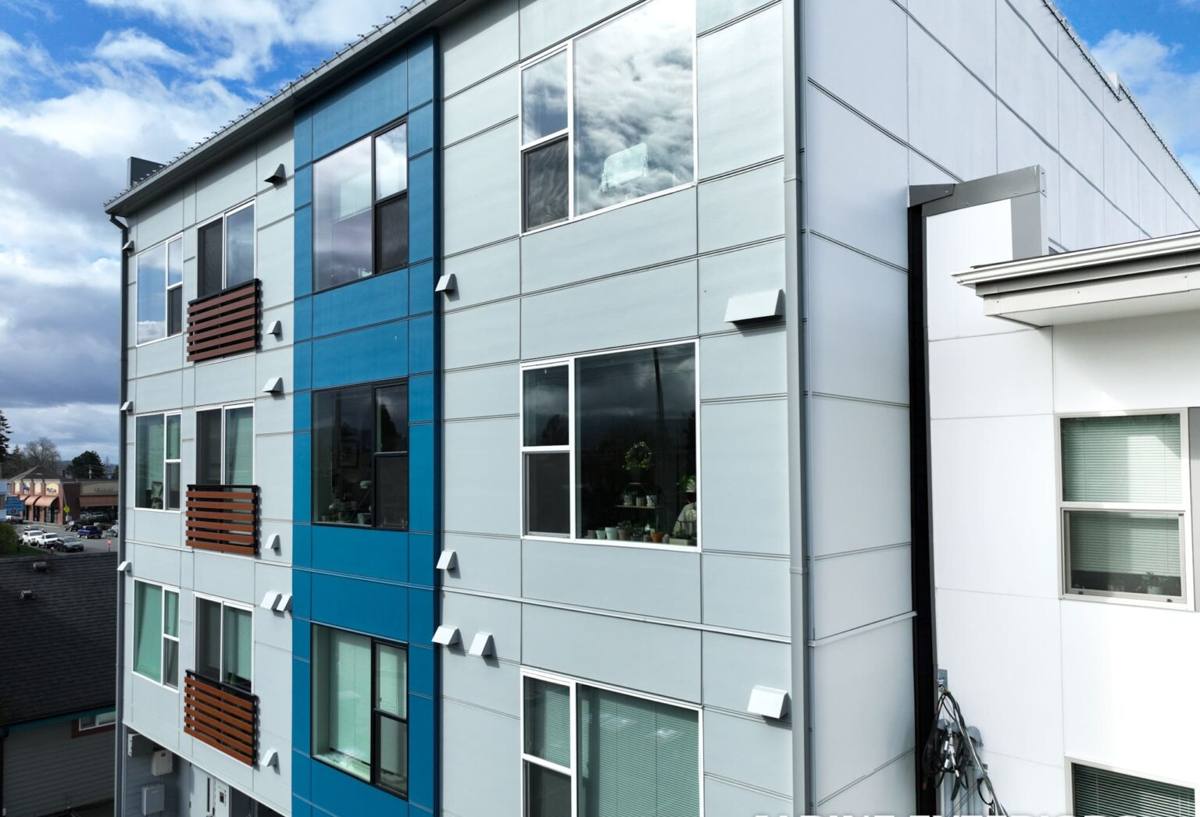
How Moisture and Moss Actually Damage Siding
Homeowners often assume moss and algae are a cosmetic nuisance — something a pressure wash fixes. In reality, moss holds moisture directly against the siding surface for extended periods, which matters more than the moss itself. Wood-based siding (cedar, primed spruce, engineered wood products) absorbs that trapped moisture, swells, and eventually softens or delaminates at the edges. Fiber cement resists moisture absorption far better, but even fiber cement siding fails at its weak points: unsealed cut ends, nail penetrations without proper sealant, and butt joints where caulking has dried out and cracked.
Driving rain — the kind that comes in sideways during a Whatcom County storm — pushes water into places vertical rain never reaches: under trim, behind J-channel, into gaps around window and door flashing. If the water-resistive barrier behind the siding is intact and properly lapped, that moisture drains back out. If it isn't, the moisture gets trapped between the siding and the sheathing, and by the time it shows up as a stain or soft spot on the outside, there's often already damage you can't see.
Signs Your Siding Needs Repair
- Soft, spongy, or crumbling spots when pressed by hand
- Paint that's bubbling, peeling, or cracking in a localized area rather than evenly across a wall
- Dark staining below window sills, at butt joints, or near roof-to-wall transitions
- Persistent moss or algae growth that returns quickly after cleaning
- Visible gaps, warping, or buckling in individual boards or panels
- Caulk joints that have shrunk, cracked, or pulled away from the siding
- A musty smell or interior wall staining on the room behind the affected exterior area
Any one of these can be a minor, contained repair. Several of them together, especially with interior symptoms, usually point to a moisture problem that's been developing for a while and needs a proper diagnosis before anyone touches a caulk gun.
What a Correct Siding Repair Actually Involves
A repair that only addresses what's visible from the driveway isn't a repair — it's a temporary cover-up. Done correctly, siding repair in a climate like ours involves finding out why the damage happened, not just patching where it shows.
The steps that separate a real repair from a patch job
- Remove the damaged material and inspect what's underneath — sheathing, house wrap, and flashing — before deciding on a repair scope.
- Check for hidden moisture in the surrounding wall cavity, not just the section that's visibly damaged.
- Repair or replace the water-resistive barrier if it's torn, improperly lapped, or missing at penetrations.
- Correct flashing details at windows, doors, and roof intersections, since these are the most common actual source of the water intrusion, even when the siding itself is what shows the damage.
- Match the replacement material as closely as possible in profile, reveal, and finish so the repair doesn't stand out.
- Fasten and seal correctly — proper fastener type and spacing, sealant at cut ends and penetrations, and caulk joints sized and placed to shed water rather than trap it.
- Reassess drainage and airflow around the repaired section, especially on shaded or tree-covered walls where things dry slowly.
Skipping the first two steps is the most common shortcut in siding repair, and it's the one that causes the same spot to fail again twelve or eighteen months later. A new board over a wet wall cavity just hides the problem for a while.
Repair or Replace: How We Actually Decide
Not every damaged section needs full replacement, and not every siding job that looks bad on the surface is actually a repair candidate. Here's the honest breakdown of how we evaluate it.
| Factor | Leans Toward Repair | Leans Toward Replacement |
|---|---|---|
| Extent of damage | Isolated to one or two sections/walls | Spread across multiple walls or the whole exterior |
| Siding age | Under 10-15 years, still structurally sound elsewhere | Original siding nearing or past its expected service life |
| Moisture behind cladding | Contained, no rot in framing or sheathing | Rot found in framing, sheathing, or widespread hidden moisture |
| Material availability | Profile and finish can be closely matched | Discontinued product, poor match, or already patched multiple times |
| Underlying material | Fiber cement or other durable material in good condition | Wood-based product showing repeated moisture failure |
| Cost over time | Repair cost is a small fraction of full replacement | Repeated repairs are approaching the cost of replacing the wall |
We'll tell you honestly which side of that table your house falls on. If a targeted repair genuinely solves the problem, that's what we recommend — a full re-side isn't the right answer just because it's the bigger job.
What We Repair, and What We Recommend for Anything New
We repair siding on Sehome homes regardless of what's currently on the walls — cedar, vinyl, engineered wood, fiber cement, whatever was installed originally. Diagnosing moisture problems and restoring a wall system to good condition doesn't require us to agree with every material choice a previous builder made.
Where our position is firm is on new material. When a repair calls for replacing a full section, a full wall, or when the homeowner decides a partial repair isn't worth chasing anymore and wants that portion re-sided properly, we install James Hardie fiber cement exclusively. We don't stock or install vinyl, LP SmartSide, primed spruce, cedar, or other fiber cement brands. That's a standard we hold across every job, not just this one.
The reason comes directly from what we see in repair calls. Wood-based products absorb and hold moisture at exactly the weak points — cut ends, fastener holes, butt joints — that our climate targets hardest. James Hardie's fiber cement doesn't absorb water the way wood does, its HZ product lines are engineered for moisture-heavy climates like ours, and the factory-applied ColorPlus finish holds up to UV and salt air without the repeated repainting that wood and some engineered products require. It's also non-combustible, which matters more each year as wildfire smoke and dry-season risk become a bigger part of Pacific Northwest summers. When we replace a section, we want it to be the section we're not called back to repair in three years.
A Note on Patching Mismatched Materials
Sometimes a homeowner asks us to patch a small section with whatever's already on the house, even if that material isn't something we'd install fresh. We'll do that where it makes sense — replacing three damaged cedar boards on an otherwise sound cedar wall, for example. What we won't do is pretend a patch is a long-term fix when the underlying material is the actual problem. We'll say so plainly and let you decide.
Our Siding Repair Process in Sehome
The process is the same discipline whether it's one damaged panel or a full wall section:
- On-site inspection — we look at the visible damage and the areas around it, including trim, flashing, and anywhere water tends to collect on that specific home.
- Moisture check — probing or moisture-meter testing where damage suggests water has been present for a while, not just where it's visible.
- Honest scope and estimate — a clear explanation of what needs to happen, why, and what it costs, including whether we think repair or replacement is the better call.
- Removal and inspection behind the siding — confirming the sheathing and water-resistive barrier are sound before closing anything back up.
- Correction of the underlying cause — flashing, sealant, or barrier repair, not just new siding over the old problem.
- Installation and finishing — matched material, correct fastening, and sealant detailing at every seam and penetration.
- Cleanup and walkthrough — we show you what was found and what was done before we consider the job finished.
Why It Matters That We Already Work in Sehome
Siding repair isn't a one-size-fits-all trade, and a crew that works regularly in Bellingham neighborhoods like Sehome develops a working sense of what tends to go wrong on which kinds of homes — older construction with original trim details, newer infill builds, homes on shaded or sloped lots where siding dries slower than a south-facing wall in the open. That familiarity shortens the diagnostic part of the job and means fewer surprises once we open a wall up.
There's also a practical side to hiring local: permitting and code requirements are handled at the city and county level, and knowing how Bellingham and Whatcom County inspections typically go keeps a repair project from stalling on paperwork. And when a repair is done right the first time, being a crew that's still working in the same neighborhood next year and the year after is part of standing behind that work.
What Drives the Cost of a Siding Repair
Repair costs vary a lot depending on scope, and we'd rather explain the variables than quote a number that doesn't apply to your house. These are the factors that move the price up or down.
| Cost Factor | Why It Matters |
|---|---|
| Extent of hidden damage | Rot found behind the siding adds sheathing or framing repair, which costs more than surface-level work |
| Material match | Matching an existing discontinued profile or custom color can add cost and lead time |
| Accessibility | Second-story walls, tight side yards, or sections near steep grade take longer to access safely |
| Flashing and barrier repair | Correcting the actual moisture source is often a bigger part of the job than the visible siding replacement |
| Scope size | A single panel repair costs far less per square foot than a full wall or elevation replacement |
| Paint or finish work | Matching finish on wood-based siding adds labor that factory-finished materials don't require |
Keeping Repaired Siding in Good Shape
A properly done repair should hold up for years, but a little seasonal attention in a climate like this one goes a long way, especially heading into another wet season.
- Rinse moss and algae off siding surfaces before it builds up thick enough to hold moisture against the wall
- Trim back tree branches and shrubs that keep sections of the house shaded and slow to dry
- Check caulk joints at trim, window, and door edges once a year for cracking or shrinkage
- Look at ground-level siding for splash-back staining, which points to gutter or drainage issues rather than a siding defect
- Watch previously repaired areas for the first year or two to confirm the fix is holding under real weather
- Address small caulk or paint failures promptly — they're inexpensive to fix early and expensive to ignore
Getting an Honest Look at Your Siding
If you're seeing soft spots, staining, moss that keeps coming back, or siding that just looks tired, it's worth getting an honest opinion before deciding between a repair and a bigger project. We'll walk your home, tell you plainly what we find, and lay out the repair and replacement options without steering you toward the bigger job just because it's bigger. Reach out for a free, no-pressure estimate using the form below.