 Bellingham
 Sehome's Siding Challenge: Moisture From Every Direction
Sehome sits inside one of the wetter, mossier corners of Washington State, and the neighborhood's mix of older established homes and newer infill construction means siding conditions vary block to block. Some houses sit under mature tree canopy that keeps north-facing walls damp for days after a storm. Others catch wind straight off Bellingham Bay, carrying salt air that slowly works on anything not built to resist it. Almost every home in the area deals with some combination of driving rain, shaded siding that never fully dries, and a moss season that can stretch from October through May.
None of that is unusual for Whatcom County. But it does mean siding here has a harder job than siding in a drier climate, and the material and installation choices that would be fine in Spokane or Boise are often the wrong call in Bellingham. Siding on a Sehome home isn't just cladding — it's the first and most important line of defense against moisture that's trying to get into the wall assembly nearly year-round.
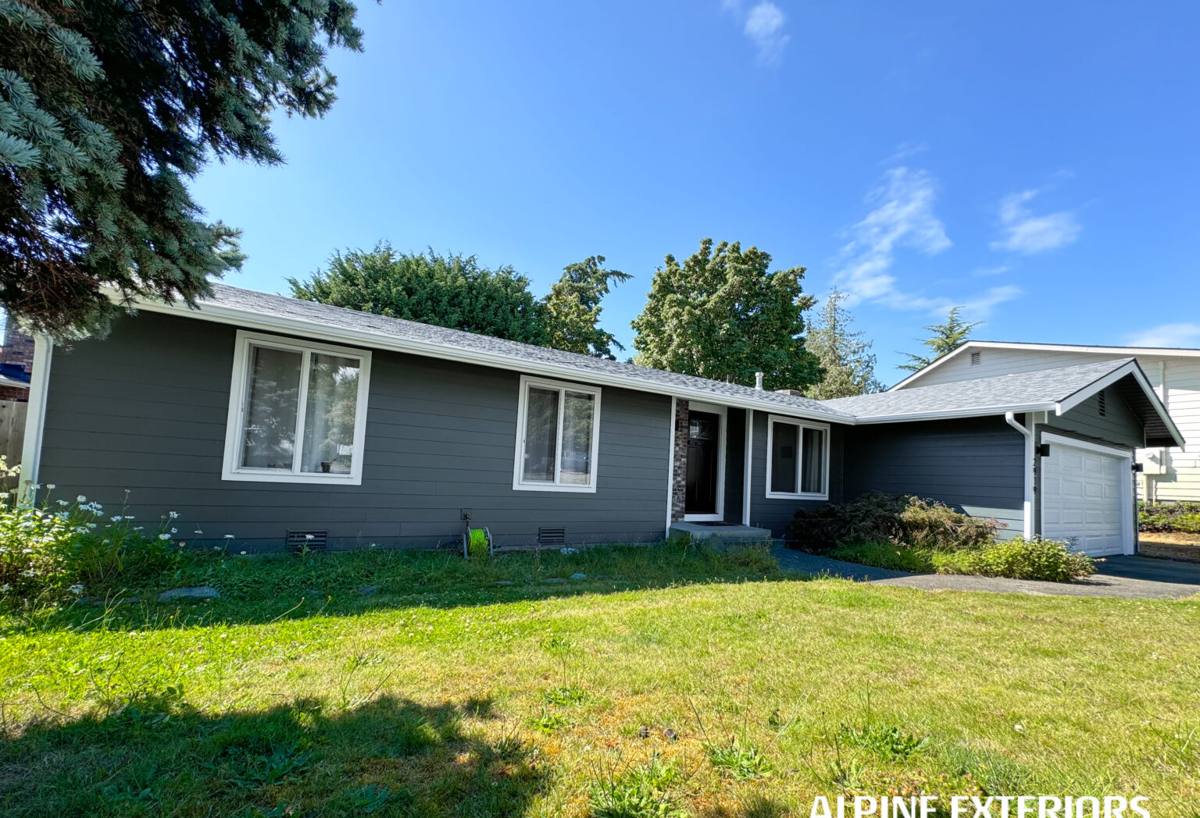
Why We Only Install James Hardie Fiber Cement
We install James Hardie fiber cement siding exclusively. We don't install vinyl, LP SmartSide, Cemplank, Allura, primed spruce, or cedar. That's not a marketing position — it's a standard we settled on after years of working on homes in this exact climate.
Fiber cement is cement, sand, and cellulose fiber, and it doesn't absorb and swell the way wood-based products can, and it doesn't expand and contract with temperature the way vinyl does. It's also non-combustible, which matters more every wildfire season in this part of the state. James Hardie's HZ5 product line is engineered specifically for climates like ours — cold, wet, and humid for long stretches of the year — and it comes with a factory-applied ColorPlus finish that's baked on under controlled conditions rather than field-painted, which is one of the biggest reasons Hardie siding holds its color and its seal against moisture longer than most alternatives.
We'll walk through the trade-offs of other materials later in this page, because we think homeowners deserve the honest comparison rather than just a company telling them what to buy. But the short version: in a neighborhood dealing with salt air, driving rain, and a long moss season, we don't think it's responsible to install anything else.
What a Correct Siding Installation Actually Involves
Siding failures in this climate are rarely about the siding material itself — they're almost always about what's underneath it, or how it was fastened, flashed, and gapped. A beautiful installation with the wrong details behind it will still let water into the wall.
Water-Resistive Barrier
Every wall gets a weather-resistive barrier installed correctly, lapped shingle-style so water sheds downward and never runs behind a seam. On older Sehome homes we're often replacing an original barrier that's decades past its intended service life, sometimes torn or improperly lapped from a prior remodel.
Flashing at Every Penetration
Windows, doors, hose bibs, light fixtures, deck ledgers — every place something interrupts the siding plane is a place water wants to get in. Proper flashing, integrated with the water-resistive barrier in the correct shingle-lap order, is what actually keeps a home dry, far more than the siding panel itself.
Fastening and Clearances
James Hardie specifies exact fastener types, spacing, and placement, and those specs exist for a reason — get them wrong and you risk cracking, blow-off in wind, or moisture wicking into the fastener holes. We also hold the siding's bottom edge above grade, decks, patios, and roof lines by the manufacturer's minimum clearances, which matters more in a climate where standing water and splash-back are a near-constant reality.
Caulking and Joint Treatment
Butt joints, trim intersections, and penetrations get treated with the right sealants — not painter's caulk that will fail in a season or two, but products rated for the movement and moisture exposure Whatcom County walls actually see.
Our Installation Process, Step by Step
Homeowners in Sehome are usually replacing existing siding rather than starting from bare sheathing, so our process is built around finding out what's really going on behind the old material before we commit to a plan.
- Inspection and tear-off assessment. We look at the existing siding, trim, and — once we open a section up — the sheathing and water-resistive barrier underneath. This is where hidden rot or old moisture damage usually surfaces.
- Sheathing repair. Any damaged or soft sheathing gets replaced before anything new goes up. Siding over compromised sheathing just buries a problem.
- Water-resistive barrier and flashing. New barrier goes on correctly lapped, and every window, door, and penetration gets flashed to manufacturer and code specifications.
- James Hardie installation. Panels, lap siding, or shingle siding go up per Hardie's fastening schedule, with correct clearances at grade, roof lines, and decks.
- Trim, caulking, and touch-up. Trim is installed, joints are sealed with the right products, and any factory-finish touch-up is done with Hardie's matched ColorPlus touch-up formulation.
- Final walkthrough. We go over the finished work with the homeowner and point out anything they should know for long-term care.
Signs a Sehome Home Needs New Siding
Because so much siding damage in this climate happens behind the surface, it's worth knowing what to look for before a small problem becomes a structural one.
- Soft or spongy spots when you press on siding, especially near the bottom courses or under windows
- Persistent moss or algae growth that comes back within weeks of cleaning
- Visible warping, cupping, or gaps between boards
- Peeling or bubbling paint, particularly on wood or engineered wood siding
- Musty smells or visible staining on interior walls that back up to exterior siding
- Siding that's noticeably colder or damper to the touch on shaded, tree-covered walls
- Cracked or missing caulk at trim joints and window edges
If a home is showing more than one or two of these, it's usually worth a professional look before deciding whether repair or full replacement makes sense.
Comparing Siding Materials for This Climate
We get asked often enough why we won't install certain popular products that it's worth laying out the honest comparison. Every material below has genuine strengths — this is about how each one holds up specifically under Whatcom County's wet, mossy, salt-air conditions over the long run.
| Material | Moisture Resistance | Salt Air / Coastal Durability | Maintenance Burden | Typical Lifespan Here |
|---|---|---|---|---|
| James Hardie fiber cement | Excellent — doesn't absorb or swell | Strong, factory-sealed finish | Low — occasional wash | 30-50+ years with correct install |
| Vinyl | Sheds water but can warp/crack in cold | Can fade and become brittle over time | Low, but limited repair options | 20-30 years, shorter if damaged |
| LP SmartSide (engineered wood) | Vulnerable at cut edges and seams if not perfectly sealed | Moderate — sensitive to sustained moisture | Moderate — edge sealing upkeep | 20-30 years, install-dependent |
| Cedar | Absorbs moisture, prone to rot in shaded/wet areas | Weathers unevenly near salt air | High — regular sealing/staining | 15-25 years without diligent upkeep |
The pattern that matters most for this neighborhood: products that rely on a field-sealed surface or an absorbent core need near-perfect ongoing maintenance to perform well in a climate this wet. Fiber cement's factory finish and non-organic composition removes a lot of that risk from the homeowner's plate.
What Siding Installation Costs Depend On
We don't publish flat prices because every home is different, but the real cost drivers on a Sehome siding project are fairly consistent.
| Factor | Why It Matters |
|---|---|
| Home size and wall complexity | More corners, gables, and dormers mean more cutting, flashing, and labor |
| Condition of existing sheathing | Rot or moisture damage found during tear-off adds repair scope |
| Siding profile chosen | Lap, shingle, and panel styles from James Hardie carry different material and labor costs |
| Trim and accessory work | Window and corner trim, soffit, and fascia work often gets bundled with a siding job |
| Access and site conditions | Hillside lots, tight setbacks, and mature landscaping can affect staging and labor time |
We give every homeowner a written, itemized estimate after an in-person inspection, so there are no guesses about what's driving the number.
Caring for Hardie Siding After Installation
One of the practical advantages of switching to fiber cement in this climate is how little ongoing care it actually needs compared to wood-based or vinyl siding. A yearly rinse with a garden hose or low-pressure wash removes the moss spores and organic buildup that Whatcom County's damp, shaded conditions tend to produce. Keep an eye on caulk lines at trim and window joints and have any cracked or gapped sections resealed before winter rains set in. Trim back vegetation that's holding moisture against the siding, and if a section is ever damaged — say, by a fallen branch — it can be repaired locally without having to reside an entire wall. None of this is intensive work, which is part of the point.
Why Hire a Crew That Already Works in Sehome
Siding installation isn't just about knowing James Hardie's fastening specs — it's about knowing how this specific neighborhood's homes tend to be built, what their common trouble spots are, and how the local climate actually behaves through the seasons. A crew that already works in and around Sehome has seen how these homes hold up over time, which shaded walls tend to stay damp longest, and where older construction is most likely to be hiding moisture issues behind the siding. That local familiarity shows up in faster, more accurate inspections and fewer surprises once tear-off starts.
It also matters for accountability. A contractor based in and working around Bellingham and Whatcom County has a reputation in the community to protect and is easy to reach if a question comes up years down the line — not a crew that showed up from out of the area for one job and moved on.
If your Sehome home's siding is showing its age, or you're planning ahead for a replacement, we're happy to take a look and walk you through what we're seeing. Reach out for a free, no-pressure estimate using the form below.