 Bellingham
 Birch Bay Asks More of Siding Than an Inland Bellingham Lot
Birch Bay sits right on the water, and that changes the math on siding. A house a few miles inland in Bellingham deals with Whatcom County's rain and gray stretches, but it's not sitting in a steady drift of salt-laden air coming off the bay. Salt is hygroscopic — it pulls moisture out of the air and holds it against whatever surface it lands on. On siding, that means more time spent damp, faster breakdown of paint films, and accelerated corrosion on anything metal: nail heads, flashing, trim fasteners. Add driving rain that comes in sideways during winter storms, plus a shaded, damp lot that never fully dries out and grows moss on the north and west walls for months at a stretch, and you've got three separate stressors working on the same siding at once.
None of that means Birch Bay homes need exotic materials. It means the materials and the installation details have to be right for the exposure, not just "typical Western Washington." A lot of siding problems we see in coastal Whatcom County neighborhoods aren't caused by bad products — they're caused by a normal product installed as if it were going on a sheltered inland lot.
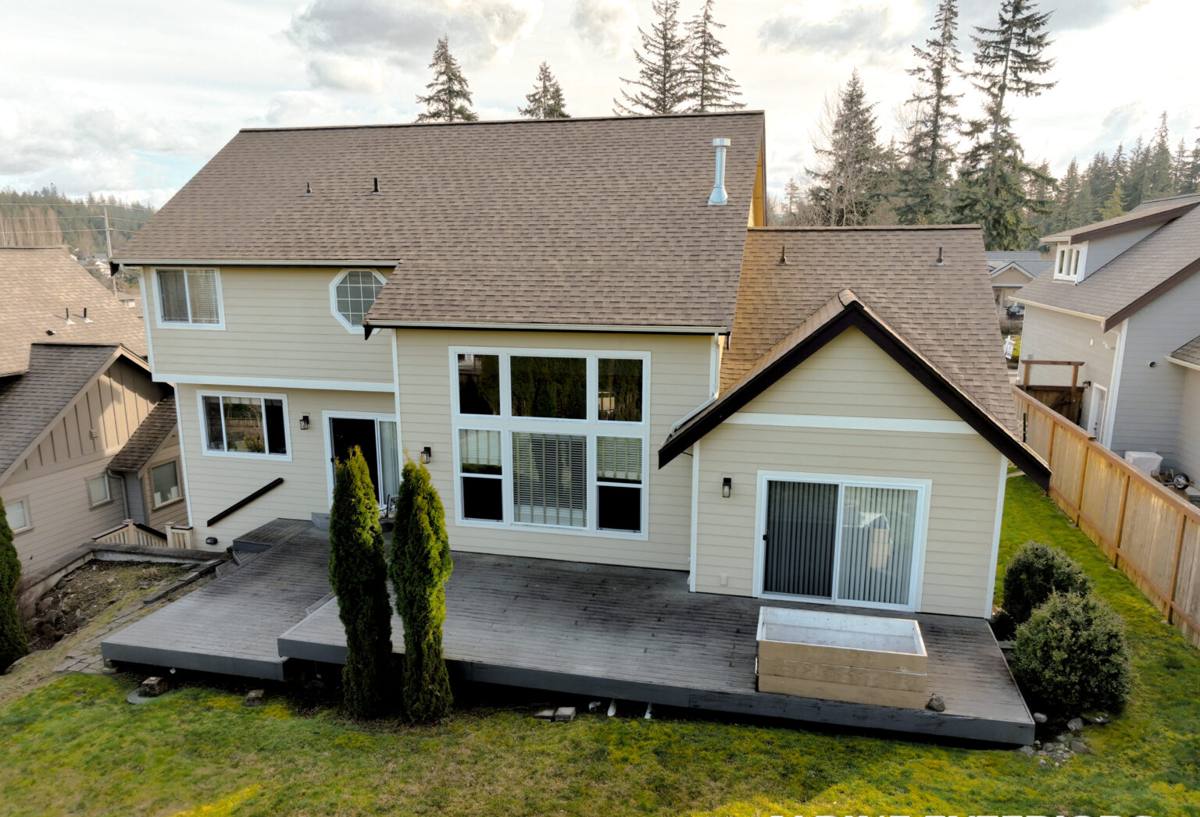
What "Correct" Siding Replacement Actually Involves
Siding replacement is not swap-the-boards-and-caulk-the-gaps. Done right, it's a full envelope job, and most of the value is in layers you never see once it's finished.
Tear-Off and Substrate Check
We remove the old siding down to the sheathing and actually look at what's underneath before covering it back up. This is the point where hidden rot, soft sheathing, or old water staining gets found — and it's far cheaper to deal with during a siding job than to discover later through a wall failure. On a waterfront-adjacent property, we're specifically checking for moisture intrusion around old trim, window flanges, and anywhere the original install skimped on flashing.
Weather-Resistive Barrier and Drainage Plane
A new weather-resistive barrier (WRB) goes over the sheathing, lapped correctly at every seam, with all penetrations — pipes, vents, hose bibs, electrical — properly flashed and sealed before a single piece of siding goes up. Behind the siding itself, a drainage gap lets any water that does get past the cladding drain out and lets the wall assembly dry rather than stay wet. On a lot exposed to wind-driven rain, this drainage plane is doing real work, not just checking a code box.
Flashing at Every Transition
Windows, doors, deck ledgers, roof-to-wall junctions, and horizontal trim boards are the places water finds its way in. Each of those needs metal or membrane flashing detailed so water sheds outward, never behind the cladding. This is the single most common place we find shortcuts in older installs, and it's the reason a house can look fine from the street while quietly rotting behind the trim.
Fastening and Fastener Choice
In a salt-air environment, fastener material matters. Siding gets face-nailed or blind-nailed with corrosion-resistant fasteners, at the pattern and spacing the manufacturer specifies — not "whatever's in the gun." Under-driven or over-driven nails, or the wrong fastener metal, are a slow-motion failure that shows up as streaking and loosening years down the road.
Why We Install Only James Hardie Fiber Cement
We standardized on James Hardie fiber cement siding and don't install vinyl, LP SmartSide, Cemplank, Allura, or raw wood siding like primed spruce or cedar. That's not a marketing position — it's a decision based on what holds up under repeated wet-dry cycling, salt exposure, and the maintenance reality of coastal Whatcom County.
Vinyl is lightweight and inexpensive, and in a sheltered inland yard it can perform acceptably for years. On an exposed Birch Bay lot, wind-driven rain finds every seam and gap in a vinyl panel system, and repeated cold snaps followed by wind events can make vinyl brittle and prone to cracking or blowing off at the very moment you need your envelope intact. Engineered wood products like LP SmartSide use real wood fiber with a resin binder — a reasonable product, but wood fiber is still an organic material, and organic material in a moss-prone, high-moisture microclimate is fighting biology as well as weather. Fiber cement competitors to Hardie exist, but factory finish quality, engineering for specific climate zones, and warranty structure vary product to product, and we only stand behind the one we've vetted.
Fiber cement itself is sand, cement, and cellulose fiber, cured into a dense, non-combustible board. It doesn't feed moss and mildew the way wood fibers can, it doesn't go brittle in cold wind the way vinyl can, and it holds a factory finish far longer than field-painted materials because the finish is baked on under controlled conditions rather than applied on a job site at the mercy of weather.
ColorPlus Factory Finish
Hardie's ColorPlus finish is applied and cured in a factory, not brushed or sprayed on site. That matters directly for salt-air exposure: a factory-baked finish resists the fading, chalking, and moisture penetration that field-applied paint struggles with, especially on a wall that stays damp longer than average because of onshore air and shade. It also means touch-up and caulk matching is simpler over the life of the siding, since the color system is standardized rather than mixed on site.
Matching the Right Hardie Line to a Coastal Lot
James Hardie makes climate-engineered product lines, and picking the right one is part of doing the job correctly rather than just picking whatever's in stock. Hardie's HZ5 formulation is engineered for cold, wet climates like ours — it's built to resist the freeze-thaw and moisture cycling that a marine climate like Whatcom County delivers all winter. That's the line we spec for Birch Bay and the rest of our Bellingham-area service area. HZ10, by contrast, is Hardie's formulation for hot, humid climates and isn't the right call here.
Beyond the climate formulation, there's a choice of profile — lap siding, board and batten, shingle-style panels — and each has slightly different exposure behavior and maintenance needs. We walk through those options with the specific house, not a one-size answer.
| Siding Option | Coastal/Salt-Air Behavior | Maintenance Reality |
|---|---|---|
| James Hardie fiber cement (HZ5) | Engineered for cold, wet marine climates; resists moisture cycling and holds factory finish | Periodic wash-down; caulk checks; no repainting for years |
| Vinyl siding | Seams and panel gaps are vulnerable to wind-driven rain; can become brittle in cold wind events | Low upkeep but prone to cracking, warping, and fading over time |
| Engineered wood (LP SmartSide) | Organic wood fiber base is more susceptible to moisture and moss in shaded, damp microclimates | Field-applied finish needs more frequent attention; edge sealing is critical |
| Cedar or primed spruce | Natural wood movement and moisture absorption are amplified by salt air and constant dampness | Regular refinishing, sealing, and moss/mildew treatment required |
Our Process, Start to Finish
We keep the process straightforward because homeowners are usually living in the house the whole time we're working on it.
- On-site assessment: we walk the exterior, check current siding condition, look at trim, flashing, and any visible moisture signs, and talk through what the house actually needs.
- Written estimate: a clear scope and price, including which Hardie profile and HZ5 color line fits the house and the exposure.
- Tear-off and substrate inspection: old siding comes off, sheathing gets checked, and any repairs needed get flagged before we move forward.
- WRB, flashing, and drainage plane installation: the parts of the job that determine whether the wall stays dry for the next 30-plus years.
- Hardie installation to manufacturer spec: correct fastener type and pattern, correct clearances, correct joint treatment.
- Final walkthrough: we go over the finished work with the homeowner before calling the job done.
What a Correct Install Should Include
- Full tear-off to bare sheathing, not siding-over-siding
- New weather-resistive barrier with properly lapped seams
- Flashing at every window, door, and horizontal trim transition
- A functioning drainage gap behind the cladding
- Manufacturer-specified fastener type, spacing, and depth
- HZ5-rated Hardie product matched to our climate zone
- Factory ColorPlus finish rather than field-applied paint
- A final walkthrough where issues get addressed before, not after, you're told the job is complete
What Drives the Cost of a Birch Bay Siding Job
Every house is different, but the same handful of factors move the price up or down on most siding replacement jobs in this area.
| Cost Factor | Why It Matters in Birch Bay |
|---|---|
| Substrate condition | Hidden rot from long-term moisture or salt exposure means added repair before new siding can go on |
| Wall complexity | Multiple gables, dormers, and trim details mean more flashing and cutting labor |
| Siding profile chosen | Lap, board-and-batten, and shingle-style panels differ in material and labor cost |
| Access and site conditions | Waterfront lots, slopes, and limited staging space can affect scaffolding and logistics |
| Trim and detail work | Window and door trim, corner treatments, and fascia detailing add time beyond flat wall area |
| Existing damage scope | The more moisture damage found at tear-off, the more repair work is folded into the project |
We give a firm written estimate after the on-site walk, not a phone-quote guess, because the substrate condition genuinely isn't visible until the old siding is off in some cases.
Signs a Birch Bay Home Needs Replacement Rather Than Repair
Not every siding problem means a full tear-off. But a few signs usually point toward replacement rather than patching:
- Soft or spongy spots when you press on the siding, especially near the bottom edge or around windows
- Persistent moss or algae growth that comes back within weeks of cleaning, particularly on shaded or north-facing walls
- Visible cracking, warping, or bowing across multiple boards rather than one isolated piece
- Paint that's failing widely — peeling, bubbling, or chalking — rather than in one weathered patch
- Interior signs like musty smells, staining, or soft drywall near exterior walls, which point to moisture already getting through
- Siding that's original to a home built more than 20-25 years ago and has never been fully replaced
A single damaged board can often be repaired. Widespread issues, or any sign that moisture has already gotten behind the cladding, usually mean the underlying weather barrier has failed and patching won't fix the actual problem.
Why It Matters That We Already Work in Birch Bay
A crew that regularly works Birch Bay and the rest of the Bellingham coastline knows the difference between a lot that's sheltered by trees and one that takes the full brunt of onshore wind. That's not something you learn from a spec sheet — it's something you learn from tearing off siding on enough waterfront and near-waterfront homes to see how salt air, wind-driven rain, and moss actually behave on this stretch of Whatcom County coastline over time.
That local experience shows up in small decisions that add up: which side of the house tends to need extra flashing attention, how much drainage gap actually gets used in a given storm season, where moss reliably comes back if the drainage details aren't right the first time. A crew installing siding here for the first time is making reasonable guesses. A crew that's already done it repeatedly in this exact microclimate is working from what they've actually seen fail and what's actually held up.
If your Birch Bay home's siding is showing its age, or you're just weighing options before it becomes an urgent problem, we're happy to take a look and talk through what your specific house needs. The estimate is free, there's no pressure, and you'll get a straight answer about whether you're looking at repair or replacement.