 Bellingham
 Siding Replacement on Bellingham's South Hill
South Hill sits above downtown Bellingham on rising ground that catches wind and weather differently than the flatter neighborhoods below it. The housing stock here runs older on average, many homes built well before modern house wrap and flashing standards were common practice, and a good number sit under mature tree canopy that keeps walls shaded and damp long after a storm has passed through. When siding fails on a South Hill home, it's rarely one thing. It's usually years of driving rain, salt-tinged marine air moving in off Bellingham Bay, and a moss season that barely takes a break, all working steadily on a wall assembly that was never built with today's siding materials or install standards in mind.
This page is specifically about full siding replacement for South Hill homes, not a general repair overview or a citywide service page. If you're weighing a tear-off and complete re-side against a patch job, here's what a correct replacement actually involves in this neighborhood, and why the approach matters as much as the material.
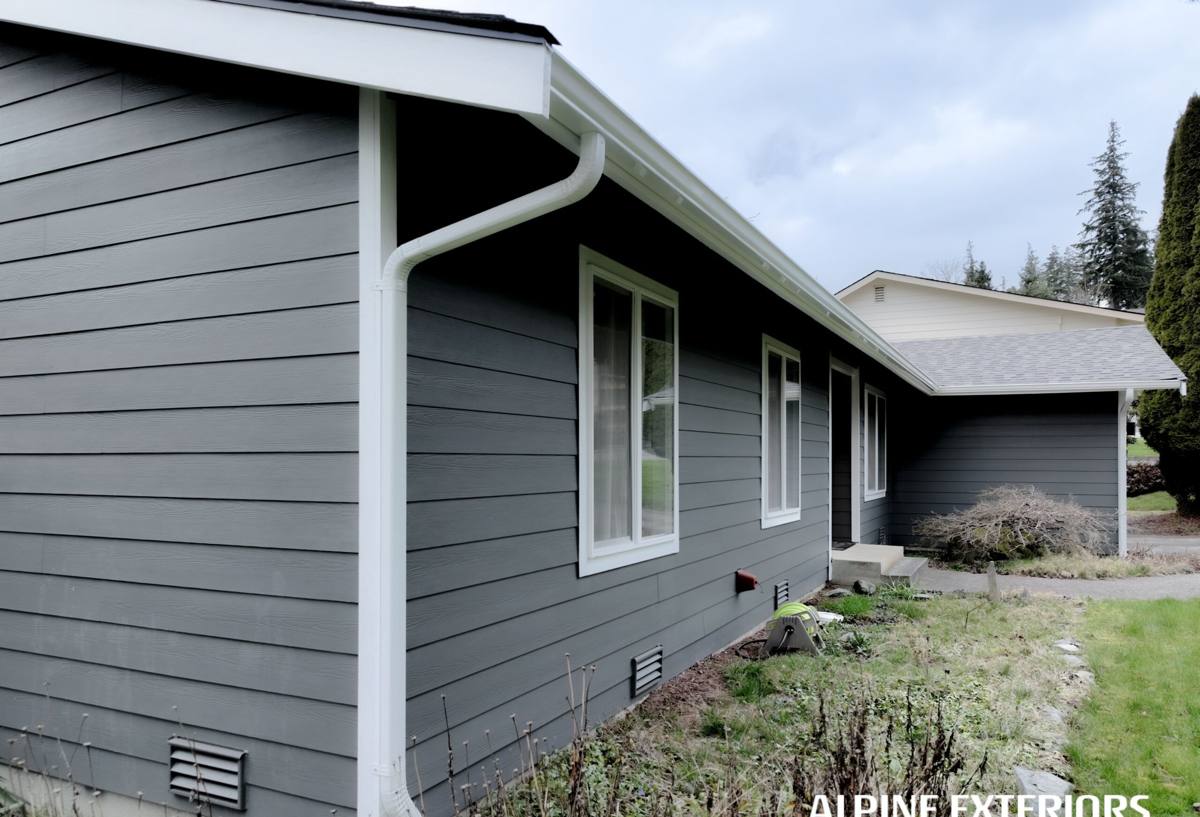
What South Hill's Setting Does to a Wall Assembly
Elevation and Wind Exposure
Higher ground means more direct wind exposure than the more sheltered, lower-lying parts of Bellingham. That wind doesn't just move air past the house, it drives rain sideways into lap joints, trim seams, and any wall penetration that wasn't sealed with real care in the first place. On a hillside lot, exposure can vary sharply from one side of the house to another, so the wall that looks fine from the street can be the one quietly failing on the uphill or windward side where nobody's looking.
Tree Canopy and a Long Moss Season
South Hill's tree cover is part of what gives the neighborhood its character, but shade and sustained dampness are exactly what moss, algae, and mildew need to establish on exterior walls. Combined with Whatcom County's mild, wet climate, north-facing and shaded walls here can stay damp for extended stretches of the year. Any siding material with even slight porosity, or one that holds moisture against the substrate instead of shedding it, becomes a growth surface, and it usually shows up first in the spots nobody checks regularly.
Older Housing Stock, Older Building Practices
Many South Hill homes predate current house wrap, flashing, and drainage-plane standards. That's not a knock on the original builders, it's simply a fact of when the houses went up. In practice it means a siding replacement here often turns up wall assembly issues, missing flashing, undersized overlaps, gaps around old penetrations, that a straightforward repaint or a cheaper overlay job would never expose or correct.
Signs a South Hill Home Needs Full Replacement, Not a Repair
Not every siding problem justifies tearing a house down to the sheathing. But certain signs point toward a wall assembly that's failed broadly enough that patching individual boards just delays a bigger job later:
- Soft or spongy siding in multiple areas, not just one isolated spot
- Moss or dark staining that returns quickly after cleaning across more than one wall
- Visible warping, cupping, or delamination on more than a handful of boards
- Musty odors near interior walls that share an exterior wall with damaged siding
- Original siding on a home built decades ago that's never been fully replaced
- Rot found during a repair attempt that turns out to extend well beyond the original spot
We'll tell you plainly when a repair is genuinely enough. But on a lot of South Hill's older homes, once we're inside the wall assembly, replacement turns out to be the more honest long-term answer, and we'd rather say that up front than sell you a patch that fails again in two years.
What a Correct Siding Replacement Actually Involves
A siding replacement isn't just stripping old boards and nailing up new ones. Done correctly, it's a sequence where each step protects the one behind it, and skipping or rushing any single step undermines the whole system, regardless of how good the siding material itself is.
- Tear-off and inspection: Old siding comes off in sections so we can inspect the sheathing and framing underneath as we go, rather than discovering problems only after the whole wall is exposed.
- Sheathing and framing repair: Any rot, soft spots, or moisture-damaged sheathing gets cut out and replaced before anything new goes back up. Covering damaged sheathing with new siding just hides a problem that keeps getting worse.
- Weather-resistant barrier: A correctly lapped, sealed house wrap goes on before siding, forming the drainage plane that actually keeps wind-driven rain from reaching the sheathing even if some moisture gets past the siding itself.
- Flashing at every penetration: Windows, doors, roof-wall intersections, hose bibs, and vents all need flashing that directs water back out and away from the wall assembly, not the other way around.
- Fastening to manufacturer spec: Correct nail or screw placement, spacing, and depth matter for both wind performance and long-term board integrity. Overdriven or misplaced fasteners are a common source of early failure.
- Trim, joints, and sealant: Butt joints, corners, and trim transitions get detailed to shed water rather than collect it, using sealants rated for the product and this climate.
- Final inspection and cleanup: We walk the finished wall system looking for anything that needs correcting before we call the job done, not after the first hard rain finds it for us.
Why James Hardie for a South Hill Replacement
We install James Hardie fiber cement siding exclusively. We don't offer LP SmartSide, vinyl, Cemplank, Allura, primed spruce, or cedar as alternatives, and on a hillside neighborhood with this much wind, moisture, and tree-shaded moss pressure, that's a deliberate standard rather than an upsell.
- HZ5 formulation: Hardie's HZ5 product line is engineered for regions with heavy sustained moisture and freeze-thaw cycling, which fits South Hill's exposure better than a generic, one-size-fits-all siding spec.
- Factory-applied ColorPlus finish: The color coat cures under controlled factory conditions instead of being brushed on at the job site, which holds up far longer against salt air and UV exposure than field-applied paint.
- Non-combustible core: Fiber cement doesn't feed a fire the way wood-based siding products can, a real consideration for household safety and often for insurance terms as well.
- Dimensional stability: Fiber cement doesn't swell, cup, or warp the way engineered wood siding can after repeated wet-season moisture cycles, which matters on walls that stay damp for extended periods under tree cover.
- Strong transferable warranty: Hardie backs its products with a substantial warranty structure, provided the installation follows spec, which is exactly why we treat install detail as seriously as the material choice.
LP SmartSide, vinyl, and cedar are legitimate products, and other contractors install them competently. Engineered wood is more sensitive to moisture intrusion at cut edges and fastener penetrations than fiber cement is, vinyl can warp or crack and trap moisture behind the panel if house wrap and flashing aren't handled with real care, and cedar requires an ongoing maintenance and sealing schedule that tends to slip in a climate this wet. We made a professional decision that standing behind one system we trust completely serves South Hill homeowners better than offering a cheaper alternative that quietly shifts maintenance risk onto them later.
Our Replacement Process, Start to Finish
We start with an on-site walk-through, not a phone quote. South Hill's hillside lots vary enough in slope, tree cover, and access that pricing off square footage alone would be guesswork. During that visit we look at wall orientation, existing moisture damage, roofline and flashing condition, and site access for staging and material delivery, since some lots need more setup planning than a flat, open yard would.
Once work starts, we protect landscaping and hardscaping before tear-off begins, remove old material in sections rather than stripping the whole house at once, and clean up daily rather than leaving debris to sit through a rain event. On closer-set South Hill lots, we're mindful of staging space and neighboring properties throughout the job, not just on day one. We finish with a walk-through where we point out what was done and why, including anything we found and corrected along the way that wasn't visible before tear-off.
Siding Replacement Cost Factors on South Hill
| Factor | What It Affects | Why It Matters Here |
|---|---|---|
| Sheathing and framing condition | Repair costs uncovered during tear-off | Older South Hill homes with decades-old siding often have hidden moisture damage that only shows once the old material is off |
| Site access and slope | Staging, scaffolding, and labor time | Hillside lots and mature tree cover common on South Hill can add setup and access time compared to flat, open sites |
| Wall complexity and trim | Material and labor total | Older homes often have more dormers, trim detail, and roof intersections where wind-driven rain finds its way in |
| Wind and moisture exposure by elevation | Flashing and detailing time | Higher, more exposed walls on South Hill need the same careful flashing attention as lower, bay-facing lots, sometimes more |
| Color and trim selection | Material cost and finish longevity | ColorPlus factory finishes outlast field-applied paint against sustained salt air and UV exposure |
These are the factors that move a number up or down, not a price list. Real numbers depend on the specific house, which is why we walk the property before quoting rather than pricing off square footage alone.
Roofing, Windows, and Decks Alongside a Siding Replacement
Siding problems on South Hill rarely start with the siding itself. A roof valley shedding water onto a wall below it, a window flashed incorrectly years ago, or a deck ledger board trapping moisture against the house can all surface as siding damage even though the siding is just where the water finally shows itself. Because we also handle roofing, windows, and decks, we can look at a South Hill property as one connected exterior system during a replacement and trace a problem back to its actual source instead of re-siding directly over a leak that's still active underneath.
Why a Local Crew That Knows South Hill Matters
A crew that works this part of Bellingham regularly sees how wind, elevation, and moss actually behave on real South Hill houses across a full year, not just how a product performs on paper. That shows up in practical decisions on tear-off day: which walls have likely been wet the longest, where extra flashing attention pays off on a hillside lot, and which older construction details are worth flagging before they become someone's callback two winters later. South Hill's mix of elevation, tree cover, and older housing stock isn't identical to Bellingham's flatter or newer neighborhoods, and a crew with hands-on experience across both accounts for that instead of treating every job the same way.
If your South Hill home needs a full siding replacement, or you're not sure yet whether it's a replacement or a repair, we're glad to take a look and give you a straight answer. Reach out using the form below to schedule a free, no-pressure estimate.