 Bellingham
 Why Sudden Valley's Setting Changes What a Roof Needs to Do
Sudden Valley sits in a heavily wooded, hillside pocket of Whatcom County along Lake Whatcom, and that setting puts different demands on a roof than a flat lot in town. Mature conifer and deciduous tree cover means most roofs here spend a good part of the year partly shaded, catching needles and leaf litter, and drying out slower after every rain. Add the driving rain and long wet stretches that define a Bellingham winter, and you have a roofing environment where drainage, ventilation, and material choice matter more than they would on an open, sun-exposed roof across town.
A lot of the roofing problems we see on visits out to Sudden Valley trace back to a roof that was designed or installed without accounting for that shade and moisture load — not to a bad roofing material itself. Metal roofing, installed correctly for this specific setting, holds up well against that combination. Installed generically, it can still trap moisture and grow moss just like anything else.
What This Climate Actually Does to a Roof Over Time
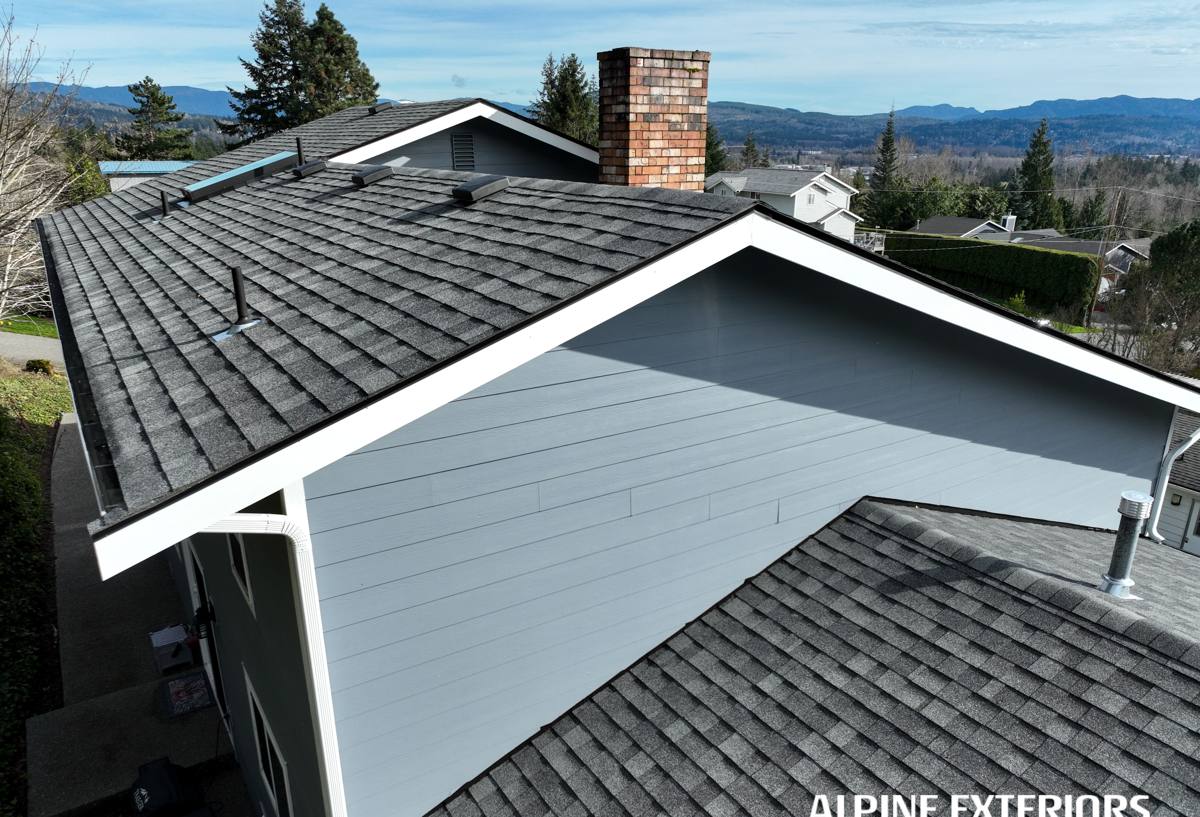
Whatcom County's marine climate brings sustained damp air, driving rain off the water and the surrounding hills, and long stretches where a shaded roof surface may never fully dry between storms. On a wooded lot like most in Sudden Valley, that moisture sits longer on north-facing slopes and under tree canopy, which is exactly where moss, lichen, and algae get a foothold. Over a season or two, that growth holds water against the roof surface, works into seams and fastener points, and accelerates wear on materials that aren't built to shed it.
Salt-bearing air moving through the region is another factor over the life of a metal roof — it's part of why fastener quality, panel coatings, and flashing metal all matter more here than they would inland. None of this is dramatic on its own. It's cumulative. A roof that's a few degrees off in ventilation or a few details short on flashing won't fail in year one — it fails quietly, five or ten years in, usually starting at a valley, a penetration, or a shaded eave.
The Conditions a Sudden Valley Roof Deals With
- Extended shade from tree cover, slowing dry-out time after rain
- Needle, leaf, and debris accumulation in valleys and gutters
- Sustained damp air and driving rain typical of a Whatcom County winter
- Moss and moisture-loving growth on north-facing or shaded slopes
- Hillside lots with steep pitches, multiple planes, and tight access
Standing Seam vs. Exposed-Fastener Metal: Which Fits a Wooded Lot
Both systems are legitimate metal roofing choices, but they behave differently on a shaded, debris-prone property, and that's worth understanding before you pick one.
| Factor | Standing Seam | Exposed-Fastener |
|---|---|---|
| Fastener exposure | Concealed clips, no exposed screws to work loose or leak | Screws penetrate the panel face; gaskets wear and need future re-tightening |
| Moss and debris resistance | Fewer horizontal ledges for debris to catch on | Rib pattern can catch needles and organic debris that holds moisture |
| Upfront cost | Higher material and labor cost | Lower upfront cost |
| Long-term maintenance | Lower — no fasteners to inspect or replace | Higher — fastener gaskets typically need attention over the roof's life |
| Best fit | Heavily shaded, steep, or hard-to-access roofs where you want to minimize return trips | Simpler roof shapes where budget is the deciding factor and access for future maintenance is easy |
For most of the homes we work on in Sudden Valley — steep pitches, shade, and access that isn't always simple — we lean toward standing seam because it needs less from you after installation. That's not a knock on exposed-fastener systems; they're a sound, proven product. It's a judgment call based on what tends to hold up best with the least upkeep on this specific kind of lot.
What a Correct Installation Actually Involves
Metal roofing rewards a careful installation and punishes a rushed one. The panels themselves are durable — most failures we're called out to fix trace back to what's underneath or around them, not the metal itself.
The details that matter most on a shaded, wet-climate roof
- Underlayment: A high-temperature, self-adhered underlayment at eaves, valleys, and penetrations — the areas that hold moisture longest under tree cover.
- Ventilation: Balanced intake and exhaust so moisture-laden air isn't trapped against the underside of the deck, which matters more on roofs that rarely get full sun to dry out.
- Flashing: Properly formed and lapped flashing at every valley, wall intersection, and penetration — the single most common source of leaks we find on any roof, metal or otherwise.
- Fastening: Matched, corrosion-resistant fasteners and clips rated for the panel and coating system, not generic hardware.
- Panel layout: Seams and laps run correctly with the water flow, especially at low-slope sections and valleys where debris tends to collect.
Get these right and a metal roof in this climate can go decades with minimal attention. Get even one wrong — an under-spec'd underlayment, a valley that wasn't detailed properly — and you can end up with a leak under a roof that still looks brand new from the ground.
Living With Moss and Debris on a Wooded Lot
Even a correctly installed metal roof in Sudden Valley will see needle and leaf buildup in valleys and against any obstruction, because that's simply what happens under tree cover. The difference between metal and something like asphalt shingles or wood shake is that metal doesn't give moss and organic growth a rough, absorbent surface to root into. Debris can still sit on top of it and hold moisture against seams or fasteners if it's never cleared, so periodic debris removal and a gutter check are still worth doing — just far less often, and with far less risk, than on a shingle roof in the same spot.
We're straightforward with homeowners about this: metal roofing reduces your moss and moisture workload here, it doesn't eliminate it. Anyone who tells you a roof in this climate is fully maintenance-free isn't being honest with you.
Access and Working on Sudden Valley's Hillside Lots
A lot of Sudden Valley properties sit on sloped terrain with driveways, tree lines, and setbacks that affect how a crew stages material, sets up fall protection, and moves equipment around the house. Steep pitches combined with hillside footing change how a job gets planned — from where a dump trailer or lift can actually park, to how panels get carried to a roof plane that isn't reachable in a straight line from the driveway.
Many homes in the community are also part of an HOA with its own architectural guidelines covering exterior materials, colors, and sometimes roofing profiles. We'd rather flag that up front than have a homeowner find out after ordering material — if your property is under HOA review, it's worth checking their guidelines before finalizing a color or panel style.
How We Approach a Sudden Valley Metal Roofing Job
We start with an on-site look at the actual roof — pitch, tree exposure, existing decking condition, and access — rather than quoting off a satellite photo. From there:
- We walk the roof and attic to check deck condition, existing ventilation, and any trouble spots from moss or past leaks.
- We talk through panel style, gauge, and finish based on your roof's shade exposure and your budget, not a one-size answer.
- We plan staging and access around your specific lot — driveway, slope, and tree clearance — before material shows up.
- We tear off and inspect the deck, replacing any compromised sheathing before a single panel goes on.
- We install underlayment, flashing, and panels in that order of priority, because a roof is only as good as what's under the metal.
- We clean up thoroughly, including a magnetic sweep for stray fasteners around the yard and driveway.
What Drives the Cost of a Metal Roof Here
We're not going to throw out a number that doesn't mean anything without seeing your roof — pitch, size, tearoff scope, and panel choice all move the price. What we can tell you honestly is what tends to drive cost up or down on a project like this:
- Roof complexity: Multiple planes, valleys, and dormers cost more in labor and flashing than a simple gable roof.
- Panel system: Standing seam runs higher than exposed-fastener panels, largely due to labor and concealed-fastener hardware.
- Deck condition: Rot or damage found at tearoff means sheathing replacement, which is priced once we can see it, not guessed beforehand.
- Access: Steep, tree-obstructed, or hillside lots can add labor time for staging and safety setup.
- Coating and gauge: Heavier gauge steel and higher-grade coatings cost more upfront and typically pay that back in reduced maintenance and longer service life.
A metal roof usually costs more upfront than asphalt shingles. Where it tends to even out — sometimes come out ahead — is over the following decades, in fewer replacements and less moss-driven maintenance, particularly on a shaded lot like most in this community.
Why It Matters That We Already Work This Community
A crew that's worked Sudden Valley knows the terrain questions before they come up — how a specific street handles delivery trucks, how HOA review timelines typically run, what a shaded, moss-prone north slope on a hillside lot actually needs versus what a textbook spec sheet says. That's not a substitute for a good installation, but it means fewer surprises, fewer change orders, and a job that's planned around your actual property from the first estimate.
If you're weighing a metal roof for a Sudden Valley home, we're happy to come take a real look and give you a straight, no-pressure estimate — no guesswork, no generic pricing, just what your roof actually needs. Use the form below to get started.