 Bellingham
 Roofing in a Wooded, Lake-Adjacent Community
Sudden Valley sits differently than most Bellingham neighborhoods. The lots are heavily wooded, many homes sit close to Lake Whatcom, and tree canopy covers roofs that would otherwise get a full afternoon of sun. That shade is nice on the deck. It's hard on a roof. Shingles and cedar that stay damp longer, needles and cones that pile up in valleys, and branches that scrape granules loose every windstorm — all of it adds up to a roof that ages differently than one on an open, in-town lot.
Add in what the rest of Whatcom County already deals with — salt-tinged marine air pushing in off the water, driving rain that comes in sideways during winter fronts, and a moss season that can run eight months or more — and you've got a roof that needs more attention than the manufacturer's warranty paperwork suggests. We've repaired enough roofs in and around Sudden Valley to know the difference between a roof that just needs a wash and one that's actually failing underneath.
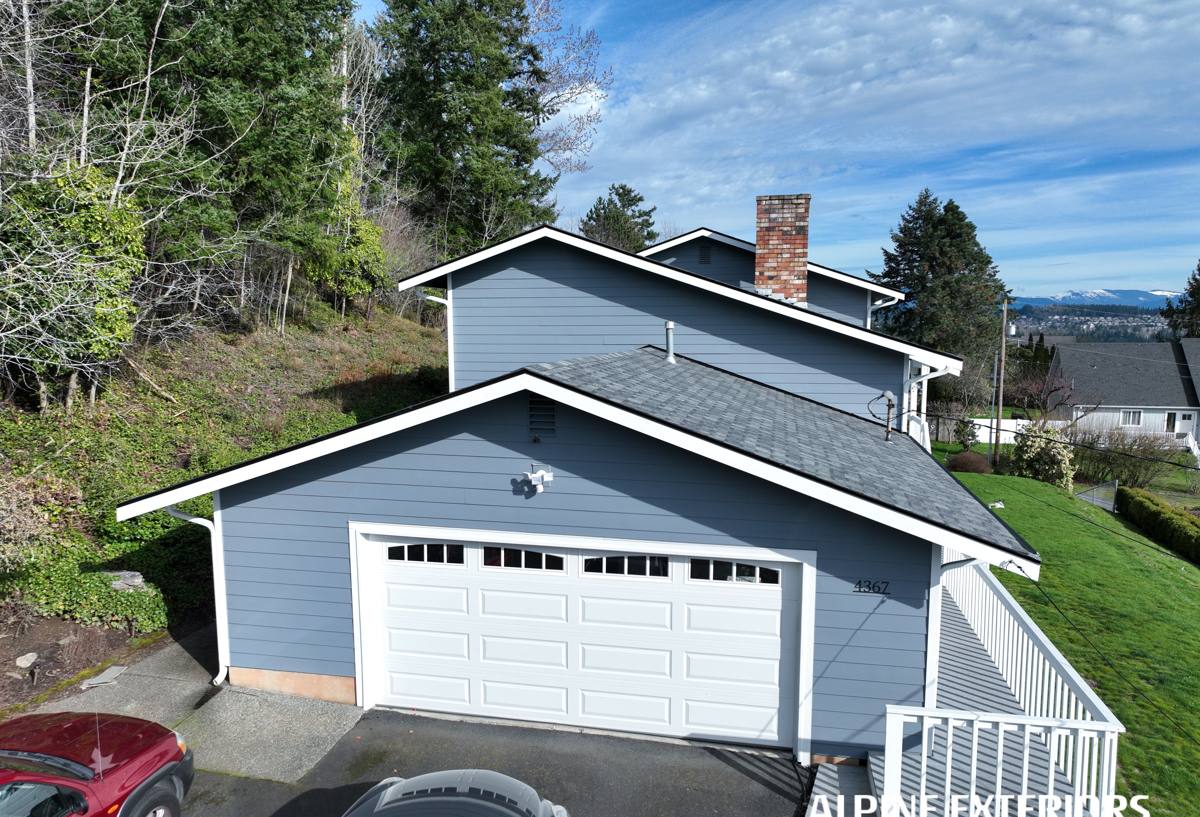
Why Repairs Here Look Different
Shade and Moisture Retention
A roof that dries out fast sheds moss, algae, and rot risk fast. A roof shaded most of the day by fir and cedar doesn't get that chance. Moisture sits in the shingle mat, in the moss itself, and under debris longer than it would on a sun-exposed roof a few miles away in town. That extended dampness is what turns a cosmetic moss patch into lifted shingles and soft decking underneath.
Debris Load
Needles, cones, and leaf litter collect in valleys and behind chimneys faster on a tree-covered lot. Left alone, that debris acts like a dam — water backs up under the shingle courses above it instead of running off, and that's exactly where we find the leaks that started as "just a little moss."
Wind-Driven Rain
Whatcom County storms don't always come straight down. When rain comes in at an angle, it tests every flashing detail on a roof — chimney counterflashing, wall-to-roof transitions, skylight curbs. A roof can be watertight in a light rain and still leak in a driving one if those details were never sealed correctly.
The Roof Problems We Actually Find
Most Sudden Valley repair calls fall into a handful of categories. Knowing which one you're dealing with matters, because the fix — and the cost — is different for each:
- Moss intrusion: moss growing under shingle tabs rather than just on the surface, lifting them and breaking the shingle's seal
- Valley and gutter blockages: needle and debris buildup causing water to back up under shingles instead of draining
- Flashing failure: gaps or corrosion around chimneys, skylights, and roof-wall intersections letting wind-driven rain in
- Damaged or missing shingles: from windthrow, falling branches, or simple age, exposing the underlayment
- Soft or stained decking: a sign water has already been getting through for a while, not just starting
- Fastener and nail pop issues: common on older roofs where seasonal wood movement has worked nails loose
What a Correct Repair Actually Involves
A repair that just covers the visible damage without finding why it happened is a repair you'll pay for twice. Here's what we actually do:
- Find the real source. Water travels before it stains. A ceiling spot in one room can trace back to a flashing gap several feet away. We trace it before we touch a shingle.
- Check the decking, not just the surface. If water's been getting in for a while, the plywood or sheathing underneath may be soft or delaminating. Covering that with new shingles just hides a structural problem.
- Match materials correctly. Shingle color, profile, and weight vary by manufacturer and age. A mismatched patch stands out and can create its own water pathway if the courses don't overlap properly.
- Rebuild flashing details properly. This is where most bad repairs fail — flashing that's caulked over instead of correctly lapped and fastened will leak again within a season or two.
- Address the moss and debris that caused the problem. A repair without a moss treatment plan on a shaded roof is a repair with a return visit already scheduled.
Repair or Replace: How We Help You Decide
Not every damaged roof needs a full tear-off, and not every roof is a good candidate for another round of patches. We walk through this with every homeowner honestly, based on what we actually find:
| Factor | Favors Repair | Favors Replacement |
|---|---|---|
| Roof age | Under 15 years, or a newer product with remaining warranty life | Nearing or past the shingle's rated lifespan |
| Damage location | Isolated area — one valley, one flashing point, a few shingles | Spread across multiple slopes or recurring in different spots |
| Decking condition | Solid, dry sheathing under the damaged area | Soft, stained, or delaminating decking in multiple areas |
| Moss/algae extent | Surface growth, shingles still sealing properly | Moss under the tabs, granule loss, shingles curling or lifting |
| Prior repair history | First repair, or a one-time storm event | Third or fourth repair call on the same roof |
We'll never push a full replacement when a repair genuinely solves the problem — and we'll tell you plainly when a repair is just delaying the inevitable and costing more in the long run.
Materials and Standards We Hold To
On a shaded, moss-prone lot, the materials matter more than the brand name on the wrapper. A few standards we hold to on every repair:
- Ice-and-water shield at valleys and eaves — even outside true ice-dam climates, this self-adhering membrane gives extra protection where debris collects and water pools longest.
- Zinc or copper strips near the ridge on moss-prone slopes — rainwater carrying trace metal ions across the roof slows moss regrowth without chemical treatments that need reapplying every year.
- Metal flashing over caulk-only fixes — caulk fails under UV and temperature swings; properly formed and lapped metal flashing doesn't rely on adhesive to stay watertight.
- Matched-weight shingles — we source shingles that match the existing roof's exposure and profile so a repair doesn't leave a visible or functional mismatch.
We don't cut corners with cheaper underlayment or skip flashing rebuilds to save an hour of labor — those shortcuts are exactly what turns a $400 repair into a $4,000 one two winters later.
Our Process, Start to Finish
Homeowners in Sudden Valley deal with longer driveways, gated or private roads in some sections, and trees close to the house — all things we plan for before a crew shows up.
- Initial contact and scheduling. We ask about access, gate codes or HOA notification if applicable, and get a rough sense of the issue.
- On-site inspection. We get on the roof, not just look from the ground — moss and flashing problems are rarely visible from the driveway.
- Written estimate. Clear scope, clear price, no vague line items. We explain what we found and why we're recommending what we're recommending.
- The repair itself. Done to the same standard as new-roof work — proper flashing, correct fastening, matched materials — not a patch-and-hope job.
- Cleanup and debris removal. Old shingles, nails, and moss debris hauled off — nothing left in the yard or gutters for you to deal with.
- Walkthrough. We show you what was done and what to watch for going forward.
Maintenance That Actually Extends a Sudden Valley Roof
Between repairs, a few habits make a real difference on a shaded, tree-lined lot:
- Clear gutters and valleys of needles and debris at least twice a year — more often under heavy conifer cover
- Trim back branches that overhang or touch the roofline to cut down on scraping and shade
- Have moss treated before it spreads under the shingle tabs, not after shingles start lifting
- Check attic ventilation — poor airflow traps moisture and accelerates decking rot from the inside
- After any major windstorm, do a visual check (or have us do one) for lifted or missing shingles before the next rain
Why Local Experience with This Neighborhood Matters
A crew that's worked Sudden Valley knows the tree cover changes the calculus on moss and debris, knows the terrain and access can mean different equipment or staging than a flat in-town lot, and isn't guessing at what "normal wear" looks like on a heavily shaded roof versus a sun-exposed one across town. That experience shows up in faster, more accurate diagnosis and repairs that hold up through the next wet season instead of needing a second visit.
If you've got a leak, lifted shingles, or a roof that's carrying more moss than it should, we're glad to take a look. Fill out the form below for a free, no-pressure estimate — we'll tell you honestly what we find and what it'll take to fix it right.