 Bellingham
 Why Decks in Sunnyland Wear Out Faster Than You'd Expect
Sunnyland is a well-established residential neighborhood, and a lot of its decks were built years before anyone was thinking about the specific punishment Bellingham weather delivers. Whatcom County sits close enough to salt water that airborne salt is a real factor in corrosion, and the region's long wet season means most decks spend a good chunk of the year damp, shaded, or both. Add in tree cover that's common throughout Sunnyland's older residential streets, and you get the three things that age a deck fastest: moisture that doesn't dry out quickly, fasteners that corrode from the inside, and moss that holds water against the wood surface for months at a time.
Salt Air and Metal Fatigue
Even a few miles inland, salt-laden air corrodes exposed fasteners, joist hangers, and railing hardware faster than it would in a dry climate. This shows up first as rust streaks below screw heads and hanger brackets — often long before the wood itself looks bad. Left alone, corroded hardware loses holding strength quietly, which is part of why deck failures can surprise homeowners who thought the structure "looked fine."
Driving Rain and Hidden Rot
Bellingham's rain doesn't just fall straight down — wind-driven rain gets pushed sideways into ledger connections, under railing posts, and into any gap where flashing wasn't installed correctly the first time. That's the water that causes structural rot, and it's almost always hidden until a board or post gets soft.
Moss Season
Whatcom County's moss season can run from fall through spring. Moss on a deck surface isn't just cosmetic — it holds moisture against the wood fibers continuously, which accelerates decay in exactly the areas that get the least sun: north-facing decks, spots under tree canopy, and the shaded side of railings and stair stringers.
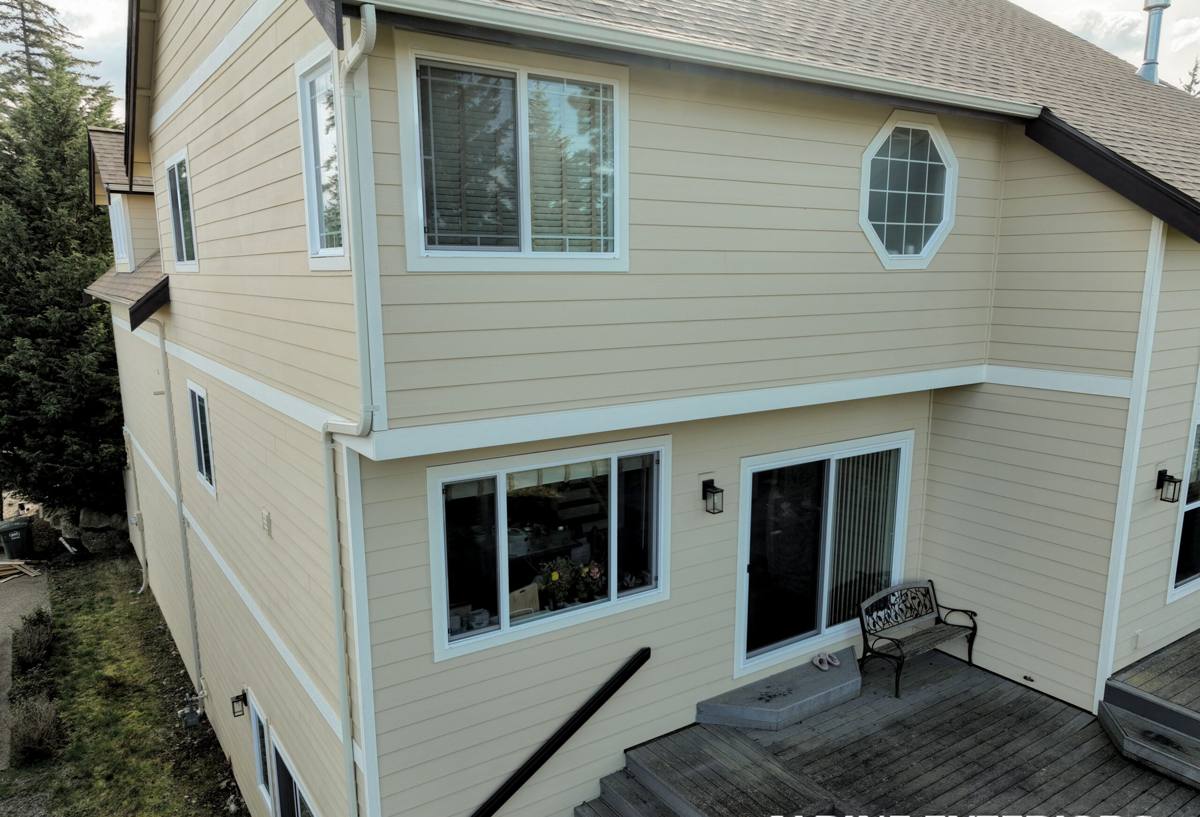
Signs Your Sunnyland Deck Needs Repair
Most deck problems we find in this area didn't start as emergencies — they started as small, ignored details that had months of wet weather to work on them. Here's what we check for, and what you should look for yourself between visits:
- Soft or spongy spots when you press on decking boards, especially near the house or in shaded corners
- Rust streaking below screws, joist hangers, or railing brackets
- Gaps or separation where the deck meets the house (the ledger board connection)
- Railings or posts that flex or wiggle more than they used to
- Green or black staining that keeps coming back within weeks of cleaning
- Stair stringers that feel less solid underfoot, particularly on the shaded side
- Boards that have cupped, split, or pulled away from fasteners
- A musty smell coming from underneath the deck
Any one of these on its own might be minor. Several at once, especially combined with visible moss buildup, usually means water has been getting into the structure for a while.
What a Correct Deck Repair Actually Involves
A repair that just swaps out the board you can see, without checking what's underneath it, tends to fail again within a season or two in this climate. We treat every repair call as a chance to check the parts of the deck that actually determine its lifespan.
Structural Inspection First
Before replacing anything cosmetic, we check the ledger board attachment, the joists, the posts and footings, and the fasteners holding it all together. This is where the real failures happen — not in the decking boards people notice first.
Ledger Board and Flashing
The ledger board — where the deck attaches to the house — is the single most common point of hidden rot in this region, because it's exactly where driving rain gets forced against the building. If flashing is missing, cracked, or was never properly integrated with the house's water barrier, we address that before anything else, since decking repairs on top of a rotting ledger are just cosmetic.
Decking Boards and Framing
We replace individual boards or sections rather than the whole surface when the framing underneath is sound. Matching existing board profiles and fastener patterns keeps the repair from standing out or creating a new weak point.
Railings and Stairs
Loose railings are a safety issue, not just an appearance one. We re-anchor posts into solid framing (not just the decking surface), and check stair stringers for the same rot patterns common on shaded, north-facing stairs.
Fasteners and Hardware
Given how fast corrosion moves in this area, we replace old fasteners and hangers with corrosion-resistant hardware rated for coastal exposure, rather than reusing what's there or matching cheaper hardware that will just rust again.
Repair or Replace? Weighing the Real Cost Factors
Not every deck problem calls for a full rebuild, and not every repair is worth doing on a deck that's structurally past its useful life. Here's how we walk homeowners through that decision:
| Factor | Favors Repair | Favors Replacement |
|---|---|---|
| Framing condition | Joists and posts test solid, only surface boards affected | Joists, posts, or footings show soft spots or rot |
| Ledger board | Intact, properly flashed | Rotted or improperly flashed — often triggers a larger repair anyway |
| Age of structure | Under 15-20 years, built to a reasonable standard | Original construction is decades old with outdated framing methods |
| Extent of damage | Isolated boards, railings, or stair sections | Damage spread across most of the deck's surface and structure |
| Code compliance | Railing height, spacing, and attachment already meet current code | Older railings or stairs don't meet current safety code |
We'll always give you a straight answer on which side of that table your deck falls on — including telling you when a repair is the smarter money even if a full replacement sounds more appealing.
Our Repair Process
The order we work in matters, especially in a climate where a rushed repair can trap moisture instead of resolving it.
- Inspection. We check the deck from the ground up — footings, posts, joists, ledger, decking, railings — and probe any suspect wood rather than guessing from appearance.
- Written plan. You get a clear explanation of what's actually wrong, what needs to happen, and what it costs — before any work starts.
- Repair. We address structural issues first, then decking, then railings and stairs, using corrosion-resistant fasteners throughout.
- Finish and protect. Any new or exposed wood gets properly sealed or finished so it isn't absorbing moisture from day one.
Material Choices That Hold Up Locally
What we repair with depends on what's already there and what the homeowner wants going forward.
Pressure-treated lumber remains a solid, cost-effective choice for framing and structural repairs, provided it's properly sealed and the fasteners are rated for the treatment chemicals used today (older mismatched hardware is a common source of accelerated corrosion). For visible decking boards, composite materials can reduce the moss and moisture maintenance burden compared to wood, though they come with their own installation sensitivities — proper spacing and ventilation underneath matter more with composite than with wood, since trapped moisture behaves differently against these products. We'll walk you through the real maintenance trade-offs for your situation rather than pushing one material as a universal answer.
Keeping a Repaired Deck From Needing Repair Again
A repair is only as good as the maintenance that follows it, especially through a Whatcom County wet season.
- Clean moss and organic debris off the deck surface at least once before winter and once in early spring
- Keep gutters and downspouts clear so runoff isn't draining directly onto or under the deck
- Re-seal or re-stain exposed wood on the schedule the product calls for — sun and rain both break down finishes faster here than in drier climates
- Check railing posts and stair connections for movement once a year
- Trim back vegetation that's keeping sections of the deck shaded and damp
Why a Local Crew Matters for This Kind of Work
Deck repair done right depends on recognizing patterns specific to this area — which framing details fail first in a Bellingham winter, where flashing tends to be missing on houses built in certain eras, and how much moss buildup is normal versus a sign of a bigger moisture problem. A crew that already works in Sunnyland and the surrounding Bellingham neighborhoods has seen these patterns repeatedly and knows what to check without guessing. That familiarity also means fewer surprises mid-project and a repair that's built for the climate it actually has to survive, not a generic fix.
If your deck has soft spots, rusting hardware, stubborn moss, or railings that don't feel as solid as they used to, we're happy to take a look. Fill out the form below for a free, no-pressure estimate — we'll tell you honestly whether you're looking at a repair or something bigger.