 Bellingham
 Sunnyland's Siding Challenge: Rain, Salt Air, and Moss
Sunnyland sits close enough to Bellingham Bay that salt-tinged air reaches the neighborhood on a regular basis, and its mature tree canopy keeps a lot of siding in partial shade for much of the year. That combination — moisture that lingers because it can't dry out quickly, plus airborne salt that accelerates corrosion on fasteners and trim — is a tougher environment for exterior siding than most homeowners realize. It's not dramatic weather that wears siding down here; it's the slow, steady grind of a wet climate that never fully lets a wall dry between rain events.
We work on homes throughout Bellingham and Whatcom County, and Sunnyland is one of the neighborhoods where we see the clearest pattern: siding that was installed without accounting for this specific mix of shade, moisture, and salt air fails years before it should. Siding that was installed correctly, on the other hand, holds up for decades. The difference isn't luck — it's material choice and installation detail.
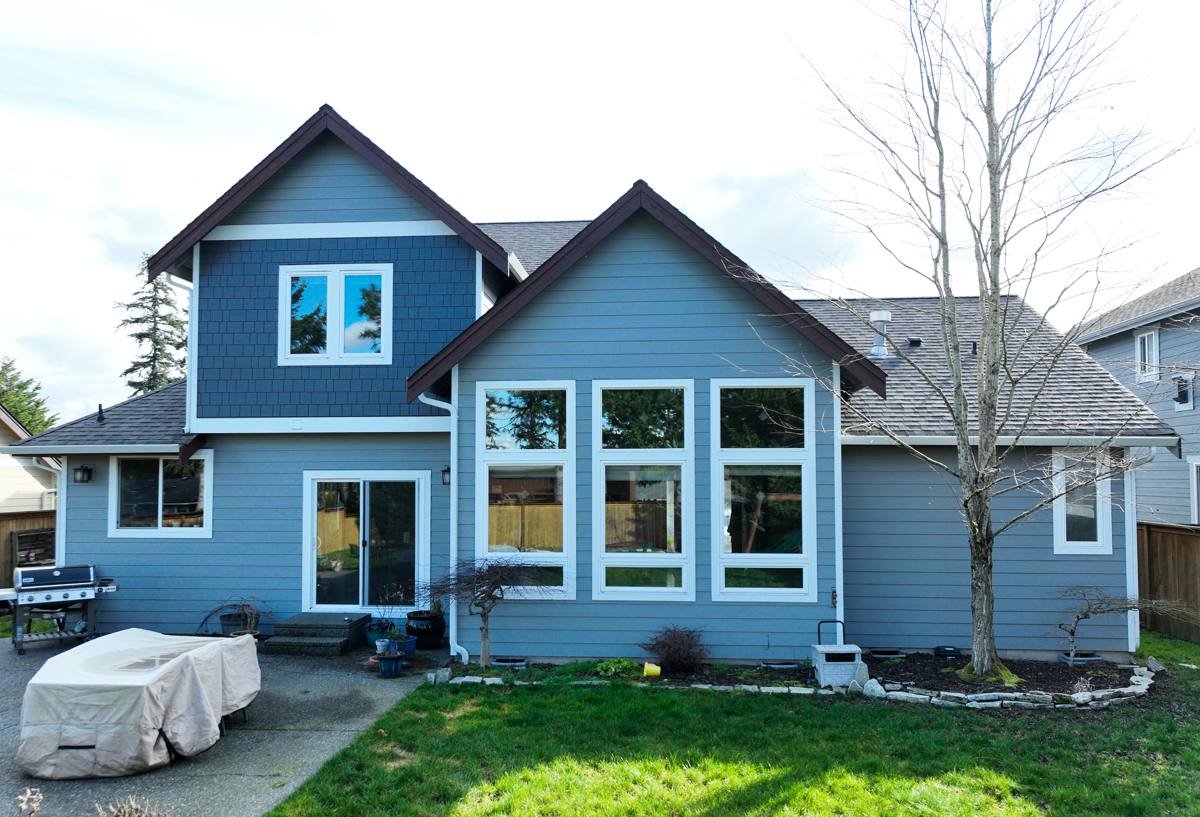
What Whatcom County's Climate Does to Exterior Siding Over Time
Bellingham's siding problems are mostly driven by duration, not intensity. Rain here tends to be steady and wind-driven rather than short and heavy, which pushes moisture sideways into seams, laps, and fastener holes that a drier climate would never test. Add a long fall-through-spring wet season and the moss and algae that come with shaded, damp surfaces, and you get a slow chemical and biological attack on anything that isn't built to shed water and resist organic growth.
On wood-based and engineered-wood siding products, this shows up as swelling at the edges, paint failure, soft spots where moisture has gotten behind the surface, and moss taking hold in the grain itself. On lower-grade or improperly sealed fiber cement, it shows up as caulk failure at joints and water tracking behind panels that weren't flashed correctly. None of this is unique to Sunnyland, but the neighborhood's tree cover and proximity to the water make the effect more pronounced than on an open, sunnier lot.
Why Shade Makes It Worse
A wall that gets direct sun for part of the day dries out between rain events. A wall that stays shaded most of the day — common on lots with mature trees, which describes a lot of Sunnyland — can stay damp for days at a time. That extended damp period is exactly what moss, algae, and rot organisms need to establish themselves, and it's why siding choice and detailing matter more on shaded lots than on exposed ones.
Why Fiber Cement Is the Right Match for This Climate
We install James Hardie fiber cement exclusively, and Sunnyland's conditions are a good illustration of why. Fiber cement is made from cement, sand, and cellulose fiber — it doesn't have the wood grain that gives moisture and organic growth something to hold onto, and it doesn't swell, warp, or delaminate the way wood and wood-composite products can when they take on water repeatedly.
Moisture Behavior
Fiber cement is dimensionally stable when it gets wet. It doesn't expand and contract the way wood-based sidings do, which means the caulk joints and paint film stay intact longer instead of cracking from repeated movement. That matters directly in a climate where the material is wet more often than it's dry.
Non-Combustible
Fiber cement is non-combustible, which is a genuine safety advantage regardless of climate, and one more reason it's the only product we put on homes.
Factory-Applied Finish
James Hardie's ColorPlus finish is baked on at the factory under controlled conditions, rather than field-painted on site. In a climate where field-applied paint has to cure in damp, cool conditions more often than not, a factory finish is a meaningful durability advantage — it resists fading and holds its bond to the substrate better than most site-applied coatings.
What a Correct Fiber Cement Installation Involves
Fiber cement's climate advantages only show up if the installation is done to spec. This is where a lot of siding jobs — on any brand — go wrong. Correct installation for a Whatcom County home includes:
- Using an HZ5 (or equivalent moisture- and freeze-thaw-engineered) product line suited to the Pacific Northwest, not a generic national spec
- Proper clearance gaps between siding and roof lines, decks, and grade so water has somewhere to go
- Correctly lapped and sealed weather-resistant barrier behind the siding, with flashing integrated at every window, door, and penetration
- A drainage plane or rainscreen gap where the wall assembly calls for one, so incidental moisture can drain and the wall can dry
- Fastener patterns and spacing that match the manufacturer's installation instructions, using corrosion-resistant fasteners appropriate for a salt-air environment
- Caulk only where the manufacturer's details call for it — not as a substitute for proper flashing
Skipping any one of these steps doesn't usually cause an obvious problem in year one. It shows up two, five, or ten years later as trapped moisture, rot in the sheathing behind the siding, or premature paint and caulk failure — the exact issues that are hardest and most expensive to fix because they're hidden until the damage is done.
Our Process for a Sunnyland Fiber Cement Job
1. On-Site Assessment
We look at existing siding condition, sheathing, moisture history, tree cover, and sun exposure on the specific lot — Sunnyland lots vary quite a bit in how much shade and airflow they get, and that affects detailing decisions.
2. Tear-Off and Substrate Check
Once old siding is off, we inspect the sheathing for hidden rot or moisture damage before anything new goes up. This step matters everywhere, but it's especially important on older homes where the original siding may have trapped moisture for years without visible signs.
3. Weather Barrier and Flashing
We install and integrate the weather-resistant barrier and flashing at every penetration before the first piece of siding goes on. This is the step that determines whether the wall assembly actually manages water the way it's supposed to.
4. Siding Installation to Manufacturer Spec
Panels and boards go up following James Hardie's published installation instructions — clearances, fastener spacing, and joint treatment included — not shortcuts.
5. Finish and Walkthrough
We do a final detail pass and walk the job with the homeowner before calling it complete.
Comparing Siding Options for a Sunnyland Home
| Factor | James Hardie Fiber Cement | Vinyl | Cedar / Wood | LP SmartSide |
|---|---|---|---|---|
| Moisture resistance | Strong — cement-based, dimensionally stable | Doesn't rot, but can warp and trap moisture behind panels | Absorbs moisture; prone to rot without diligent upkeep | Engineered wood core is moisture-sensitive at cut edges |
| Moss/algae resistance | Good with factory finish; doesn't feed organic growth | Resists organic growth but shows staining | Moss readily takes hold in grain | Vulnerable if finish is compromised |
| Fire performance | Non-combustible | Combustible, can melt/deform | Combustible | Combustible |
| Finish longevity | Factory-baked ColorPlus finish | Color molded in, can fade/chalk | Field-applied paint/stain, needs recoating | Field- or factory-primed, needs paint upkeep |
| Maintenance | Low — periodic wash, repaint on long cycle | Low, but limited repair options if damaged | High — regular sealing/painting required | Moderate — edge sealing and paint upkeep matter |
Keeping Moss and Algae From Undermining Your Siding
Even the right siding, installed correctly, benefits from basic homeowner upkeep in a climate like this. We tell Sunnyland clients to keep an eye on the following:
- Trim back tree limbs and shrubs that keep siding shaded and damp against a wall
- Rinse siding gently once or twice a year, especially on north-facing and shaded walls, to keep moss and algae from establishing
- Check gutters and downspouts before the wet season — overflow running down a wall is one of the most common causes of localized siding damage
- Watch caulk joints around windows and trim for cracking or gaps, and have them addressed before water gets behind the siding
- Keep soil, mulch, and deck boards from contacting siding directly at grade
Why Hiring a Crew That Already Works in Sunnyland Matters
A contractor who works Sunnyland regularly already knows how the neighborhood's tree cover, lot orientation, and closeness to the bay affect a wall assembly, and adjusts detailing accordingly instead of applying a one-size-fits-all approach. That local familiarity also extends to knowing City of Bellingham permitting requirements and inspection expectations, which keeps a project moving instead of stalling on paperwork.
It also means we've seen what happens on other homes in the area — which details hold up and which ones fail early — and we bring that experience to every new job instead of learning it at your expense.
Cost Factors for a Sunnyland Fiber Cement Project
Every home is different, so we don't quote a number until we've assessed the specific job, but the main factors that drive cost on a project like this are:
- Total square footage of siding and the complexity of the home's shape, trim, and rooflines
- Condition of the existing sheathing — hidden rot or moisture damage found during tear-off adds repair work
- Amount of removal and disposal required for the old siding
- Product line, profile, and color selection within the James Hardie lineup
- Site access and staging, which matters on tighter or heavily landscaped Sunnyland lots
In general, fiber cement costs more upfront than vinyl and less than a full high-grade cedar re-side, and its lower long-term maintenance and longer service life are a big part of the value case in a climate this wet.
If you're weighing siding options for a Sunnyland home, we're glad to take a look and give you a straightforward, no-pressure assessment — reach out using the form below to get a free estimate.