 Bellingham
 Storm Damage Roof Repair for Birch Bay's Waterfront Exposure
Birch Bay sits directly on the water in northern Whatcom County, and that location changes what "storm damage" usually means for a roof out here. It's rarely a single dramatic event. More often it's a windstorm that lifts a run of shingles along an exposed ridge, driving rain that gets forced sideways under flashing that was already weakened by a long moss season, or a falling branch that punches through a section of decking that had already been softened by trapped moisture. The damage that shows up after a storm is frequently the last step in a process that started months earlier, not the whole story by itself.
That distinction matters because a repair that only patches the visible hole or the missing shingles, without asking what let the storm in, tends to fail again in the next round of weather. This page covers what a correct storm damage roof repair looks like for a Birch Bay home, how we sort out what's actually storm-related versus pre-existing wear, and how our process works from the first call to a finished repair.
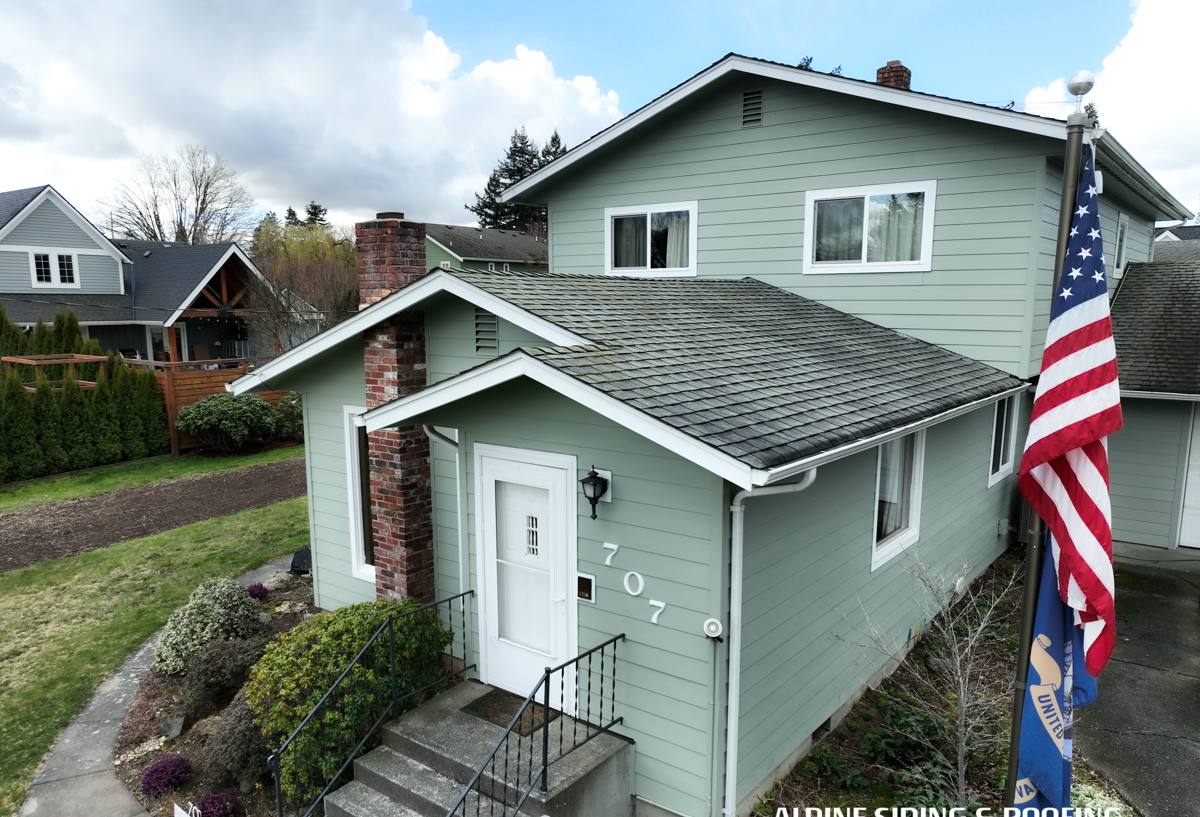
What Actually Causes Storm Damage on This Stretch of Coastline
Wind Off the Bay
Homes set close to open water catch wind loads that inland roofs a few miles away simply don't see. Gusts coming off Birch Bay hit roof edges, ridges, and any shingle that was already lifting at the tab with more force than a sheltered lot would experience. Once wind gets under one shingle edge, it peels outward from there, which is why storm damage often shows up as a spreading patch rather than one isolated spot.
Wind-Driven Rain
Rain during a coastal windstorm rarely falls straight down. It gets pushed sideways and upward into valleys, under flashing laps, and behind siding-to-roof transitions that are built to shed water falling normally, not water being forced in at an angle. A flashing detail that's held up fine for years can suddenly leak the first time a strong enough gust drives rain into it from an unusual direction.
Moss and Trapped Moisture Weakening the Roof First
Birch Bay's long moss season does quiet damage well before any storm arrives. Moss holds moisture against the shingle surface and decking underneath, and that sustained dampness softens wood and degrades adhesive seal strips over time. A roof carrying heavy moss going into a windstorm is starting from a weaker position than a clean one, which is part of why we always look at moss and general roof condition, not just the storm damage itself, during an inspection.
Debris Impact
Tree limbs and wind-blown debris are a real factor on wooded or heavily landscaped Birch Bay lots, and impact damage can range from a few cracked shingles to a full puncture through the decking. Impact damage is usually the easiest kind to spot from the ground, but it's also worth a close look at the surrounding area, since a falling branch can loosen flashing and shingles well beyond the point of direct contact.
Signs Your Birch Bay Roof May Have Storm Damage
- Shingles that are missing, cracked, or visibly lifted at the tab, especially on wind-exposed slopes facing the water
- Granules collecting in gutters or at downspout outlets after a windstorm, beyond normal seasonal shedding
- New water staining on interior ceilings or in the attic, particularly near valleys, chimneys, or roof-to-wall transitions
- Flashing that's visibly bent, lifted, or separated from the roof surface
- Soft spots or sagging when the roof is walked, which can point to a decking issue underneath
- Debris resting on the roof, or visible impact marks from branches or wind-blown material
- Daylight visible through the roof deck from inside the attic
Some of this is obvious from the ground. Some of it isn't, which is why a roof-level inspection after any significant windstorm is worth doing even if nothing looks wrong from the driveway.
What a Correct Storm Damage Repair Involves
Stopping Active Water Intrusion First
If a roof is actively leaking or has an open section of decking exposed, the first priority is temporary protection, not a permanent fix done under pressure. A properly secured tarp or temporary covering keeps water out while a full repair gets planned correctly, rather than rushing a permanent patch that has to be redone once the real scope is understood.
Full Inspection, Not Just the Obvious Damage
A storm rarely damages only the spot that's visible from the ground. We check the full roof plane, not just the area around the reported problem, because wind and impact damage often extends beyond what's immediately obvious, and a repair scoped only to the visible issue tends to miss a second weak point that fails in the next storm.
Checking the Decking, Not Just the Shingles
Where water has gotten in, the plywood or OSB decking underneath needs to be checked for softness or rot, not just covered back over with new shingles. Replacing shingles over damaged decking treats the surface without fixing the structure underneath, and that's a shortcut that shows up again as a leak within a season or two.
Matching Materials Correctly
A patch repair needs to match the existing roof's shingle type, profile, and where possible, color and age-weathering, closely enough that it blends in and performs the same as the surrounding material. On an older roof, an exact match isn't always available, and we'll tell you honestly when that's the case rather than mismatching materials without mentioning it.
Rebuilding Flashing Properly
Storm damage frequently shows up at flashing points — valleys, chimneys, vents, and roof-to-wall transitions — because those are the places already under the most stress from wind-driven rain. A correct repair reintegrates new flashing with the surrounding underlayment and shingle courses as a system, not a bead of caulk laid over a bent piece of metal.
Repair or Replace? How We Make the Call
| Situation | Repair Usually Makes Sense | Replacement Worth Discussing |
|---|---|---|
| Age of roof | Mid-life roof with otherwise sound shingles and decking | Roof already near or past its expected service life |
| Extent of damage | Damage limited to one or two localized areas | Damage spread across multiple slopes or repeated storm events |
| Decking condition | Decking underneath is solid once exposed | Widespread soft spots or rot found during inspection |
| Moss and general wear | Minimal moss, roof otherwise well-maintained | Heavy moss coverage and finish wear beyond the storm damage itself |
| Material availability | Matching shingles still available or close enough to blend | Discontinued product with no reasonable match |
Most storm calls we get on Birch Bay roofs end up being a repair, not a replacement. We'll always give you a straight answer on which category a given roof falls into, along with the reasoning, rather than defaulting to the bigger job.
Materials and Fasteners That Hold Up in This Exposure
A storm repair done with standard hardware can leave a roof more vulnerable the second time around, not less. Because Birch Bay sits directly on saltwater, we pay close attention to what goes into a repair, not just what shingles get used:
- Corrosion-resistant fasteners: Salt-laden marine air accelerates rust on standard nails and screws faster than it does a few miles inland, and a corroding fastener is a future leak point.
- Properly rated flashing metal: Flashing needs to hold up to the same salt exposure as the rest of the roof, not just match on appearance.
- Underlayment rated for wind-driven rain: Where a repair opens up a section of roof, that's an opportunity to upgrade the underlayment underneath to something built for sideways-driven moisture rather than just relying on the shingle layer alone.
- Sealant and adhesive rated for cold, wet application: Storm repairs often happen in less-than-ideal weather, and materials applied outside their rated conditions don't bond the way they're supposed to.
Working With Your Insurance Claim
Many storm damage repairs on Birch Bay homes involve a homeowner's insurance claim, and we're glad to work alongside that process, though we're not the ones who decide what's covered — that's between you and your insurance carrier. What we can do is document what we find clearly: photos of the damage, a written description of scope, and an honest assessment of what's storm-related versus what was pre-existing wear.
That distinction matters to an adjuster, and it matters to you. A roof with heavy moss and worn shingles going into a storm may show combined damage, some of it from the event and some of it from age, and we'll tell you which is which rather than blurring the line either direction. Being straightforward about that tends to make claims go more smoothly, not less, because it holds up to scrutiny.
Our Process From First Call to Finished Repair
- Initial call and triage: We ask what you're seeing and how urgent it is, and get out promptly for active leaks or exposed decking.
- Temporary stabilization if needed: If the roof is actively letting water in, we secure it first so the damage doesn't get worse while a full repair is planned.
- Full roof inspection: We walk the roof and check the attic from inside, looking at the full extent of the damage, not just the reported spot.
- Written estimate: You get a clear, itemized scope covering decking, underlayment, flashing, and shingle work, along with photo documentation useful for an insurance claim if you're filing one.
- Repair work: Damaged decking gets replaced, flashing gets rebuilt as a system, and shingles are matched as closely as the existing roof allows.
- Final walkthrough: We review the completed repair with you and do a site cleanup, including a check for stray fasteners and debris.
Why Hiring a Crew That Already Works Birch Bay Matters
After any significant windstorm, it's common to see unfamiliar crews going door-to-door in hard-hit neighborhoods offering fast repairs. Some of that work is legitimate. Some of it is a rushed job from a crew that won't be reachable a year later if something goes wrong. A contractor with an established, ongoing presence in Whatcom County is one you can actually call back, with a workmanship warranty that means something because the company is still here to honor it.
A crew that already works roofs on this stretch of coastline also knows the specific failure points that come up here repeatedly — where wind-driven rain tends to find flashing weak points, how moss buildup interacts with storm damage, and which roof orientations take the worst of the wind coming off the bay. That's practical knowledge that shows up in how thoroughly a repair gets scoped, not just how fast it gets done.
Questions Worth Asking Before You Hire a Storm Repair Contractor
- Do they inspect the full roof, or just patch the spot you called about?
- Will they check and document decking condition before covering it back up?
- Do they carry current Washington contractor licensing, liability insurance, and workers' compensation?
- Can they provide clear photo documentation useful for an insurance claim?
- Do they have an established, ongoing presence in Whatcom County, not just a temporary post-storm operation?
- Does the estimate distinguish storm damage from pre-existing wear, and explain the difference honestly?
If a recent storm has left your Birch Bay roof with missing shingles, a leak, or damage you're not sure how serious it is, we're glad to take a look and give you an honest, no-pressure assessment. Use the form below to request a free estimate.