 Bellingham
 Building New in Birch Bay Means Building for Wind and Salt First
Birch Bay sits right on the water, which is exactly why people build here — and exactly why the windows going into a new build need more thought than a standard interior-lot install. Salt-laden air off the bay accelerates corrosion on hardware, fasteners, and unprotected metal flashing. Driving rain off Georgia Strait pushes water sideways into wall assemblies during winter storms, not just straight down. And the long moss season that Whatcom County deals with every fall through spring means anything with a horizontal ledge — sills, mulls, trim returns — needs a real plan for shedding water and drying out between storms. On a new-construction project, you get to solve these problems before drywall goes up, which is the cheapest and most permanent time to solve them.
We install new-construction windows on builds throughout Bellingham and Whatcom County, and Birch Bay jobs get treated differently than a job three miles inland. The framing details, flashing sequence, and glass package we recommend all shift once a lot is exposed to open water and prevailing weather.
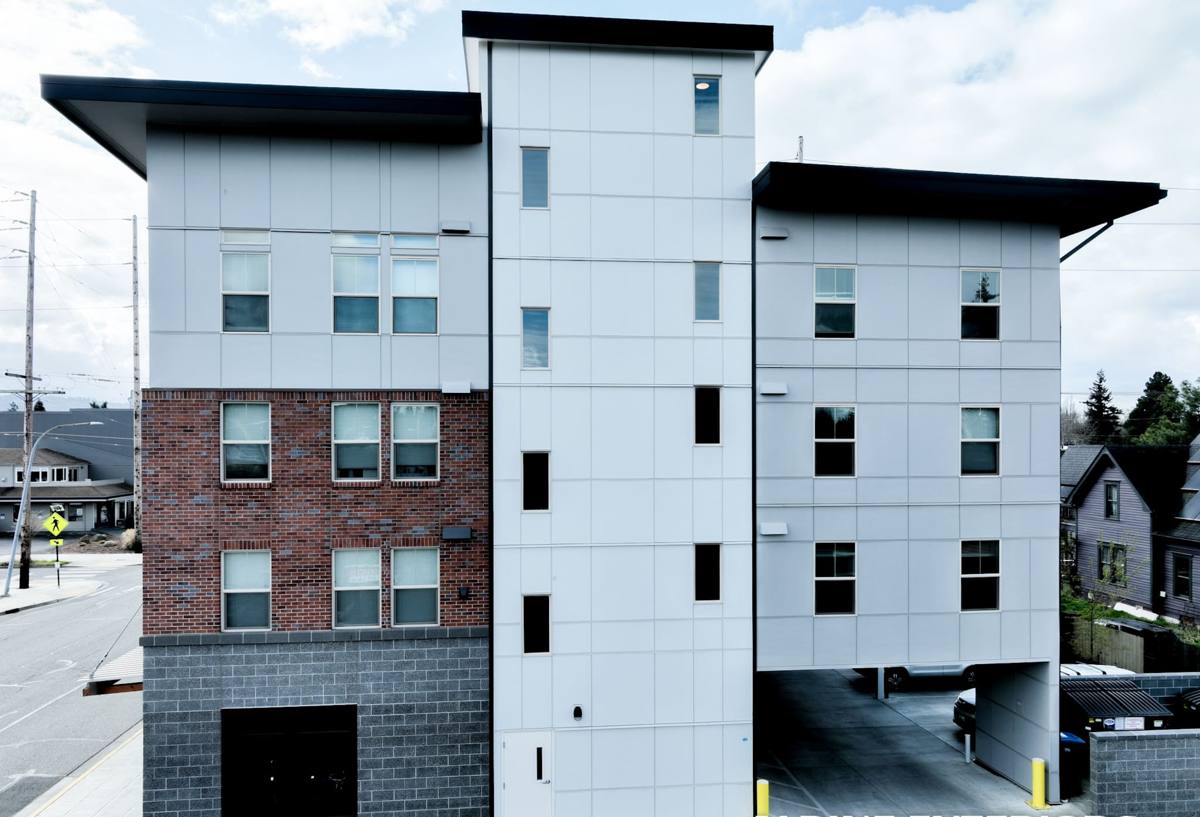
What "New-Construction" Actually Means for a Window Order
New-construction windows have a nailing fin (also called a flange) built into the frame, installed before the exterior siding or stucco goes on. This is different from a replacement or "pocket" window, which gets inserted into an existing opening with the old frame left in place. On a ground-up build or a full addition, new-construction windows are almost always the right call because they let us integrate the window into the wall's water-resistive barrier (WRB) and flashing system as one continuous assembly, rather than working around what's already there.
Why the Distinction Matters in a Coastal Build
The nailing fin is only as good as the flashing detail around it. In a high-exposure spot like Birch Bay, we're not just tacking the fin to the sheathing and calling it done — the sequencing of flashing tape, sill pan, and WRB integration is what actually keeps wind-driven rain out of the wall cavity over the next 20-plus years. A rushed or out-of-sequence install can look fine on day one and still leak in year three.
Window Selection for a Birch Bay Site
Not every window line is built the same way underneath the surface finish, and that matters more here than in a sheltered inland neighborhood. We look at frame material, glass package, and hardware corrosion resistance as three separate decisions.
| Factor | Why It Matters in Birch Bay | What We Look For |
|---|---|---|
| Frame material | Salt air corrodes untreated or low-grade metal components over time | Vinyl or fiberglass frames with marine-grade or stainless hardware; if aluminum-clad, verify the cladding and fastener spec |
| Glass package | Coastal wind loads and driving rain demand a tighter seal and structural rating | Dual-pane low-E glass rated for the wind exposure category of the lot; impact-rated glass where the site calls for it |
| Hardware & weatherstripping | Constant moist air degrades cheap gaskets and locks faster than a dry climate would | Corrosion-resistant hardware, compression-style weatherstripping over cheaper foam strips |
| Sill design | Moss and standing water build up on flat or poorly sloped sills | A sill with real slope and a drainage path, not a flat shelf that holds water |
We don't push a single brand as the answer for every build. What we push is a documented spec sheet for wind rating, water penetration resistance, and structural performance that actually matches your lot's exposure — a builder-grade window rated for a sheltered inland lot is not the same product a bayfront lot needs, even if they look identical in the showroom.
The Flashing and Integration Detail That Actually Prevents Leaks
This is the part of a new-construction window job that nobody sees once the siding is on, and it's the part that determines whether the window performs for 5 years or 30. On every install we follow a shingle-lap sequence, meaning each layer of flashing overlaps the one below it so water is always directed outward and down, never trapped behind a layer that dead-ends into the wall.
Our Sequence, Roughly
- Sill pan flashing installed first, sloped to drain toward the exterior, not flat
- Self-adhered flashing tape at the jambs, lapped over the sill pan
- Window set into the opening, checked for level, plumb, and square before a single fastener goes in
- Head flashing installed last, lapped over the WRB above it so water sheds over the top of the window, not behind it
- Backer rod and sealant at the interior and exterior perimeter, sized to the gap — not overpacked, not skipped
- Final water-management check against the site's WRB layer before siding crews close it in
On a bay-exposed lot, we also pay close attention to the rough opening size relative to the window unit. Too tight and there's no room for proper flashing lap; too loose and you're relying on sealant alone to do a flashing detail's job, which is not a long-term fix in a wind-driven rain climate.
Moss, Algae, and Long-Term Sill Maintenance
Whatcom County's moss season isn't a cosmetic issue — sustained moisture sitting in a sill channel or window track breaks down finishes, holds water against seals longer than it should, and on wood-trimmed installs, can eventually feed rot at the sill. We factor this into the trim detail on new builds: proper slope away from the glass, drip caps above the window where the siding design allows for one, and material choices on any exterior trim that won't wick moisture the way untreated wood can.
None of this eliminates the need for basic homeowner upkeep — clearing debris from sill tracks and weep holes a couple of times a year keeps drainage paths open — but a correctly built sill and flashing system means that maintenance is about tidiness, not about preventing a leak.
How We Work With Your Builder or GC
Most of our new-construction window work in Birch Bay happens in coordination with a general contractor or builder, not as a standalone trade showing up cold. That coordination matters for timing — windows need to go in at the right point in the framing-to-siding sequence, not before the WRB is up and not after siding crews are already staging materials.
What We Typically Handle
- Reviewing the window schedule against the site's wind exposure and orientation
- Confirming rough opening dimensions match the ordered units before they arrive on site
- Installing and flashing each window per manufacturer instructions and our own moisture-management standard
- Documenting the install for warranty purposes, including any wind or water-resistance ratings tied to the specific product
- Walking the GC or homeowner through the finished install and pointing out anything that needs attention before siding closes it in
We're licensed to work throughout Whatcom County, and Birch Bay is close enough to our Bellingham base that scheduling and follow-up visits aren't a logistics problem — which matters if a punch-list item comes up after the siding crew has already moved on.
Cost Factors on a New-Construction Window Package
Pricing on a new build depends on more variables than a simple replacement job, since you're specifying products from scratch rather than matching an existing opening. Broadly, expect the total to move based on:
| Factor | Effect on Cost |
|---|---|
| Number and size of openings | Larger, more numerous windows raise material and labor cost proportionally |
| Frame material | Vinyl is typically the most economical; fiberglass and aluminum-clad options cost more upfront |
| Wind and water rating required | Higher-rated units for exposed lots cost more than standard-rated units for sheltered sites |
| Glass upgrades | Impact-rated or upgraded low-E glass adds cost per unit |
| Site accessibility | Difficult site access or a multi-story build adds labor time |
We give a firm quote after reviewing the actual window schedule and site conditions — there's no honest way to price a new-construction window package off a phone call alone, since the right spec for a bayfront lot and an inland lot in the same subdivision can be genuinely different.
Why Local Experience on This Specific Coastline Matters
A crew that's only worked inland jobs will often spec and flash a window the same way regardless of exposure, because most of their projects don't demand otherwise. Working Birch Bay regularly means we've seen where wind-driven rain actually finds its way into a wall assembly on this stretch of coast, which sill designs hold up to the moss season without extra maintenance, and which hardware choices hold up against salt air over years, not just through the first winter. That's the kind of judgment that doesn't show up on a spec sheet — it comes from doing the work in this specific climate, repeatedly.
If you're planning a new build or addition in Birch Bay, we're happy to walk the site, review your window schedule with your builder, and put together a straightforward, no-pressure estimate — just fill out the form below and we'll follow up.