 Bellingham
 Building a Deck That Actually Holds Up in Blaine
Blaine sits right on the water at the top of Whatcom County, which means every deck built here has to deal with conditions that inland Bellingham neighborhoods barely notice. Salt-laden air off the strait accelerates corrosion on fasteners and hardware. Driving rain off Boundary Bay finds every gap in flashing and decking that isn't detailed correctly. And the long, wet moss season that runs from fall through spring turns a poorly ventilated deck surface into a slip hazard and a slow-motion wood rot problem. A deck built the same way you'd build one in a drier inland climate simply won't last as long here — the materials, fastener grades, and drainage details all need to be chosen with this specific exposure in mind.
We build custom decks for homes throughout the Blaine area with that reality built into every decision, from the footings up to the railing caps.
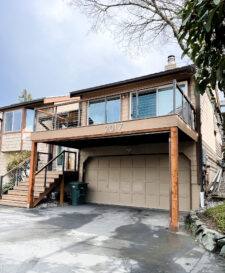
What Blaine's Climate Actually Does to a Deck
Salt air and corrosion
Coastal air carries fine salt particles that settle on exposed metal. Over a few seasons, standard zinc-coated fasteners and connectors can start to weep rust stains into the decking, and in worse cases the metal itself weakens at the joint. This isn't a hypothetical — it's the single biggest difference between building a deck three miles inland and building one near the water in Blaine.
Driving rain and wind-driven moisture
Storms coming off the strait don't just fall straight down — wind pushes rain sideways into ledger connections, under railing posts, and into any seam that isn't properly flashed or sealed. A deck attached to the house needs a ledger flashing detail that assumes rain will hit it horizontally, not just from above.
The long moss season
Shaded decks, north-facing decks, and decks under tree cover in this region can stay damp for months at a stretch. Moss and algae growth isn't just cosmetic — it holds moisture against the decking surface, makes boards slick underfoot, and on wood decking it accelerates surface decay in exactly the spots where people walk most.
Decking Material Choices for This Climate
There's no single "best" decking material for every home — the right choice depends on sun exposure, budget, and how much upkeep you want to take on. Here's how the common options actually perform under Blaine's specific conditions:
| Material | Moisture/Moss Behavior | Maintenance | Typical Lifespan Here |
|---|---|---|---|
| Pressure-treated wood | Absorbs moisture; needs airflow underneath to resist rot and moss buildup | Annual cleaning, periodic sealing/staining | 10–15 years with upkeep |
| Cedar | Naturally rot-resistant but still surface-stains and can host moss in shaded spots | Regular cleaning, periodic oil or sealer | 15–20 years with upkeep |
| Composite decking | Doesn't absorb water like wood, but still needs cleaning where moss and algae can grow on the surface film | Occasional washing, no sealing/staining | 25–30+ years |
| PVC / capped polymer | Fully moisture-resistant board, best resistance to staining and surface mold | Lowest maintenance of the group | 25–30+ years |
We install all of these, but we're honest about trade-offs. Composite and PVC cost more up front and some homeowners prefer the look and feel of real wood — that's a legitimate choice as long as you go in knowing it needs more regular attention in this climate. Whatever material you choose, the framing and drainage underneath matter more to long-term performance than the decking surface itself.
Framing and Hardware: The Part You Don't See
A deck's substructure is where corner-cutting shows up years later as sag, soft spots, or failed connections — and it's where salt air exposure does the most damage if the wrong hardware is used. For coastal-exposed builds we use fasteners and structural connectors rated for corrosive environments, not the standard-grade hardware that's fine three miles inland but starts rusting at the joints near the water within a few years. Joist hangers, ledger bolts, and post bases all get this treatment, because those are the connections holding the whole structure together.
Footings also need to be sized and set to actual local frost and soil conditions, not guessed at. And any ledger board attached to the house gets flashed so wind-driven rain sheds away from the house band joist rather than tracking behind it — that single detail is one of the most common failure points we see on older decks in this area.
What a correctly built deck frame includes
- Corrosion-resistant structural connectors and fasteners at every joist, post, and ledger connection
- Properly flashed ledger board with a drainage gap or self-adhered membrane behind it
- Footings sized to the actual load and set below frost depth for this area
- Joist spacing matched to the decking material's span rating, not a generic default
- Adequate clearance and airflow beneath the deck to let moisture escape rather than pool
Drainage, Airflow, and Fighting Moss Before It Starts
Most moss and slip problems on decks aren't really a decking-material problem — they're a design problem. A deck built tight to grade with no airflow underneath, or oriented so a shaded section never sees direct sun, is going to grow moss regardless of what board you put on top. We plan for this at the design stage: keeping deck height and joist spacing generous enough for ventilation, sloping any solid surfaces so water sheds instead of pooling, and, where a covered or partly shaded deck is unavoidable, choosing a decking profile and gap spacing that lets water drain through rather than sit on the surface.
For decks that see heavy shade for most of the day — common on lots with mature trees or homes close to their neighbors — we'll talk through realistic moss expectations up front rather than promise a maintenance-free surface that doesn't exist in this climate.
Railings, Stairs, and Code Requirements
Railing height, baluster spacing, and stair geometry are governed by building code, and inspectors in this area check them closely on any permitted deck project. Beyond meeting code minimums, railing posts and connections near the coast face the same corrosion exposure as the rest of the frame, so post-to-frame connections get the same corrosion-resistant hardware treatment. We handle the permit and inspection process as part of the project, so you're not left guessing whether your deck meets current code.
Our Process, Start to Finish
- On-site assessment — we look at sun exposure, drainage, existing structure (if replacing a deck), and how you actually plan to use the space.
- Design and material selection — we walk through decking and railing options with honest cost and maintenance trade-offs for your specific site conditions.
- Permitting — we prepare and submit the paperwork required for your project and coordinate inspections.
- Demolition (if applicable) — safe removal and disposal of an existing deck, checking the ledger and house framing underneath for hidden moisture damage before rebuilding.
- Framing — footings, posts, ledger flashing, and joists built to the corrosion-resistant standard described above.
- Decking, railings, and finish work — installed to manufacturer spec, with attention to fastener placement and board spacing for proper drainage.
- Final walkthrough — we go over care and maintenance specific to the material you chose before we consider the job done.
Keeping Your Deck in Good Shape Year After Year
Whatever material you choose, a little seasonal attention goes a long way in this climate. A basic maintenance routine for a Blaine-area deck should include:
- Sweeping debris and standing leaves off the surface regularly, especially in fall
- Washing off moss and algae film before it gets a foothold, particularly on shaded sections
- Checking that gaps between boards are clear so water keeps draining through
- Inspecting fasteners and railing connections annually for early rust or looseness
- Re-sealing or re-staining wood decking on the schedule the product calls for — don't wait until it looks bad
- Confirming underneath the deck stays ventilated and isn't blocked by stored items or overgrown landscaping
Why It Matters to Hire a Crew That Already Works in Blaine
A contractor who mostly builds decks in drier, inland parts of Whatcom County may not default to corrosion-resistant hardware or coastal ledger flashing unless you specifically ask for it — and by the time problems show up, the deck is already built. Working regularly in Blaine means we already know which details matter here: the hardware grade, the flashing approach, the framing height for airflow, and the realistic maintenance expectations for a property this close to the water. That local familiarity also means fewer surprises during permitting and inspection, since we're used to the requirements that apply in this part of the county.
If you're planning a new deck or replacing one that's showing its age, we're happy to take a look and talk through what makes sense for your specific lot and budget. Reach out for a free, no-pressure estimate using the form below.