 Bellingham
 Blaine's Climate Puts Real Stress on Siding
Blaine sits right on the water at the northwest corner of Whatcom County, and that location comes with a specific set of siding problems most inland contractors rarely think about. Homes here take on salt-laden air blowing in off Semiahmoo Bay and Drayton Harbor, near-constant driving rain off the Strait of Georgia, and a moss and mildew season that can run eight or nine months out of the year in shaded, north-facing exposures. Add in wind-driven rain events that push water sideways into seams and laps, and you have a climate that finds every weakness in a siding system faster than almost anywhere else in the Pacific Northwest.
Salt air is corrosive to metal fasteners, flashing, and trim if the wrong materials or installation details are used. Constant moisture exposure is what breaks down products that rely on paint film or edge sealant to stay watertight. And moss doesn't just look bad — its root structure holds water against a wall assembly and, on the wrong substrate, accelerates rot from the outside in. Any siding installed in Blaine needs to be selected and installed with all three of these factors in mind, not just for how it looks the day it goes up.
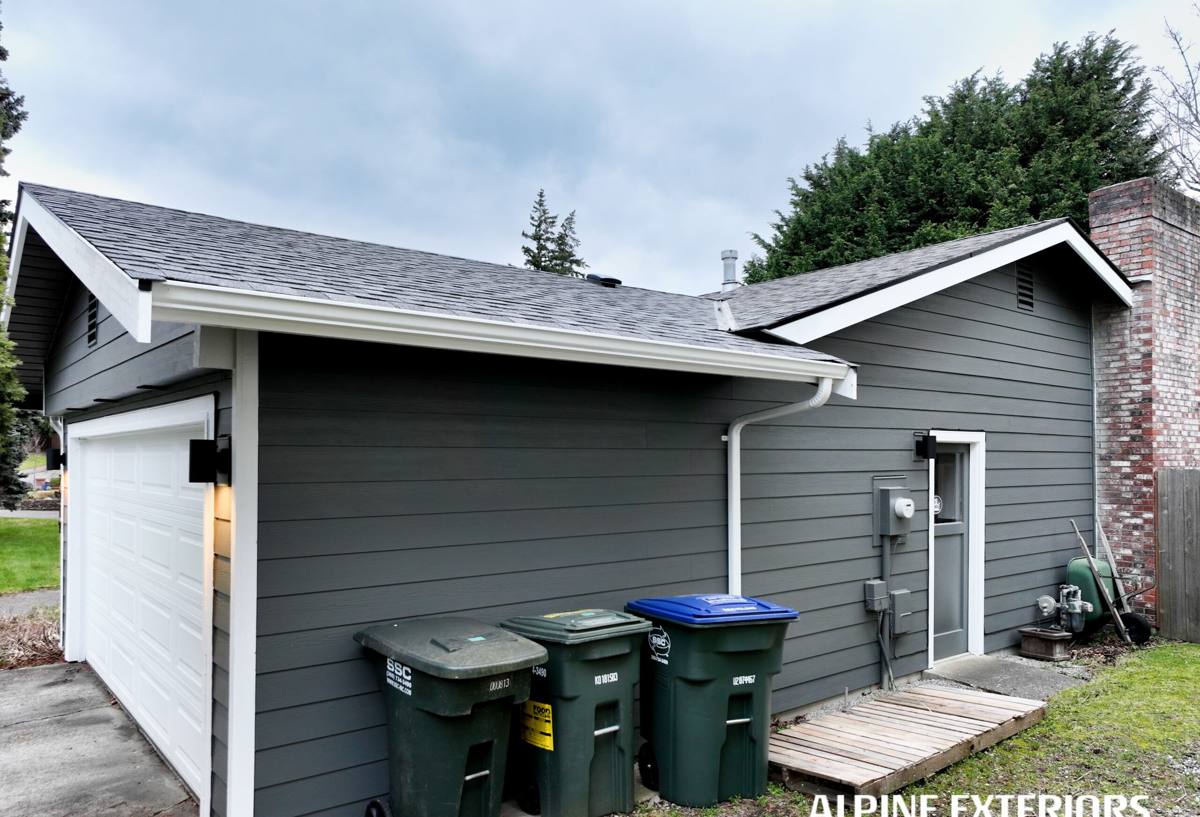
What "Correct" Siding Installation Actually Involves
A lot of siding failures aren't material failures — they're installation failures. The product gets blamed, but the real problem is a shortcut taken underneath it. In a marine climate like Blaine's, the details behind the siding matter as much as the siding itself.
Weather-Resistive Barrier and Flashing
Every wall needs a continuous weather-resistive barrier (WRB) installed with proper shingle-lap sequencing, so water is always directed outward and down, never trapped behind the cladding. Window and door openings need head flashing, and every horizontal trim transition needs kick-out flashing or a drip cap to break water's path before it can wick behind the siding. This is invisible work once the job is done, but it's the single biggest factor in whether a wall stays dry for decades or develops hidden rot in five years.
Fasteners and Clearances
In a salt-air environment, fastener choice matters. Corrosion-resistant nails or screws, installed at the manufacturer's specified pattern and depth, prevent streaking and loosening over time. Siding also needs proper clearance from grade, roof lines, decks, and hardscape — generally a minimum gap so splash-back and standing moisture can't wick continuously into the bottom courses.
Joints, Caulking, and Field-Painting
Butt joints, corners, and penetrations (hose bibs, vents, light fixtures) are where most siding leaks start. These need to be sealed with a high-quality, paintable exterior sealant rated for the product, not general-purpose caulk that shrinks and cracks within a couple of seasons. Any field-cut edges on fiber cement need to be sealed or back-primed per the manufacturer's instructions so raw material isn't left exposed to moisture.
Why We Install Only James Hardie Fiber Cement
Bellingham Exterior installs James Hardie fiber cement siding exclusively. We don't install vinyl, LP SmartSide, Cemplank, Allura, or primed wood siding, and that's a deliberate standard, not a limitation of what we're capable of installing. Here's the honest reasoning:
Vinyl siding is affordable and low-maintenance in mild weather, but it's a thin material that relies on interlocking panels rather than a sealed, monolithic surface. Wind-driven rain in an exposed Blaine location can drive moisture behind vinyl panels over time, and the material itself can warp, fade, or crack in temperature swings and impact events. Wood siding — cedar or primed spruce — looks great when new, but it's organic material in a climate built to grow moss and mildew on organic material; it needs recurring painting, caulking, and moss treatment to hold up, and skipped maintenance shows up fast as rot. Other fiber cement brands like LP SmartSide (engineered wood, not cement) and generic fiber cement lines like Cemplank or Allura may perform reasonably, but we've standardized on one product line so our crews are deeply proficient in one installation system, one flashing detail set, and one warranty structure — rather than splitting expertise across several products with different failure modes.
James Hardie fiber cement is non-combustible, dimensionally stable in wet-dry cycling, and available in HZ5 formulations engineered for climate zones with high moisture exposure — which describes Whatcom County's coastline well. The factory-applied ColorPlus finish is baked on under controlled conditions, which holds color and resists the moss and mildew that plague field-painted materials, and it comes with a strong transferable warranty when installed to spec. That "installed to spec" part is why we control the whole job rather than mixing products — the warranty and the performance are only as good as the installation underneath them.
How James Hardie Compares to Other Common Siding Options
| Material | Moisture/Salt Air Behavior | Maintenance | Typical Lifespan |
|---|---|---|---|
| James Hardie fiber cement | Engineered HZ5 lines for wet coastal exposure; dimensionally stable | Occasional wash; factory finish resists moss staining | 30+ years with correct install |
| Vinyl | Can allow water intrusion behind panels; warps under heat/impact | Low, but panels can't be spot-repaired invisibly | 15-25 years |
| Cedar / primed wood | Absorbs moisture; prone to moss and rot without upkeep | High — repainting, caulking, moss treatment | 10-20 years without diligent care |
| Engineered wood (e.g. LP SmartSide) | Resists moisture better than raw wood; edge sealing critical | Moderate — field caulking and touch-up over time | 20-30 years |
Our Installation Process in Blaine
- On-site assessment — we walk the exterior, check existing siding and sheathing condition, note wind/water exposure on each elevation, and look for existing moisture damage before quoting anything.
- Tear-off and substrate check — old siding comes off and we inspect sheathing for soft spots or hidden rot, especially around windows, decks, and roof-to-wall intersections common trouble spots in wet climates.
- WRB and flashing install — a continuous weather-resistive barrier goes on with correctly lapped seams, followed by window, door, and penetration flashing.
- Hardie panel or lap installation — installed per manufacturer fastening schedule and clearance requirements, with attention to butt joint placement and corner details.
- Sealing and trim — joints and penetrations sealed with appropriate exterior sealant; trim and caulking finished to shed water at every transition.
- Final walkthrough — we review the finished job with the homeowner and confirm everything meets both our install standards and Hardie's warranty requirements.
Signs Your Blaine Home May Need New Siding
- Persistent moss or dark streaking that returns within weeks of cleaning
- Soft or spongy spots when pressing on siding near the bottom courses or under windows
- Paint that's peeling, bubbling, or won't hold on wood or engineered wood siding
- Visible warping, cracking, or panel gaps, especially on walls facing prevailing wind and rain
- Rising energy bills that suggest the wall assembly behind the siding is no longer performing
- Interior signs — musty smell, staining, or soft drywall near exterior walls
What Drives Siding Project Cost
| Factor | Why It Matters |
|---|---|
| House size and elevation count | More wall area and more corners/transitions mean more material and labor |
| Substrate condition | Rotted sheathing found during tear-off requires repair before new siding goes on |
| Product line and profile | Lap width, panel style, and trim complexity affect material and install time |
| Site access and exposure | Water-facing homes and tight lots can add scaffolding or staging time |
| Existing siding removal | Full tear-off versus siding over existing material changes labor scope |
Why a Crew That Already Works Blaine Matters
Blaine isn't identical to Bellingham proper or the inland parts of Whatcom County. Homes closer to the water deal with more direct wind-driven rain and salt exposure, and shaded lots near the harbor or wooded lots tend to hold moss longer into the year. A crew that regularly works this specific stretch of coastline already knows which elevations need extra flashing attention, which fastener and sealant choices hold up against salt air, and what a wall assembly here looks like when it's failing versus when it's just cosmetically weathered. That local pattern recognition shows up in fewer callbacks and a job that's built for the actual conditions on your lot, not a generic spec sheet.
It also matters for scheduling and follow-up. A contractor based in the region can respond quickly if a question comes up after the job is done, and understands local permitting and inspection expectations in Whatcom County without a learning curve.
Get a Straightforward Estimate
If your Blaine home's siding is showing moss, staining, soft spots, or just isn't keeping up with the weather off the water anymore, we're happy to take a look. We'll walk the exterior, tell you honestly what we see, and put together a free, no-pressure estimate for James Hardie siding installed the right way for your home's exposure — just fill out the form below.