 Bellingham
 Cordata's Climate Is Harder on Siding Than It Looks
Cordata sits in north Bellingham, close enough to the water and the lowland weather patterns that move through Whatcom County to take the full brunt of what a Pacific Northwest winter can throw at a house. Salt-tinged marine air works its way into siding seams and fasteners year-round. Driving rain off Bellingham Bay doesn't just wet the surface of a wall — wind-driven storms push moisture sideways, testing every lap, joint, and piece of trim on a home. And because this area gets a long stretch of overcast, damp weather every year, north-facing walls and shaded siding under mature trees spend months at a time staying wet, which is exactly what moss and mildew need to take hold.
None of that is unique to Cordata, but it is a real, cumulative load on a home's exterior. Siding that isn't engineered for it, or that isn't installed with the details this climate demands, tends to show problems years before it should — swelling at the bottom edges, staining, soft trim, or moss creeping up from the ground line. A correct siding installation in this neighborhood isn't just about picking a good product. It's about installing that product the way the climate actually requires.
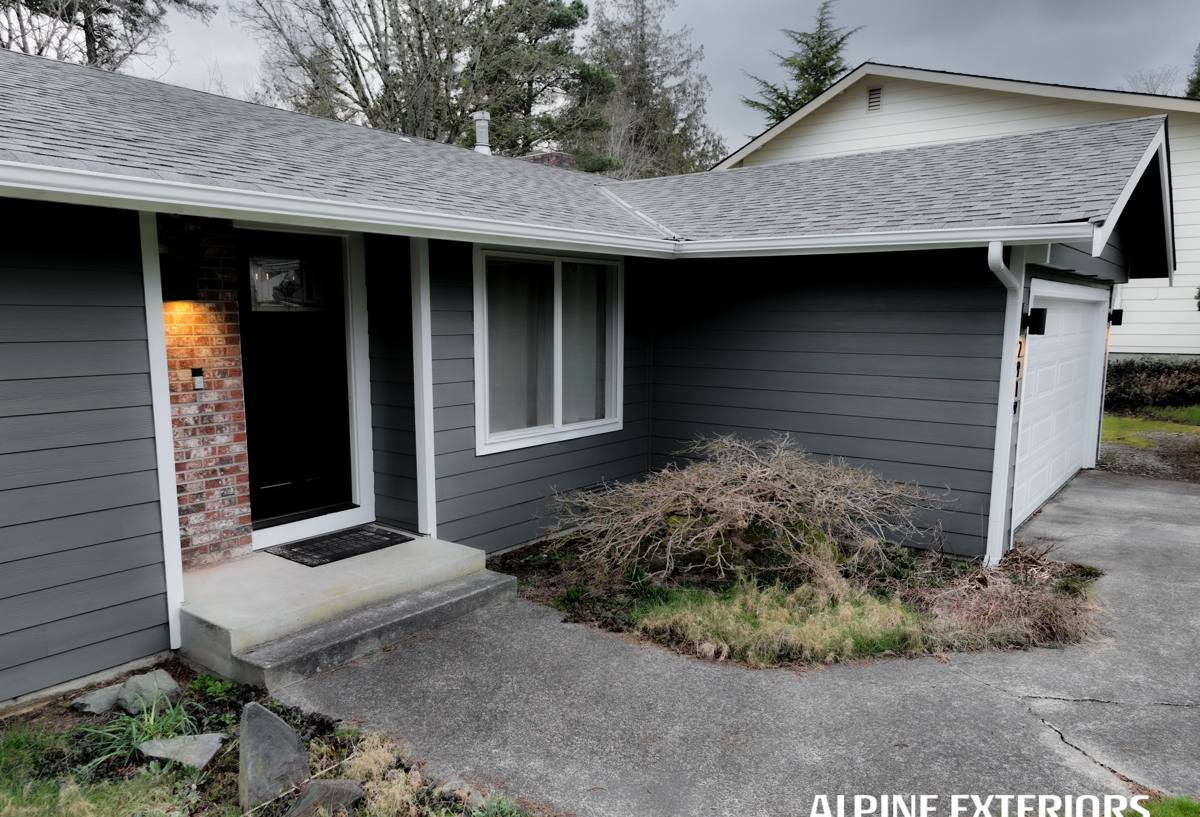
What Siding Failure Looks Like Before It's Obvious
Most siding problems in this climate don't announce themselves. By the time a homeowner notices bubbling paint, a soft spot near a window, or a dark green cast climbing the lower few feet of a wall, moisture has usually been working behind the surface for a while. Common early signs worth paying attention to on a Cordata home include:
- Dark streaking or a green tint on siding that stays shaded most of the day, especially on north- and west-facing walls
- Paint that's peeling, bubbling, or chalking faster than it should, particularly at butt joints and trim edges
- Soft or spongy trim boards around windows, doors, or at the bottom course near grade
- Gaps opening up at caulked joints as older siding expands, contracts, and eventually cups or bows
- Musty odor or visible staining on interior walls that share an exterior wall with a problem area outside
Any of these can mean the siding itself has failed, or that it was installed without the moisture-management details this area needs even if the material is sound. Either way, it's worth having someone look at the wall assembly, not just the surface.
What a Correct Installation Actually Involves
A siding job that will actually hold up in Cordata's climate comes down to what happens underneath the visible surface. The finished product can look identical whether it's installed correctly or not — the difference shows up in year five or year fifteen, not on install day.
Tear-off and a real look at the wall
Old siding has to come off, not get covered over, so the crew can actually see the sheathing, framing, and any rot that's been hiding behind the old material. This is the point where hidden moisture damage from years of driving rain gets found and fixed, rather than sealed back up.
Weather-resistive barrier and a drainage gap
A correctly lapped weather-resistive barrier goes on first, with all seams, penetrations, and window and door openings flashed so water is directed out and down, never trapped. In a climate that stays wet as long as this one does, a rainscreen gap — a furring strip or drainage mat between the barrier and the siding — matters. It gives any moisture that does get behind the cladding a path to drain and dry out, instead of sitting against the back of the siding and the sheathing.
Flashing over caulk
Caulk breaks down. Sun, cold, and constant damp cycles all shorten its life, and once a bead fails, water gets a direct path behind the wall. Correct practice uses flashing — at heads, sills, kick-out points where a roofline meets a wall, and anywhere water concentrates — as the actual line of defense, with sealant used the way it's meant to be used: as a secondary layer, not the only one.
Fastening and gaps to the manufacturer's spec
Nail type, placement, and spacing aren't cosmetic details — they're what keeps siding flat and tight through decades of wet-dry cycling and wind exposure off the bay. Cut ends get sealed or back-primed so they don't wick moisture, and boards are hung with the clearances the manufacturer specifies at grade, roofs, and other siding-to-material transitions, so nothing sits in standing water or gets buried in mulch or landscaping.
Why We Only Install James Hardie Fiber Cement
We don't install vinyl, LP SmartSide, Cemplank, Allura, or unfinished wood siding, and that's a deliberate standard, not a matter of what happens to be in stock. James Hardie fiber cement is non-combustible, holds a factory-applied ColorPlus finish that resists fading and holds paint far longer than field-applied coatings, and is engineered in versions built specifically for cold, wet regions like ours — what Hardie designates its HZ10 climate zone, versus the milder HZ5 formulation used in drier parts of the country. For a Cordata home dealing with salt air, sideways rain, and months of damp shade, that distinction is not marketing — it's the difference between a product engineered for this exact set of conditions and one that wasn't.
Hardie also backs its siding with a strong, transferable limited warranty, which matters more in a wet climate than a dry one, since moisture-related failures are the most common reason siding warranties get invoked. We stand behind the installation; Hardie stands behind the product. That combination is why we standardized on it rather than offering a menu of cheaper alternatives.
What Drives the Cost of a Cordata Siding Job
Every home is different, and we won't quote a number without seeing the house, but the factors that actually move the price are consistent. Homeowners comparing bids should know what they're paying for.
| Cost Factor | Why It Matters |
|---|---|
| Home size and number of stories | More wall area and taller elevations mean more material, more staging, and more labor time |
| Condition of the existing siding and sheathing | Hidden rot or water damage found during tear-off adds repair scope that can't be priced sight-unseen |
| Trim and architectural detail | Multiple gables, dormers, or decorative trim take more cutting, fitting, and flashing than a simple rectangular wall |
| Rainscreen and flashing scope | Full drainage-gap installation and proper flashing at every penetration take more time than a direct-applied approach, but they're what makes the job last here |
| Access and site conditions | Mature trees, tight side yards, or sloped lots common in this area can add setup and staging time |
A bid that's noticeably lower than others is worth a second look — it's usually missing one of these items, most often the rainscreen gap or proper flashing detail, both of which are invisible once the job is finished but expensive to fix later.
How Our Process Works
- Free on-site assessment. We look at your current siding, trim, and any visible moisture issues, and talk through what your home actually needs.
- Written estimate. A clear scope and price, with the drainage and flashing details spelled out rather than assumed.
- Tear-off and inspection. Old siding comes off, sheathing is inspected, and any repairs are identified and priced before we close the wall back up.
- Weather barrier, rainscreen, and flashing. The parts of the job that determine whether it lasts twenty years or five.
- James Hardie installation. Fastened, gapped, and finished to manufacturer specification.
- Final walkthrough. We go over the finished work with you before calling the job done.
A Checklist for Homeowners Comparing Bids
- Does the bid specify a rainscreen or drainage gap, or just "install siding over existing barrier"?
- Is flashing called out at windows, doors, and roof-to-wall intersections, or is caulk doing that job?
- Does the contractor plan to inspect sheathing during tear-off, or install over whatever is already there?
- Is the siding material specified by name and climate line, not just "fiber cement" or "Hardie-style"?
- Are warranty terms — both material and labor — written down, not just mentioned verbally?
Why It Helps to Hire a Crew That Already Works This Neighborhood
Cordata has grown up over the last couple of decades, and much of the housing stock here shares similar construction patterns, lot layouts, and landscaping choices — mature plantings close to foundations, mixed sun and shade exposures, and the newer subdivision layouts common across this part of Bellingham. A crew that already works in this neighborhood has seen how those patterns interact with the local climate: where moss tends to establish first, which wall orientations take the worst of the driving rain, and how City of Bellingham and Whatcom County permitting and inspection expectations apply to exterior work. That familiarity shows up in fewer surprises during tear-off and a finished job that accounts for the specific way this neighborhood weathers, not a generic install plan.
If your siding is showing its age, or you're planning ahead before a problem gets expensive, we're happy to take a look. The estimate is free, there's no pressure, and you'll get a straight answer about what your home actually needs.