 Bellingham
 Building New in Sehome Means Getting the Window Install Right the First Time
Sehome sits close enough to Bellingham Bay that salt-laden air is a regular visitor, and it sits in a part of Whatcom County that sees long stretches of driving rain from fall through spring. Add in the shaded, damp pockets near Sehome Hill where moss and algae take hold on north-facing surfaces for months at a time, and you've got a climate that is unforgiving of shortcuts in window installation. On a new build, you only get one chance to install these windows correctly before siding, trim, and interior finish work close everything up behind them. There's no "we'll fix it later" on a new-construction window opening — once the wall is buttoned up, a bad flashing detail is hidden until it fails.
That's the core difference between a new-construction window job and a replacement job: on new construction, we're not working around existing siding and trim, we're building the water-management system from scratch, in the order it needs to happen, before the rest of the building envelope closes over it.
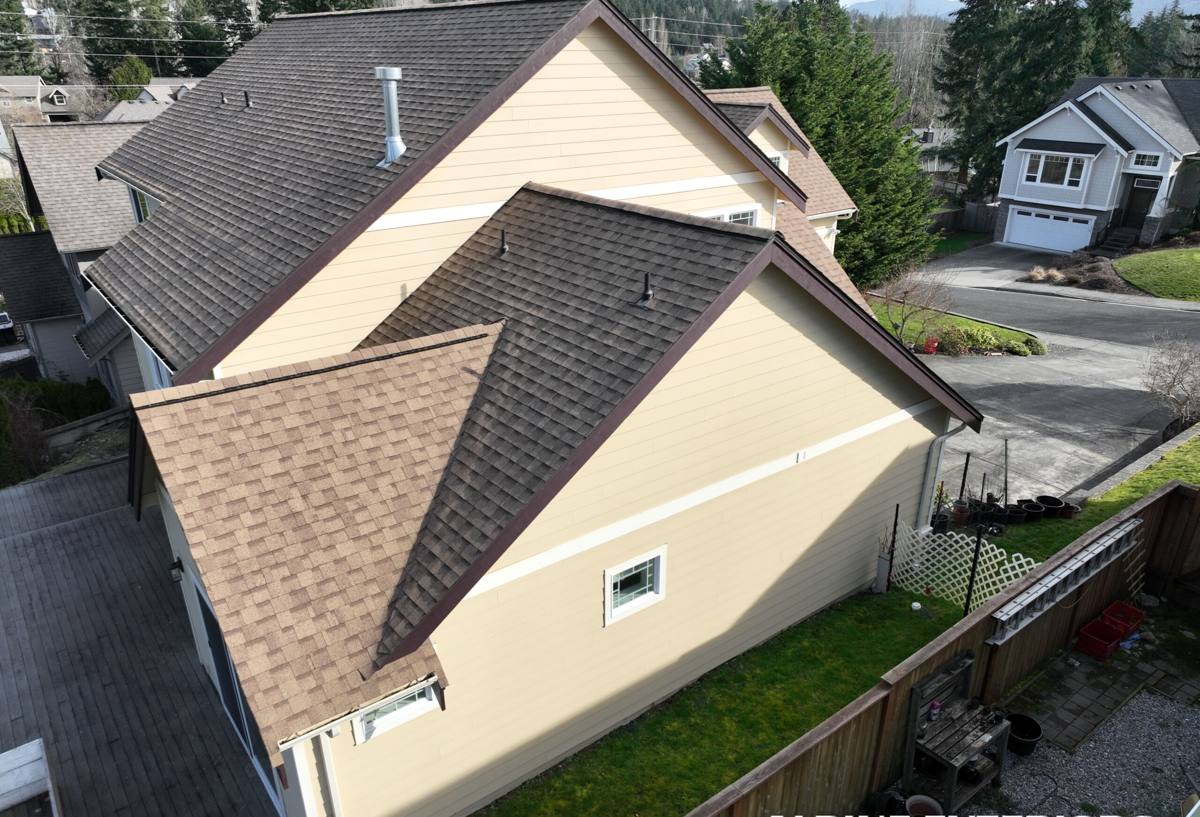
New-Construction Windows vs. Replacement Windows — Why the Distinction Matters
People sometimes use "new-construction window" loosely to mean "a new window," but it's actually a specific product category. New-construction windows have a nailing fin (sometimes called a nail flange) around the perimeter of the frame that gets fastened directly to the wall sheathing and integrated with the weather-resistive barrier (WRB) and flashing tape before siding goes on. Replacement windows, by contrast, are built to fit into an existing frame with minimal disruption to siding that's already in place.
On a Sehome new build or a full exterior remodel down to the studs, the nailing-fin window is almost always the right call, because it lets us build a continuous, lapped drainage plane around every opening — critical in a climate where wind-driven rain doesn't just fall straight down, it gets pushed sideways into wall assemblies.
When a Block-Frame Window Comes Into Play
Some new-construction projects — particularly additions tying into masonry, stucco, or certain modern siding systems — call for a block-frame (flangeless) window instead, which gets set into the rough opening and sealed and fastened through the jambs. We'll tell you plainly which approach fits your specific wall assembly rather than defaulting to whatever's easiest to install.
What a Correct Installation Actually Involves
A window installed correctly for this climate isn't just "set it, screw it, caulk it." The sequence matters as much as the product:
- Rough opening checked for square, level, and correct sizing before the window ever shows up on site
- Sill pan flashing installed first, sloped to drain water outward, not into the wall cavity
- Window set, shimmed, and fastened per manufacturer spec — over-driving or under-driving fasteners is a common failure point
- Flashing tape lapped in the correct shingle-style order (sill, then jambs, then head) so water always sheds downward and outward
- Head flashing installed above the window, integrated with the WRB above it
- Backer rod and low-expansion sealant at the interior and exterior gaps, sized correctly rather than overfilled
- Final check for square operation and weathertight seal before siding crews close in around it
Skip or rush any one of these steps and the window itself can be a premium product and still leak. We've seen it happen with good windows installed poorly far more often than we've seen a mid-grade window fail on its own.
Choosing a Window Frame Material for a Sehome Build
Frame material affects how a window handles Whatcom County's moisture load and salt exposure over the long run. There's no single "best" choice — it depends on your budget, your home's design, and how much upkeep you want to take on.
| Frame Material | Moisture & Salt-Air Tolerance | Maintenance | General Cost Position |
|---|---|---|---|
| Vinyl | Good — won't rot or corrode; seals can wear over decades | Low | Most affordable |
| Fiberglass | Very good — dimensionally stable in wet, temperature-swinging conditions | Low | Mid to upper-mid |
| Wood-clad | Good on the exterior clad side; interior wood needs protection from condensation | Moderate | Upper |
| Aluminum | Prone to condensation and thermal transfer in our wet, cool climate unless thermally broken | Low to moderate | Varies widely |
For most Sehome new builds we lean toward vinyl or fiberglass for the exterior exposure this area gets, but if the design calls for a wood interior look, a properly clad wood window can work fine as long as interior humidity and condensation are managed — something worth discussing if the home will have a lot of glazing facing the Bay-side weather.
Our Process for New-Construction Window Installs
1. Plan Review and Rough-Opening Verification
Before framing is locked in, we review window schedules against actual rough-opening dimensions. Catching a sizing mismatch on paper is a lot cheaper than catching it after framing is nailed together.
2. Sequencing with Your Builder or GC
Window installation has to happen at the right moment in the build sequence — after sheathing and WRB, before siding. We coordinate directly with your general contractor or framing crew so nobody's waiting on anybody, and so the WRB laps correctly with our flashing rather than fighting it.
3. Installation
Sill pan, window set, flashing lapped in order, sealant, and a functional check on every unit — swing, slide, or tilt, whatever the window type calls for.
4. Walkthrough
Before we leave, we walk every opening with you or your builder so everyone's clear on what's installed and how it's flashed, since that detail gets buried once siding goes on.
Mistakes We See on New Builds in This Area
Most window problems that show up years later trace back to a handful of avoidable errors during the original install:
- Flashing tape applied out of order, so water gets directed into the wall instead of out of it
- Sill pans skipped or installed flat instead of sloped
- Windows fastened before the rough opening was actually verified square
- Sealant used as the primary water barrier instead of as a backup to proper flashing
- Siding crews closing in around windows before the flashing details were fully inspected
Every one of these is preventable with the right sequence and a crew that isn't rushing to move to the next house on the schedule.
Cost Factors on a Sehome New-Construction Window Job
| Factor | How It Affects the Job |
|---|---|
| Number and size of openings | Larger and more numerous units mean more flashing detail work, not just more glass |
| Frame material selected | Vinyl runs most affordable; fiberglass and wood-clad cost more up front |
| Wall assembly complexity | Rainscreen systems, multiple siding types, or unusual trim details add install time |
| Access and building phase | Coordinating around scaffolding, other trades, or tight scheduling windows adds cost |
| Special glazing or hardware | Impact-rated glass, tinted or low-E upgrades, or custom hardware all shift the price |
We'll walk your specific plan set and give you a real number rather than a rough per-window average that doesn't account for your actual wall assembly.
Why It Matters to Hire a Crew That Already Works Sehome
A crew that's worked new-construction windows across Bellingham and Whatcom County knows how this climate behaves at the wall — where wind-driven rain tends to concentrate on a given elevation, how much moss and algae growth to expect on shaded north sides near tree cover like Sehome Hill, and how salt air off the Bay slowly works on unprotected fasteners and hardware over the years. That's knowledge you use before the walls close in, not after a leak shows up in year six. It also means we're not learning the local permitting and inspection expectations on your job — we already know what Whatcom County inspectors are looking for at window rough-in.
What to Ask Before You Sign a Window Contract
- Will you use sill pan flashing on every opening, sloped to drain outward?
- What's your flashing lap sequence, and can you explain it in plain terms?
- Are you coordinating directly with my GC or framing crew on sequencing?
- What frame material are you recommending for my specific elevations, and why?
- Will someone walk the flashing details with me before siding closes in?
- What's covered under the manufacturer's warranty versus your installation warranty?
If a contractor can't answer these clearly, that's worth noticing before the contract's signed, not after.
If you're planning a new build or full exterior remodel in Sehome, we're glad to walk your plans, talk through window options for your specific wall assembly, and give you a straightforward, no-pressure estimate — just fill out the form below.