 Bellingham
 Why Birchwood Siding Wears Differently
Birchwood sits close enough to the water and open exposure that homes here take a different kind of beating than siding fifteen minutes inland. Salt-laden air off Bellingham Bay works into fasteners, trim seams, and any spot where paint has thinned. Driving rain off Puget Sound doesn't fall straight down — it hits siding at an angle, especially on west- and south-facing walls, and finds its way behind boards that have started to gap or cup. And Whatcom County's long, wet moss season means anything shaded by mature trees or a north-facing roofline stays damp for months at a stretch. None of this is exotic — it's just Bellingham weather doing what it does, year after year, to a building material that was never designed for it.
When we get called out to a Birchwood home for siding repair, the damage almost always traces back to one of these three things: moisture intrusion at a failed joint or fastener, moss and algae holding water against the surface, or salt-accelerated corrosion of nails and trim fasteners. Understanding which one you're dealing with changes how the repair should be done.
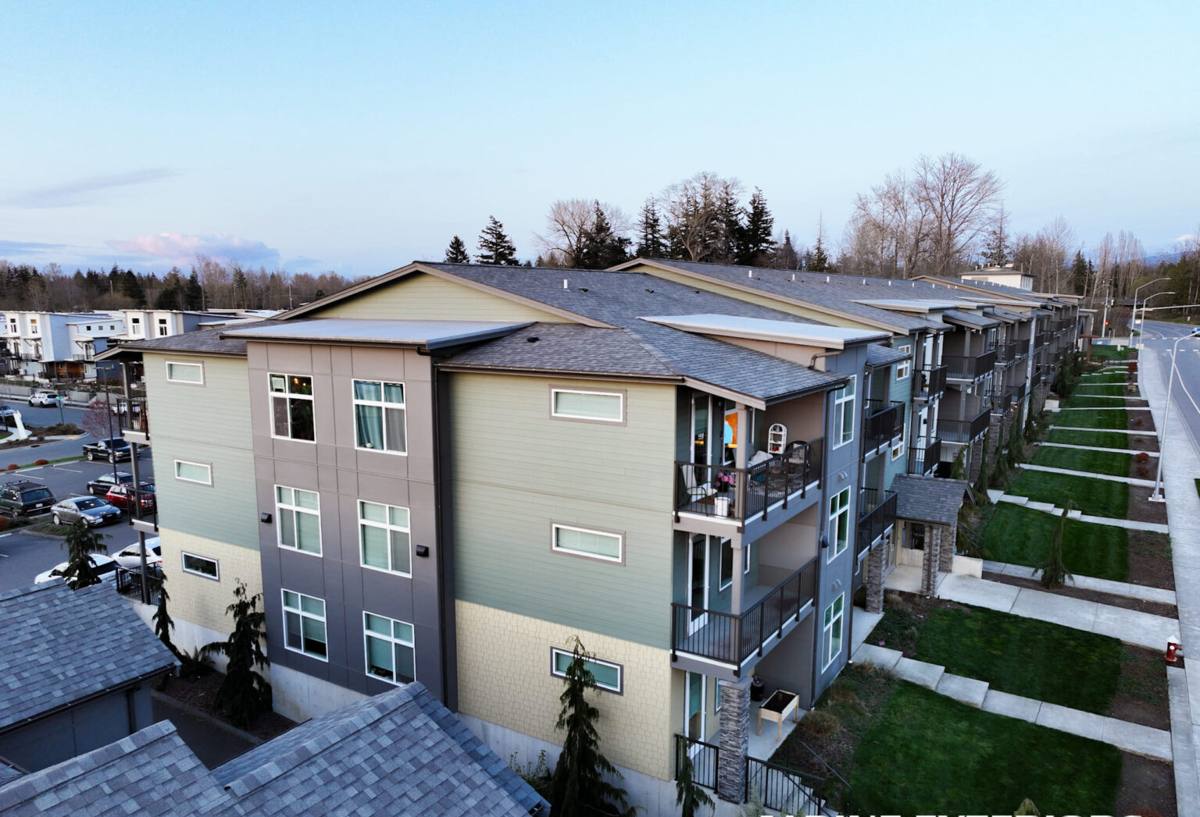
What Actually Causes Siding Failure Here
Moisture Behind the Board, Not Just On It
Most siding failure isn't a surface problem — it's a behind-the-board problem. Water gets past a cracked caulk joint, a warped board, or a poorly lapped seam, and then has nowhere to dry out because the wall assembly behind it traps it there. In older siding — cedar, primed spruce, and some fiber cement installed without proper flashing — this shows up as soft spots, staining, or boards that have swollen and separated from the wall.
Moss, Algae, and the Shade Problem
Birchwood has enough tree cover and cooler, shaded exposures that moss and algae growth on siding is common, especially on north walls and anywhere gutters overflow or downspouts discharge onto the wall below. Moss holds moisture against the siding surface far longer than open air would, which softens paint film, breaks down caulk, and eventually lets water migrate into the substrate. A siding surface that looks "just dirty" is often a surface that's been wet, continuously, for weeks.
Salt Air and Fastener Corrosion
This is the one homeowners rarely think about until it's already a problem. Standard steel nails and staples corrode faster in coastal air, and once a fastener rusts and loses its grip, the board it's holding starts to move. Movement opens gaps, gaps let in water, and the cycle accelerates. It's a slow failure — often five to ten years in — which is why it tends to surprise people who thought their siding was fine.
Signs a Birchwood Home Needs Siding Repair
- Soft or spongy siding when you press on it, especially near the bottom edges of walls or below windows
- Visible gaps, cupping, or warping in individual boards
- Peeling or bubbling paint concentrated in one area rather than spread evenly across the house
- Dark streaking, green or black growth, or a persistently damp-looking wall section
- Rust stains bleeding from nail heads or trim fasteners
- Caulk that has cracked, shrunk, or pulled away from joints and trim
- Interior clues — a musty smell, a stained wall, or peeling interior paint on an exterior-facing wall
Any one of these on its own might be minor. Two or three together, especially on the same wall, usually means water has been getting behind the siding for a while and the damage extends further than what's visible from the ground.
What a Correct Repair Actually Involves
A lot of siding repairs fail again within a couple of years because they only address what's visible. Slapping new caulk over a cracked joint or replacing one board without checking what's behind it just resets the clock on the same failure. A repair that's going to hold up through another Whatcom County winter needs to do a few things every time:
- Confirm the extent of the damage. We pull back or remove damaged boards to check the sheathing, house wrap, and flashing underneath — not just patch over the surface symptom.
- Address the water source, not just the water damage. If the problem is a flashing gap, a caulk failure, or a grading issue sending water up the wall, that gets fixed as part of the repair — otherwise the new siding fails the same way.
- Match materials correctly. Repairs on fiber cement need the right product, thickness, and factory finish to blend in and perform the same as the surrounding siding. Repairs on older wood or composite siding need an honest conversation about whether patching is still worth it.
- Re-fasten with corrosion-resistant hardware. Given the salt air here, we don't reuse or replace with standard fasteners where it can be avoided — it's a small cost difference for a real gain in longevity.
- Re-seal and re-flash properly. Joints, trim intersections, and penetrations get sealed to actually shed water, not just look finished.
Repair vs. Replacement: How We Make That Call
Not every damaged section needs full replacement, and we're not going to tell you it does. But there's a point where patch repairs stop making financial sense, and it's worth being upfront about where that line is.
| Situation | Usually Repairable | Usually Time to Replace |
|---|---|---|
| Damage isolated to one or two boards | Yes, if sheathing underneath is dry | — |
| Rot or soft spots on multiple walls | — | Points to a systemic moisture issue |
| Siding is fiber cement, well-maintained | Yes | — |
| Siding is original wood/spruce, 20+ years old | Case-by-case | Often, once repairs recur |
| Recurring failure at the same spot | — | Underlying cause needs a real fix, sometimes full re-side |
| Moss/algae staining only, no soft wood | Yes — clean, treat, re-seal | — |
If we open a wall and find the damage is more widespread than expected, we'll tell you that plainly and lay out the options rather than pushing a bigger job than you need — or patching over something that's going to fail again by next winter.
Why Local Experience Matters for This Kind of Repair
Siding repair is one of those jobs where general contracting experience isn't quite the same as Bellingham-specific experience. A crew that mostly works drier inland climates can underestimate how much moisture Birchwood's exposure and moss season push into a wall assembly, or use standard fasteners that won't hold up to salt air. A crew that works this area regularly already knows which wall orientations tend to have problems, what a genuine moisture failure looks like versus surface staining, and how to flash a repair so it actually sheds Bellingham's sideways rain instead of channeling it into the wall.
We work siding repairs across Whatcom County homes with this same coastal, tree-shaded, wet-winter exposure, and Birchwood's mix of mature landscaping and open water-facing walls is a pattern we recognize quickly.
Why We Rebuild With James Hardie, Not Whatever Was There Before
When a repair on wood, primed spruce, or older composite siding turns into "this needs more than a patch," we don't recommend replacing like-for-like. We install James Hardie fiber cement siding exclusively, and in a climate like this one, the reasons are practical, not brand loyalty. Hardie's fiber cement doesn't rot, and it isn't a food source for the moss and algae that thrive in Birchwood's shaded, damp conditions the way wood siding can be. It holds up to sustained moisture exposure far better than wood-based products, and its ColorPlus factory finish is baked on and warranted against fading and peeling — which matters on walls that take direct salt air and UV without much protection from the elements. Hardie also makes climate-engineered HZ product lines built specifically for wet, humid regions like the Pacific Northwest.
We're not going to tell you every repair needs a full re-side in Hardie — most don't. But when a section of siding is failing for structural reasons rather than a fixable joint or flashing issue, replacing it with fiber cement instead of another round of the same material is the difference between a repair that lasts a couple of seasons and one that lasts decades.
Maintaining Your Siding Between Repairs
A few habits go a long way toward keeping Birchwood siding from needing repair in the first place:
- Keep gutters clear so overflow doesn't run down the wall face, especially before the fall rains start
- Trim back vegetation and tree branches that shade siding and keep it from drying out
- Rinse moss and algae buildup off gently at least once a year rather than letting it establish
- Walk the exterior each fall and check caulk joints, trim seams, and fastener heads for early wear
- Address small issues — a cracked caulk line, a loose board — before winter rather than after
Get an Honest Look at Your Siding
If you're seeing soft spots, staining, gapping, or moss buildup on your Birchwood home's siding, it's worth having it looked at before another wet season adds to the damage. We'll give you a straight assessment of what's actually happening behind the surface, what repair options make sense, and what it would cost to do it right. Reach out for a free, no-pressure estimate — the form below gets you started.