 Bellingham
 Why Blaine's Coastal Position Is Tough on Siding
Blaine sits right on Boundary Bay and the Strait of Georgia, about as close to salt water and the Canadian border as a Whatcom County home can get. That location is beautiful, but it's also demanding on exterior building materials in ways that homes even a few miles inland don't experience. Salt-laden air moves off the water and settles on everything it touches, including siding, trim, and fasteners. Over years, that salt exposure accelerates corrosion in metal fasteners and flashing, and it can degrade paint films and less durable siding materials faster than a standard weathering chart would predict.
Add to that the driving rain that comes with wind off the water — rain that doesn't just fall straight down but gets pushed sideways into wall assemblies — and you have a climate that punishes any siding installation with weak flashing details or gaps in the water-resistive barrier. Then there's moss. Whatcom County's long, damp, mild-temperature season gives moss and algae months to get established on north-facing walls, shaded elevations, and anywhere siding stays wet longer than it should. Moss holds moisture against the surface, which is a problem for wood-based products in particular.
None of this means Blaine homes need to fight nature — it means the siding system and the installation details need to be chosen and executed with this specific exposure in mind, not treated the same as a project in a drier, more sheltered part of the county.
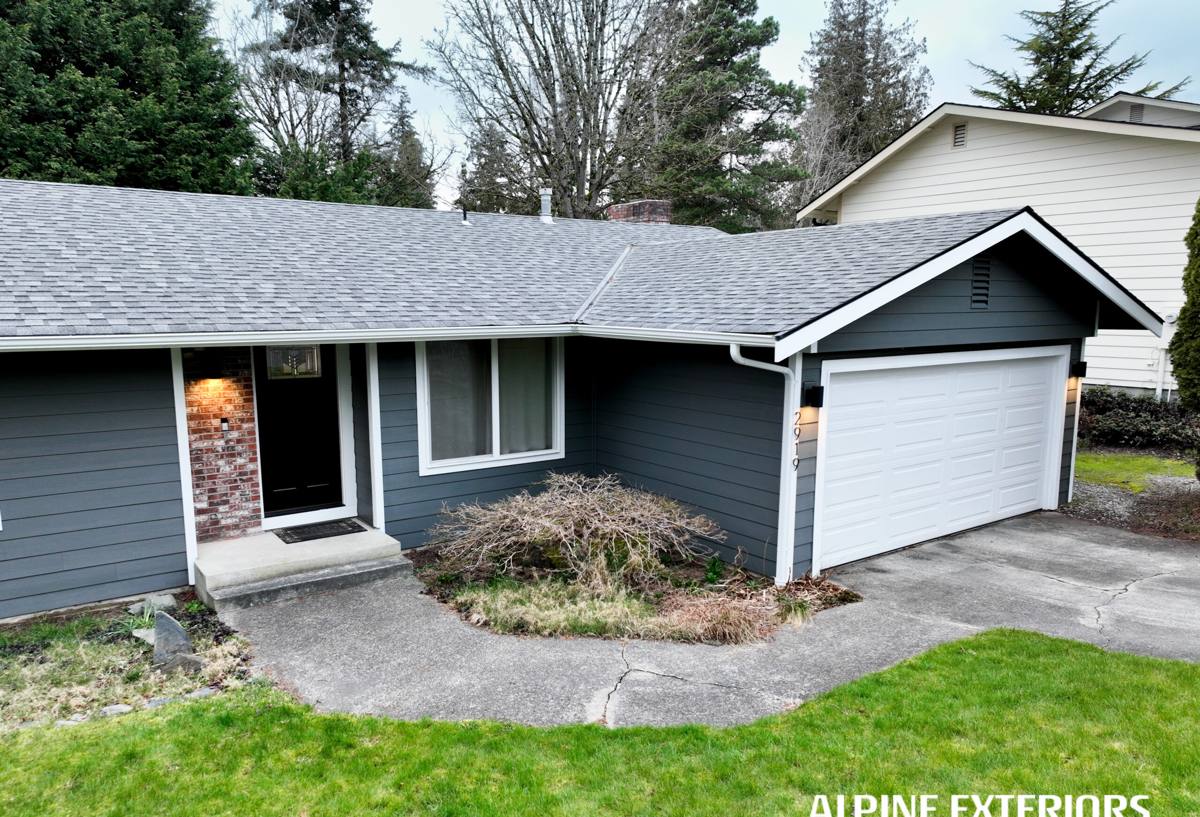
Signs a Blaine Home Needs Siding Replacement, Not Just Repair
Because of the salt air and moisture load, siding problems in Blaine tend to show up as a combination of surface and structural symptoms rather than one obvious failure point. Watch for:
- Paint or finish that's chalking, peeling, or fading unevenly, especially on the water-facing side of the house
- Soft spots, bubbling, or visible warping in wood-based or engineered wood siding
- Persistent moss or dark streaking that comes back within weeks of cleaning
- Rust staining below nail heads or metal trim, a sign fasteners are corroding
- Visible gaps or separation at seams, corners, and window trim where wind-driven rain can get behind the cladding
- A musty smell or soft drywall on interior walls that share an exterior wall facing the water
Any one of these can sometimes be addressed with a repair. But when several show up together, or when the siding is original and past 15–20 years old, it's usually a sign the underlying water-resistive barrier and flashing system have been compromised long enough that patching won't solve the actual problem — only a full replacement resets the wall assembly.
What a Correct Siding Replacement Actually Involves
Full Tear-Off, Not Overlay
On a coastal property like this, siding over the existing material is a shortcut we don't take. Full tear-off lets us inspect the sheathing underneath for rot or hidden moisture damage — common where old flashing has failed — and replace anything compromised before new siding goes on.
Water-Resistive Barrier and Flashing
This is the part of the job that matters most in a driving-rain, salt-air environment and the part that's invisible once the siding is up. That means a continuous weather-resistive barrier, properly lapped and taped seams, and correct flashing at every window, door, deck ledger, and roof-to-wall transition. Wind-driven rain finds any shortcut here, and in Blaine it finds it faster than in more sheltered inland areas.
Fasteners and Hardware
Given the corrosion risk from salt air, fastener selection isn't a detail to skip past. Corrosion-resistant fasteners and hardware, installed per manufacturer spacing and embedment requirements, matter more here than on a project 20 miles inland.
Ventilation and Drainage Plane
A rainscreen or drainage gap behind the siding lets any moisture that does get past the cladding drain and dry out instead of sitting against the sheathing. In a climate with Blaine's damp season length, this drainage detail is what keeps a wall assembly healthy for decades instead of one.
Material Comparison: What We Considered and Why We Standardized on One
Homeowners researching siding replacement in this area will run into several material options. Here's an honest look at how they hold up under Blaine's specific combination of salt air, wind-driven rain, and extended moss season:
| Material | Behavior in salt air / driving rain | Moss and moisture resistance | Long-term maintenance |
|---|---|---|---|
| Vinyl siding | Can warp or become brittle with temperature swings; seams are a water-entry risk if not detailed well | Doesn't rot, but moss and algae still grow on the surface | Low maintenance, but color fades and it's not repairable — panels are replaced |
| Primed wood / cedar | Attractive but needs a sound, unbroken paint film to resist moisture intrusion | Most vulnerable to moss-driven surface decay if not recoated regularly | Highest maintenance — repainting and caulk upkeep on a recurring cycle |
| LP SmartSide (engineered wood) | Performs reasonably when installed and maintained to spec, but is a wood-based product at its core | Manufacturer finish helps, but any breach in the coating exposes the wood substrate to moisture | Moderate — relies on caulking, coating touch-ups, and edge sealing staying current |
| James Hardie fiber cement | Non-combustible, dimensionally stable; doesn't warp with moisture or temperature swings | Resists moisture absorption at the core; factory finish holds up to repeated cleaning | Low — periodic washing, no repainting cycle needed for the life of the ColorPlus finish |
We install James Hardie exclusively. We don't offer vinyl, LP SmartSide, Cemplank, Allura, primed spruce, or cedar — not because those products have no merit, but because after years of doing this work in exactly this climate, Hardie's fiber cement performance and factory-applied ColorPlus finish are what we're willing to stand behind on a home that's absorbing salt air and driving rain every week of the year.
Why Hardie Specifically Fits Blaine's Exposure
James Hardie's HZ5 product line is engineered for climates with significant moisture exposure, which describes Blaine's position on the water well. Fiber cement doesn't absorb and swell the way wood-based products can, so it holds its shape and its paint line tighter over time — a real advantage in a location where humidity and rain are near-constant companions for months at a stretch. It's also non-combustible, which matters given how dry late-summer conditions can get in Whatcom County even in a generally wet region.
The ColorPlus factory finish is baked on under controlled conditions rather than field-applied, which means better adhesion and color retention than site-painted siding — directly relevant when salt air and UV are working against any finish. And because it's a factory finish backed by a strong transferable warranty, homeowners aren't stuck managing a recoat schedule the way they would be with wood or engineered wood products.
Our Process for a Blaine Siding Replacement
1. On-Site Assessment
We walk the exterior, check the elevations most exposed to wind and water off the bay, and look for the specific failure signs common to this location — fastener corrosion, moss buildup, and moisture entry at trim and flashing.
2. Scope and Product Selection
We go over which Hardie plank or panel profile and ColorPlus color fit the home, and explain the flashing and drainage plan for the specific elevations most exposed to the water.
3. Tear-Off and Sheathing Repair
Old siding comes off completely, sheathing gets inspected, and any rot or damage found underneath is repaired before anything new goes on.
4. Weather Barrier, Flashing, and Install
Weather-resistive barrier, flashing, and drainage details go in first, followed by Hardie siding installed to manufacturer spec — correct fastener type, spacing, and clearances throughout.
5. Final Walkthrough
We walk the finished job with the homeowner, confirm trim and caulking details, and make sure everything meets the standard we'd want on our own home.
Questions Worth Asking Any Contractor Before You Hire
- Will the job include full tear-off, or is siding going over the existing material?
- What water-resistive barrier and flashing details will be used at windows, doors, and roof-to-wall transitions?
- What fastener type is being used, and is it rated for coastal or high-moisture exposure?
- Is there a drainage gap or rainscreen behind the siding?
- Does the crew have experience with homes specifically on the water in Whatcom County, not just general siding experience?
- What does the manufacturer's warranty actually cover, and is it transferable if you sell the home?
A contractor who already works this stretch of coastline should be able to answer these without hesitation, because they've had to account for salt air and driving rain on every job, not just this one.
Why Local Experience in Blaine Matters
Siding installation done to a generic standard can still fail early in a climate like this. A crew that already understands how wind off Boundary Bay drives rain sideways, how long moss season really runs in Whatcom County, and how quickly unprotected fasteners corrode near salt water will make different decisions on flashing details, fastener choice, and drainage than a crew installing the same product inland. That local calibration is what separates a siding job that looks right at completion from one that still performs right ten years later.
If your Blaine home is showing signs of wear from the salt air, moss, or driving rain, we're happy to take a look and give you a straightforward assessment — no pressure, no upsell, just an honest read on what your siding actually needs. Request a free estimate using the form below.