 Bellingham
 Why Birch Bay Is Tougher on Decks Than Most of Bellingham
Birch Bay sits right on the water, and that changes what a deck has to survive. A few miles inland in Bellingham, a deck mostly deals with rain and the occasional freeze. In Birch Bay, you add salt-laden air blowing off the water, wind-driven rain that gets pushed sideways into railings and ledger boards, and a shaded, damp growing season that lets moss and algae get a foothold almost anywhere the sun doesn't reach. None of that is exotic — it's just Whatcom County's marine climate doing what it does — but it means a deck built to a generic spec will show its age faster here than the same deck would in a drier part of the county.
We're not describing anything unusual to homeowners who've lived in Birch Bay a while. Most have already dealt with a gate hinge that rusted early, a fence that stayed green with moss on the north side, or metal fixtures on the house that pit faster than they expected. A deck is more exposed than most of those things — it's a large horizontal and vertical structure sitting outside, catching wind, spray, and standing moisture all at once. Building one that lasts here starts with respecting that exposure, not fighting it after the fact.
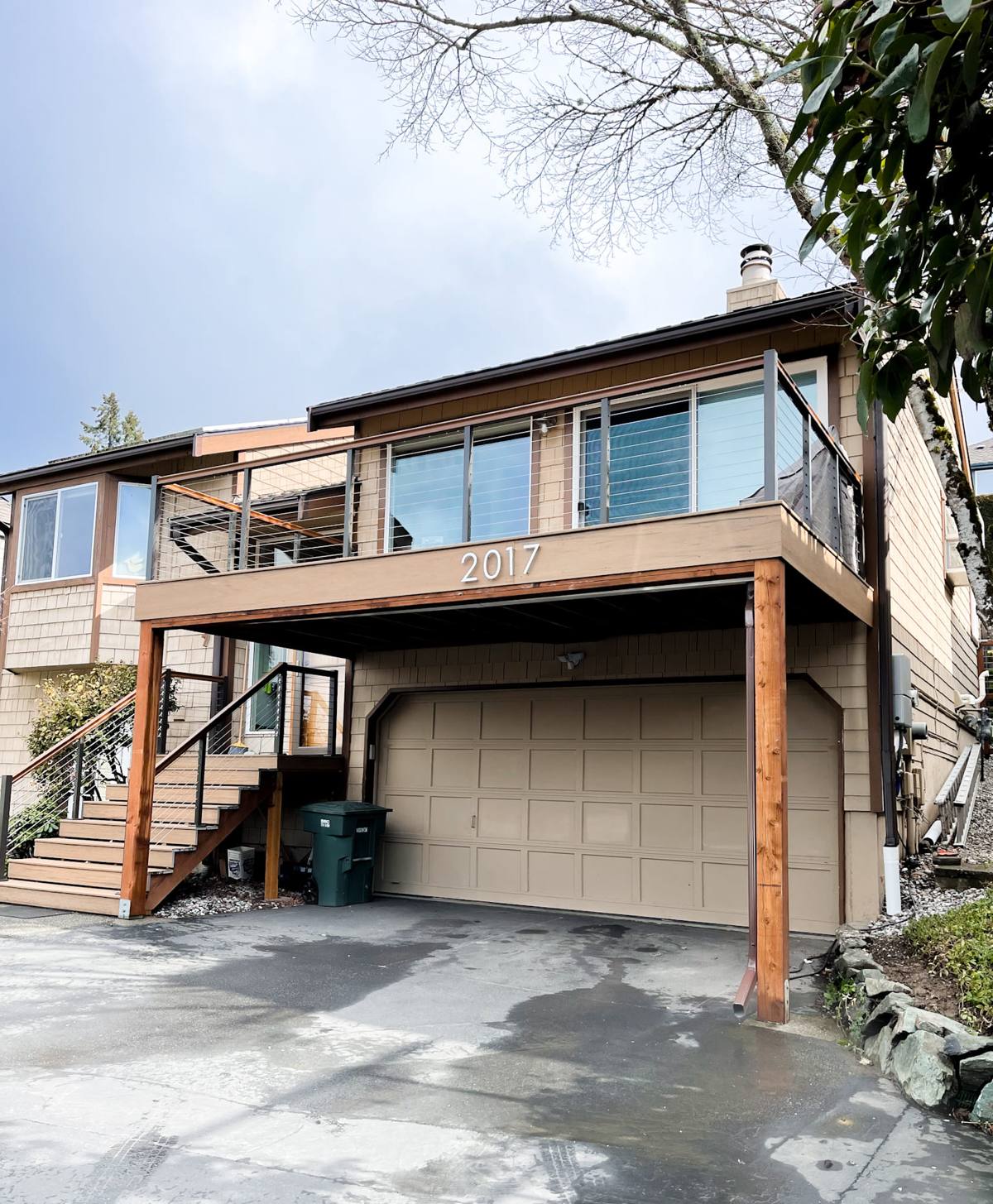
Framing and Fasteners: The Structure Nobody Sees
The framing underneath a deck does the real work, and it's also the part that fails quietly, out of sight, if it's built wrong. In a coastal environment like Birch Bay, three things matter more than usual:
- Fastener material. Standard electro-galvanized screws and nails corrode faster in salt air. We use hot-dip galvanized or stainless fasteners rated for coastal or treated-lumber use, especially anywhere the fastener is in direct contact with treated wood, which speeds up corrosion on the wrong hardware.
- Joist protection. Joist tape over the top of each framing member keeps rainwater from sitting in fastener holes and wicking into the wood grain. It's a small material cost that prevents the slow rot that eventually shows up as soft spots years later.
- Airflow under the frame. Framing height and joist spacing affect how quickly the underside of a deck dries out after a storm. Too little clearance to grade, and that structure stays damp for days at a time — which is exactly the environment moss, algae, and wood rot need.
None of this is visible once the decking goes down, which is precisely why it's worth getting right the first time. A deck that looks fine on top can still have compromised framing underneath if these details were skipped.
Choosing a Decking Material for Salt Air and Rain
There's no single "best" decking material — there's a best fit for how a specific deck will be used, how much upkeep the owner wants to do, and how much direct wind and spray it will see. In Birch Bay, that last factor carries more weight than it would inland.
| Material | How it handles salt air & rain | Maintenance | Typical lifespan |
|---|---|---|---|
| Pressure-treated wood | Needs sealing to resist moisture cycling; fasteners must be corrosion-rated | Annual cleaning, re-sealing every 1-3 years | 10-15 years with upkeep |
| Cedar | Naturally rot- and insect-resistant, but greys and can cup if left unsealed near the water | Cleaning plus periodic oil or stain | 15-20 years with upkeep |
| Composite decking | Doesn't absorb moisture or rot; capped boards resist algae staining better than uncapped | Periodic washing, no sealing or staining | 25-30 years, manufacturer-dependent |
| PVC decking | Fully synthetic, no wood fiber for moisture or moss to latch onto | Lowest upkeep of the group | 25-30+ years, manufacturer-dependent |
We install all of these, and the right call usually comes down to budget and how much maintenance the homeowner actually wants to do. Wood costs less up front but asks for more attention in a climate like this — skip a sealing cycle or two and the wear shows. Composite and PVC cost more initially but hold up with less intervention, which is a real advantage on a deck exposed to constant humidity and salt. Whatever material we're discussing, we walk through the trade-offs honestly rather than pushing one option — the right deck is the one that fits how you'll actually maintain it.
Ledger Attachment and Flashing at the House
The ledger board — where the deck bolts to the house — is the single most common failure point on decks anywhere in the Pacific Northwest, and Birch Bay's rain exposure makes it more important, not less. Water that gets behind an improperly flashed ledger has nowhere to go, and it sits against the house's rim joist and siding, causing rot that's often invisible until the deck starts to feel spongy or pull away from the structure.
A correct ledger installation includes flashing that directs water out and away from the house, a gap or waterproof membrane between the ledger and the siding, and structural bolts (not just deck screws) rated for the load. We check this detail closely on every project — and on repair or rebuild calls, it's frequently the reason we're there in the first place.
Railings and Hardware That Hold Up to Corrosion
Railings take the most direct hit from wind-driven spray, since they're the tallest, most exposed part of the structure. A few material notes worth knowing before you choose a railing style:
- Wood railings need the same sealing schedule as wood decking, and balusters dry out and check faster than the flatter decking boards because they get hit from more angles.
- Aluminum railings are powder-coated to resist corrosion and hold up well near the water, with minimal upkeep beyond occasional washing.
- Cable railing looks clean and keeps sightlines open, but the stainless cable and end fittings still need to be a marine-rated grade — lower-grade stainless will show surface rust in a salt-air environment faster than most people expect.
- Composite or PVC rail systems match low-maintenance decking and avoid the corrosion question on the visible rail entirely, though internal metal brackets and fasteners still need to be rated correctly.
Whatever the material, every bolt, screw, and bracket holding a railing to the frame is a structural safety item, not just a fastener. We spec hardware for the environment it's going into, not just the material it's attaching.
Drainage, Airflow, and Managing Moss Long-Term
Moss doesn't need much to get established — shade, moisture, and still air are enough, and Birch Bay's tree cover and marine humidity provide all three for a good part of the year. You can't eliminate moss risk entirely on an outdoor structure here, but a well-built deck manages it instead of fighting a losing battle:
- Board spacing that lets water drain through rather than pool on the surface
- Adequate clearance and airflow underneath the deck so the frame and undersides of boards can actually dry out between rain events
- Decking material and finish chosen with the deck's sun exposure in mind — a north-facing deck under trees needs a different approach than one in open sun
- A realistic cleaning schedule, since even the best-built deck benefits from an annual wash to remove the organic buildup that gives moss and algae something to grow on
This is another area where design decisions made during the build affect how much work the deck needs later. A deck built without attention to drainage and airflow will need pressure washing and moss treatment far more often than one built with those details handled up front.
Our Process for a Birch Bay Deck Build
Every deck project starts with a site visit, not a phone quote. Birch Bay lots vary a lot in slope, sun exposure, tree cover, and proximity to the water, and those factors change the framing, material, and finish decisions we'd recommend. From there, our process generally looks like this:
- Site assessment. We look at grade, drainage, existing structure (for rebuilds), sun and wind exposure, and how the deck connects to the house.
- Design and material selection. We walk through decking, railing, and fastener options against your budget and how much maintenance you want to take on, with the coastal exposure of the specific site factored in.
- Permitting. Birch Bay is unincorporated, so permitting for most projects runs through Whatcom County rather than a city office. We handle the application and inspections as part of the build.
- Framing and structural work. This is where ledger flashing, joist protection, and fastener grade get handled correctly — the part of the job that determines how the deck ages.
- Decking, railing, and finish work. Installed to the manufacturer's spacing and fastening specs, which matter more in a wet climate where boards expand, contract, and drain differently than they would in a dry one.
- Final walkthrough. We go over maintenance expectations specific to the material you chose and the site's exposure, so there are no surprises about upkeep down the road.
What to Ask Before You Hire a Deck Builder
Not every contractor who builds decks inland builds them the same way for a waterfront-adjacent site. Before hiring anyone for a Birch Bay project, it's worth asking directly:
- What fastener grade will be used, and is it rated for coastal or treated-lumber exposure?
- Will the ledger board be flashed, and how does water get directed away from the house?
- Is joist tape or another moisture barrier included on the framing?
- What's the plan for drainage and airflow underneath the deck?
- Are they pulling the correct permit through Whatcom County for the scope of work?
- Can they explain the maintenance schedule for the specific material you're choosing?
A contractor who's built decks in Birch Bay before should be able to answer all of these without hesitating, because they're the same questions we ask ourselves on every project here. If a bid skips over fasteners, flashing, or drainage entirely, that's usually a sign those details were skipped in the build too.
Why Local Experience in Birch Bay Matters
A deck built for inland Bellingham and a deck built for Birch Bay can use the same lumber and the same basic plan and still age very differently, because the exposure is different. Crews who work this stretch of Whatcom County regularly know which fastener grades hold up, how much clearance a given lot's drainage actually needs, and where moss tends to build up fastest based on sun and tree cover. That's not something you get from a manufacturer's spec sheet — it comes from building and maintaining decks in this specific environment over time.
If you're planning a new deck or replacing one that's showing its age in Birch Bay, we're happy to take a look and talk through what makes sense for your site. The estimate is free, there's no pressure, and you can use the form below to get started.