 Bellingham
 Cordata's Climate Puts Real Stress on a Deck
Cordata sits close enough to Bellingham Bay and the Strait to pick up salt-tinged air, and far enough inland to still catch the heavy, sideways rain that rolls off the water through fall and winter. Add in a moss season that can stretch from October well into spring, and you've got a set of conditions that a lot of decking materials simply weren't designed for. Wood decking in particular takes the brunt of it: boards stay damp for days at a time, moss and algae find a foothold on north-facing sections that never fully dry, and fasteners corrode faster than they would in a drier climate.
None of this is unusual for Whatcom County — it's just the reality of building outdoors here. The difference between a deck that looks good in year eight and one that's already cupping, graying, and growing a green film comes down to two things: the material you choose and how correctly it's installed. This page is specifically about composite decking for Cordata properties — what it needs to hold up here, what a correct installation looks like, and how our process works from first look to final walkthrough.
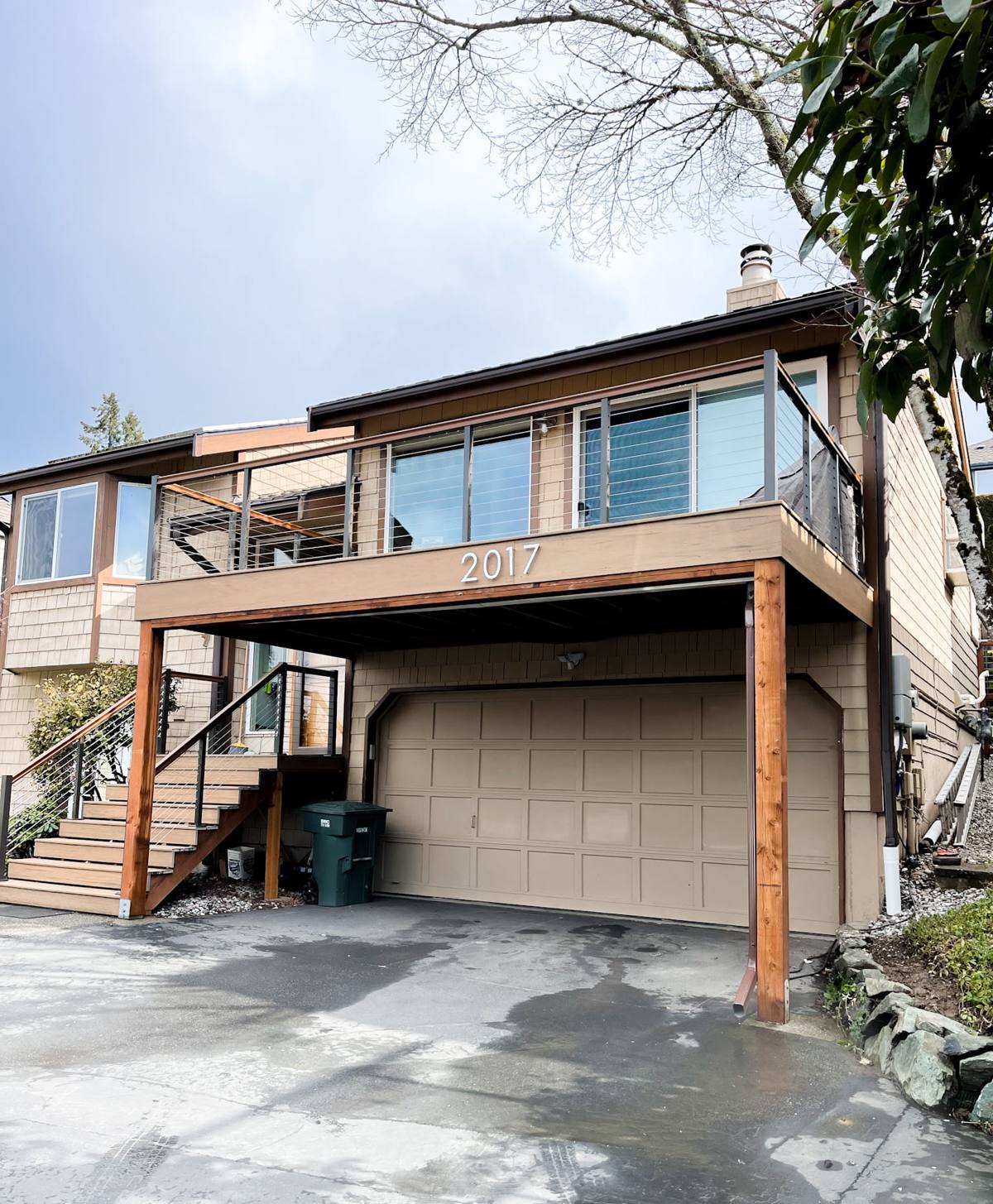
Why Composite Decking Makes Sense in This Climate
Capped composite decking doesn't behave like wood when it's wet. It doesn't absorb water into its cell structure, so it doesn't swell, cup, or splinter the way lumber does after a wet winter. That matters a lot in a place where boards can stay saturated for extended stretches between dry spells. It also means you're not sealing or staining a deck every year or two just to keep moisture out — a maintenance cycle that's easy to fall behind on when the weather rarely gives you a solid dry week to do it in.
We'll also give you the trade-offs, because a composite deck isn't maintenance-free — it's lower-maintenance. The cap layer resists moss and algae staining far better than bare wood, but moss spores don't care what surface they land on, and a shaded, damp section of composite decking can still develop a surface film if it's never cleaned. Composite also costs more upfront than pressure-treated lumber, and dark-colored boards can get noticeably warm on a sunny August afternoon. We'll walk through all of that honestly during your estimate rather than oversell it.
What a Correct Composite Deck Build Actually Involves
Substructure and Drainage Come First
The composite boards get the attention, but the framing underneath them is what determines whether the deck lasts. In a climate that stays wet as long as this one does, we flash the ledger board where it meets the house, use joist tape to keep moisture out of fastener penetrations, and make sure the whole structure slopes slightly away from the building so water doesn't pool against the siding or foundation. We also keep enough clearance underneath the deck for air to move — a low, tight substructure with no airflow is exactly the kind of damp, dark space where mold and rot take hold, composite surface or not.
Fastening, Spacing, and Board Direction
Composite boards expand and contract with temperature more than most homeowners expect, so joist spacing and gap sizing have to match the manufacturer's specs — tighter joist spacing is often required for angled or diagonal board layouts, and gapping that's too tight will cause buckling once the boards heat up. We use hidden fastener systems on the visible field wherever the product line supports it, so you get a clean surface without exposed screw heads that can back out or corrode over time.
Rail, Stairs, and Trim Details
The rail system, stair stringers, and fascia matter as much as the decking field. Stringers need to be rated for the actual load and span, guard rail height and baluster spacing need to meet code, and fascia boards should fully cover the structural edge so you're not looking at exposed treated lumber a year later. These are the details that get rushed on a fast job and show up as problems within a couple of wet seasons.
Comparing Decking Materials for a Cordata Deck
Every material has a place, but they don't perform the same way in a climate this wet. Here's how the common options stack up for a project in this area:
| Material | Upfront Cost | Maintenance Here | Moss/Algae Resistance | Typical Lifespan |
|---|---|---|---|---|
| Pressure-treated lumber | Lowest | Annual cleaning, periodic sealing/staining | Low — grays and grows moss without upkeep | 10-15 years |
| Cedar | Mid-range | Regular sealing to prevent graying and softening | Low to moderate | 10-20 years |
| Capped composite | Higher | Periodic washing, no sealing/staining | Good — cap layer resists staining | 25-30+ years (mfr. warranty dependent) |
| PVC decking | Highest | Periodic washing, no sealing/staining | Very good | 25-30+ years (mfr. warranty dependent) |
Lifespan figures reflect manufacturer warranty ranges under normal use, not a guarantee — actual performance depends on installation quality, sun exposure, and how consistently a deck gets cleaned. We'll talk through which tier fits your budget and how the property is situated (shade, exposure, foot traffic) during the estimate.
How We Approach a Composite Deck Project
Evaluation and Design
We start by looking at the site itself — how the deck ties into the house, drainage slope, sun and shade exposure, and whether an existing structure underneath can be reused or needs to be rebuilt. A deck on a shaded, north-facing side of a Cordata home is going to need different drainage and airflow planning than one that gets afternoon sun.
Material Selection
We'll go over composite product lines, color and board profile options, and rail systems that pair with them, and give you straight information on cost differences between tiers. If a lower-tier composite board fits your budget and use case better than a premium line, we'll say so rather than upselling.
Installation and Cleanup
Framing and flashing work happens first and gets checked before any decking goes down — it's the part of the job nobody sees later but that determines whether the deck stays solid. Boards, rail, stairs, and trim follow, and we keep the site clean and safe to walk through for the length of the project.
Walkthrough and Care Guidance
Before we call the job done, we walk the finished deck with you, point out anything you should know about the specific product installed, and cover the basic cleaning routine that keeps it looking good through the wet months.
Keeping a Composite Deck Ahead of Moss Season
Composite resists staining far better than wood, but a little seasonal attention goes a long way in a climate where things stay damp for months. A simple routine covers most of it:
- Sweep off leaves and debris regularly in fall — trapped organic matter holds moisture against the boards and is the main thing that feeds moss growth
- Wash the deck surface a couple of times a year with a soft-bristle brush and a mild soap-and-water solution, focusing on shaded or low-airflow areas first
- Avoid pressure washers on composite unless you know the product's rated pressure — too much force can scar the cap layer
- Check that gaps between boards stay clear so water can drain through rather than sitting on the surface
- Confirm gutters and downspouts near the deck are directing water away, not onto or under it
- Inspect railing posts and stair connections once a year for any looseness, since these areas take the most structural stress
Deck Problems We Commonly Find on Older Cordata Homes
When we're called out to replace or repair an aging deck in this area, a handful of issues show up again and again: rotted ledger boards where flashing was never installed correctly, joists that were spaced too wide for the decking product that went over them, moss buildup on shaded sections that were never cleaned, and rail posts that have loosened because the original blocking wasn't substantial enough. Most of these trace back to shortcuts taken on the substructure, not the decking material itself — which is why we spend as much time on what's underneath as on what you'll actually see.
Why Hire a Crew That Already Works in Cordata
A lot of what makes a deck last here isn't exotic — it's knowing how this specific climate behaves and building for it every time, not just when it's convenient. That means understanding how drainage needs to be handled on a lot that stays saturated for weeks at a stretch, scheduling installation around the wetter months so framing isn't exposed to rain longer than necessary, and being familiar with Bellingham and Whatcom County permitting requirements for deck size, height, and guard rail specs before the job starts, not after an inspection flags it. A crew that already works in this neighborhood also tends to be easier to reach if a question comes up after the project wraps — we're not driving in from out of the area for a follow-up.
If you're weighing options for a deck in Cordata, we're happy to take a look at your property and give you a straightforward, no-pressure estimate — what it would take, what materials make sense for your site, and an honest cost range. Use the form below to get started.