 Bellingham
 Metal Roofing Built for Edgemoor's Particular Kind of Weather
Edgemoor sits close enough to Bellingham Bay that the air itself is different than it is a few miles inland — damper, saltier, and slower to dry out a roof after a storm rolls through. Add in the tree cover that shades a lot of lots in this part of Bellingham and you get a roofing environment that's tougher on materials than most homeowners realize until they're dealing with premature wear, granule loss, or moss creeping under the shingle tabs. Metal roofing handles this combination better than almost anything else on the market, but only when it's specified and installed with that environment in mind. A metal roof put on the same way you'd do it in a dry inland town isn't going to hold up the same way here.
This page is about metal roofing specifically for Edgemoor homes — what the local climate actually does to a roof, what a correctly installed system looks like, and why it matters that the crew doing the work already has hands-on experience in this exact neighborhood, not just Bellingham in general.
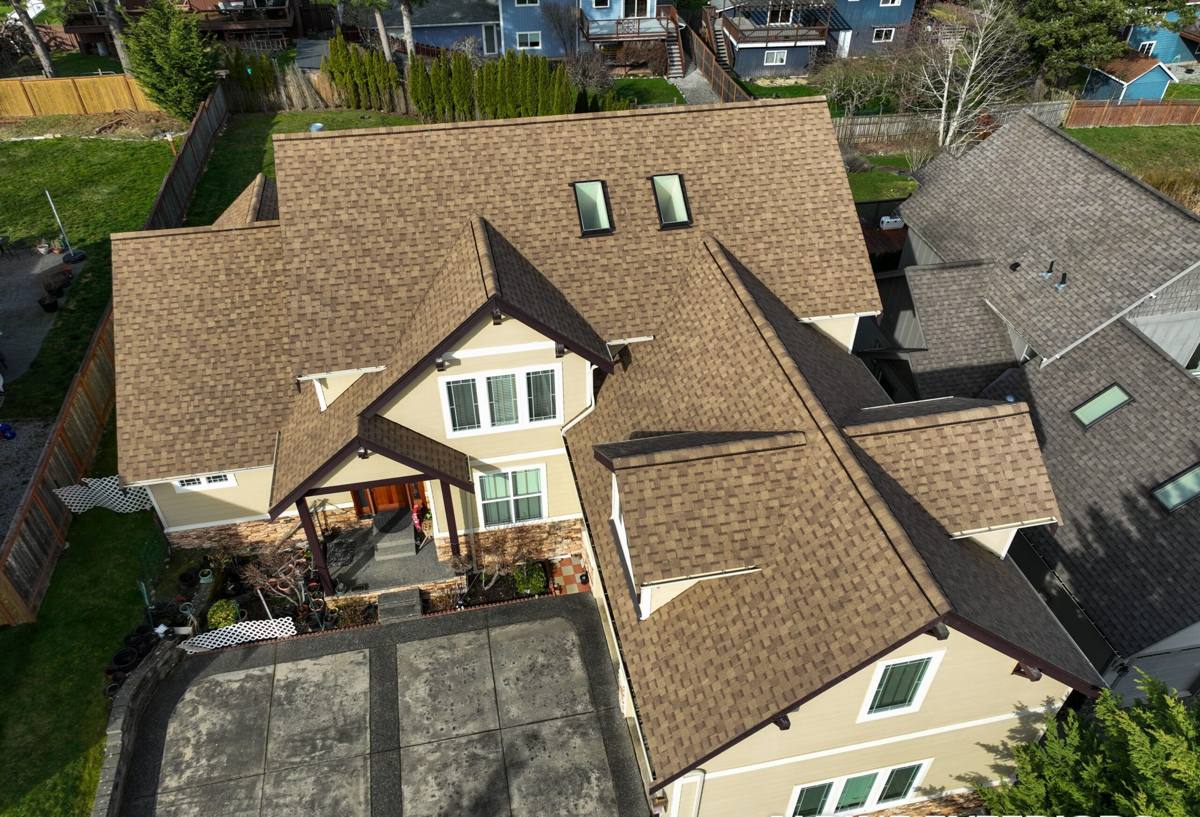
What Bay-Adjacent, Tree-Shaded Weather Does to a Roof
Salt Air and Corrosion
Homes closer to the water pick up airborne salt that settles on exposed metal — fasteners, flashing, gutters, and panel edges. Over years, that accelerates corrosion on anything that isn't rated for coastal or near-coastal exposure. This isn't a dramatic, fast process; it's slow pitting and staining that eventually shows up as rust streaks at cut edges, fastener heads, and flashing seams. It's the reason material selection matters more here than it would twenty miles inland.
Driving Rain and Wind-Driven Water
Storms coming off the water tend to bring rain sideways, not just straight down. That changes how water behaves on a roof — it gets pushed up under laps, into gaps around penetrations, and along ridges and hips where a lesser installation might get away with looser detailing. A roof that only has to shed water falling straight down is a different (easier) problem than one that has to resist wind-driven rain being forced uphill under a panel edge.
Moss, Shade, and Slow-Drying Surfaces
Mature tree canopy is common on wooded lots in this part of Bellingham, and shade plus year-round moisture is exactly what moss wants. On asphalt shingles, moss roots into the granule surface and holds moisture against the deck. Metal doesn't give moss the same foothold, but debris still collects in valleys and against any obstruction, and a roof that stays wet longer because it's shaded will always need more attention than one that gets full sun.
Why Metal Roofing Is a Strong Match for This Environment
None of this means metal roofing is immune to Bellingham's climate — nothing is. It means metal responds to these conditions better than most alternatives, for a few honest reasons:
- Smooth, hard panel surfaces give moss and organic growth far less to grip onto compared to a textured shingle surface.
- Properly lapped and sealed metal seams shed wind-driven rain more reliably than a shingle system relying on gravity and granule adhesion alone.
- Coated steel and aluminum systems, specified correctly for coastal exposure, resist corrosion far longer than uncoated or under-rated fasteners and trim.
- Steeper roof pitches common on Edgemoor's older and custom homes shed water and debris faster, which pairs well with metal's slick surface.
The trade-off is that metal roofing is less forgiving of sloppy installation than shingles are. A shingle roof with a mediocre flashing detail might leak slowly and give you warning. A metal roof with the wrong fastener, the wrong closure strip, or a panel lap installed backward against prevailing wind can fail faster and with less warning. That's exactly why the installation details matter as much as the material choice.
Choosing the Right Metal System for an Edgemoor Home
Not every metal roofing product is the same, and the right choice depends on the home's pitch, exposure, and what the homeowner actually wants to maintain over time.
| System | Fastener Exposure | Best Fit | Maintenance Load |
|---|---|---|---|
| Standing seam | Concealed clips, no exposed fasteners on the field | Homes with bay or partial water exposure; steeper pitches; long-term low-maintenance goals | Low — no fastener heads to monitor or reseal |
| Exposed-fastener panel | Screws through the panel face, with washers/gaskets | Budget-conscious projects, outbuildings, lower-pitch sections | Higher — gaskets and fastener heads need periodic inspection |
| Stone-coated steel | Concealed, similar to standing seam in coverage | Homes wanting a shingle or shake profile with metal's durability | Moderate — coating and granule adhesion should be checked over time |
For most Edgemoor homes with real exposure to bay winds and rain, we lean toward concealed-fastener systems like standing seam. Exposed-fastener panels aren't a bad product, but every screw penetration is a future maintenance point, and that adds up faster in a climate that's already hard on metal hardware.
Gauge and Coating
Thicker panel gauge resists dents and oil-canning better, but it isn't the only thing that determines longevity — the coating system is just as important. In a salt-influenced environment, we favor coatings and metals with documented coastal performance over standard inland-rated products, even when the upfront cost is a bit higher. Paying more once for the right coating is cheaper than a corrosion-driven repair or premature replacement.
The Details That Actually Determine Whether the Roof Performs
Underlayment
Metal roofing gets installed over a synthetic or self-adhered underlayment, not directly on bare decking. In areas prone to wind-driven rain, we pay particular attention to self-adhered ice-and-water membrane at eaves, valleys, and around every penetration — the places where water is most likely to be pushed backward under a panel edge during a storm.
Fasteners and Flashing
In a salt-air environment, fastener and flashing material has to match the panel material to avoid galvanic corrosion — mixing incompatible metals accelerates rust at exactly the points that are hardest to inspect later. This is a detail that's easy to get wrong if a crew isn't used to coastal installs, and it's one of the more common causes of early metal roof failure we see when correcting other contractors' work.
Closures and Terminations
Ridge caps, eave closures, and rake terminations are where wind-driven rain finds its way in if they're not detailed correctly. Foam or metal closure strips need to be fitted tightly against the panel profile, not just caulked and hoped for. This is slow, careful work — and it's the difference between a roof that performs for decades and one that develops slow leaks within a few years.
How We Approach a Metal Roofing Project in Edgemoor
- On-site assessment — we look at pitch, tree exposure, existing decking condition, and how close the home sits to the water, since that affects material recommendations.
- System recommendation — we walk through panel type, gauge, and coating options honestly, including cost trade-offs, rather than defaulting to one product for every job.
- Tear-off and deck inspection — any soft, rotted, or moisture-damaged decking gets addressed before a single panel goes on; covering up a bad deck is how a good roof fails early.
- Underlayment and flashing installation — this is where most of the actual weatherproofing happens, done to the details above, not rushed to get to the visible panel work.
- Panel installation — set to manufacturer spec for fastening pattern, seam engagement, and expansion allowance, accounting for local wind exposure.
- Final walkthrough — we review the completed roof with the homeowner, including what routine maintenance to expect given the property's shade and exposure.
Living With a Metal Roof in a Moss-Prone, Bay-Adjacent Neighborhood
A correctly installed metal roof needs far less maintenance than shingles, but "far less" isn't "none." A short seasonal checklist keeps a metal roof performing the way it's supposed to:
- Clear needles, leaves, and branch debris out of valleys and off any low-slope sections, especially after fall windstorms.
- Check gutters and downspouts for moss and debris buildup, particularly on shaded sides of the roof.
- Walk the roofline visually (from the ground or a ladder, not by climbing on the panels) for any streaking at fastener heads or seams that could signal a coating issue.
- Trim back overhanging branches where practical to reduce shade, debris load, and the risk of impact damage during storms.
- After any major wind event, do a quick visual check for lifted trim, loose closures, or displaced ridge caps.
Why It Matters That We Already Work This Neighborhood
Metal roofing specs that work fine in a dry, inland part of Whatcom County aren't automatically right for a home with real exposure to Bellingham Bay's air and weather. A crew that's already worked on homes in this part of Bellingham has a feel for which lots get hit hardest by wind-driven rain, which ones sit under enough canopy that moss and debris are a year-round concern, and which fastener and flashing choices have actually held up here versus which ones show corrosion after a handful of winters. That's not something you get from a spec sheet — it's something you get from doing the work in this specific area, season after season.
It also matters for the practical side of a project: knowing what access looks like on wooded, sloped lots, understanding typical roof pitches on Edgemoor's older and custom-built homes, and being realistic with homeowners about how long a job will take given tree cover and weather windows.
Get a Straight Answer for Your Roof
If you're weighing metal roofing for a home in Edgemoor, we're glad to take a look and give you an honest read on what your roof actually needs — no pressure, no inflated recommendations. Fill out the form below for a free estimate, and we'll walk you through the options that make sense for your specific home and exposure.