 Bellingham
 Why Puget's Climate Is Hard on Exterior Siding
Homes in the Puget area of Bellingham sit close enough to the water and the weather patterns rolling off it that siding takes a different kind of beating than it would twenty miles inland. It's not one dramatic event that wears siding out here — it's the accumulation of three things happening at once, year after year.
First is salt air. Even a modest distance from saltwater is enough to carry fine salt particles onto exterior surfaces, where they settle into seams, fastener heads, and any spot where the finish has started to open up. Salt air accelerates corrosion on unprotected metal trim and fasteners, and it can slowly degrade paint films that weren't formulated to handle it.
Second is driving rain. Whatcom County doesn't just get rain — it gets wind-driven rain that hits siding at an angle instead of falling straight down. That matters because siding systems are designed to shed water moving downward. Wind-driven rain pushes moisture sideways and upward into laps, seams, and penetrations that a straight-down rain would never reach.
Third is a long moss season. Cool, damp, and shaded conditions for much of the year create ideal growing conditions for moss and algae on north-facing walls, under eaves, and anywhere air movement is limited. Moss holds moisture against the siding surface far longer than the siding itself would otherwise stay wet, which is where a lot of hidden problems start.
None of these three factors is unique to Puget. What's unique is having all three working on a home at the same time, for most of the year. That combination is exactly what we evaluate before we recommend a siding system or an installation approach.
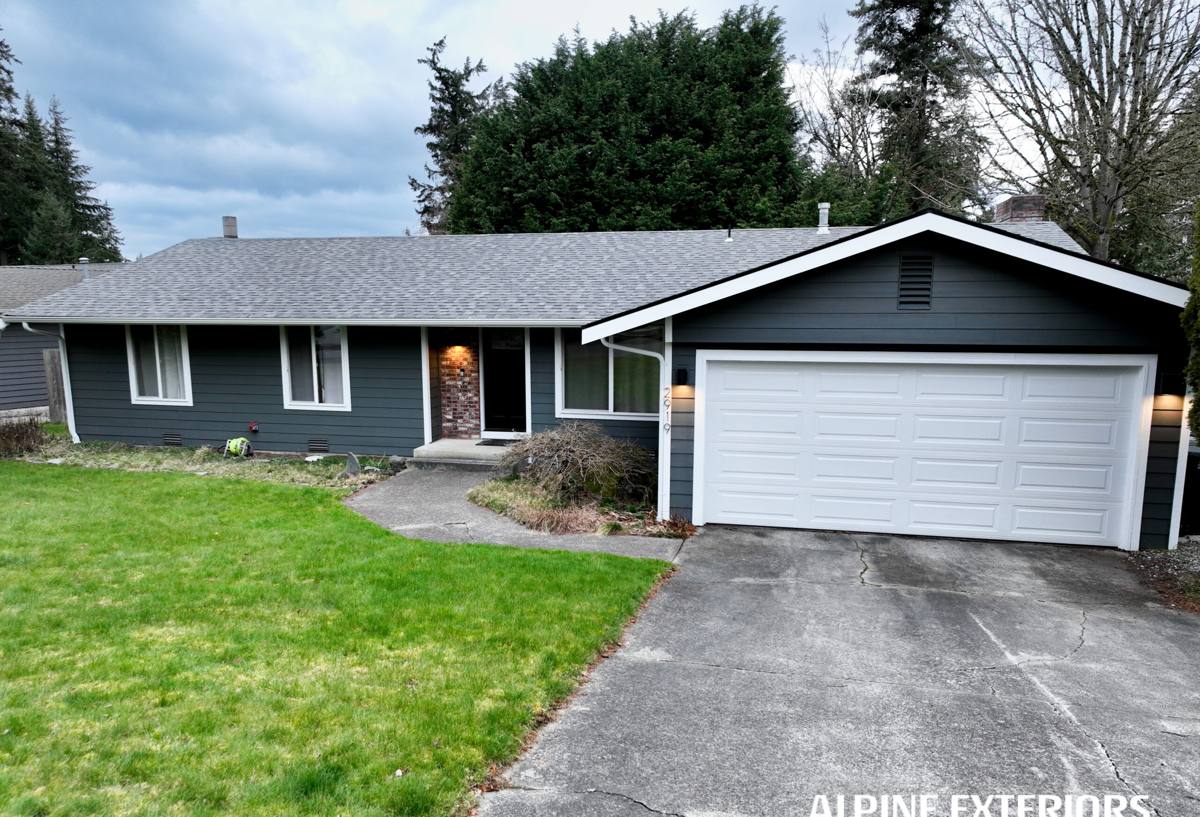
What Correct Siding Needs to Do in This Environment
Manage Water, Don't Just Repel It
Good siding isn't just a waterproof shell — it's a managed system. Water that gets behind siding (and some always will, through wind-driven rain, condensation, or minor penetrations) needs a way to drain and dry out. That means correct flashing at every window, door, and roofline transition, a weather-resistant barrier behind the siding, and enough of a gap or drainage plane that trapped moisture doesn't just sit against the wall sheathing.
Resist Moisture Absorption at the Material Level
The siding material itself matters as much as the installation. Wood-based products absorb moisture readily, which is exactly the wrong trait in a climate with a long wet season and heavy moss growth. A material that stays dimensionally stable and resists moisture absorption at the panel level gives the rest of the water-management system a much easier job.
Hold a Finish Under UV, Salt, and Damp Cycling
Puget siding cycles between damp and dry constantly. A paint or finish system that isn't formulated for that kind of cycling — combined with salt exposure and UV — will chalk, fade, or peel years before it should. This is a finish problem as much as a material problem, and it's one of the main reasons we're selective about what goes on the wall.
James Hardie: The Only Fiber Cement System We Install
We install James Hardie fiber cement siding exclusively — not as a brand preference, but because of how the product is engineered and finished. Hardie's HZ5 product line is specifically formulated for climates like ours: wetter, cooler, and more prone to moisture cycling than the HZ10 line built for hot, dry regions. That's not marketing language — it's a real formulation difference in how the cement composite handles moisture over time.
The factory-applied ColorPlus finish is the other half of the equation. Because it's baked on in a controlled factory process rather than field-applied, it holds color and resists the chalking and fading that field-applied paint struggles with under repeated wet-dry, sun-shade cycling. For a home dealing with salt air and a long moss season, that finish durability is not a cosmetic detail — it's what keeps the material underneath protected.
We don't install LP SmartSide, vinyl, or cedar because each of those products asks a homeowner to accept a trade-off we're not willing to build a reputation on in this climate — whether that's wood-based moisture absorption, a finish that needs more frequent attention, or a warranty structure that doesn't hold up the way Hardie's does. Fiber cement done right, with the correct product line for this specific climate, is the standard we hold every job to.
Signs Existing Siding Is Losing the Fight
If you're trying to decide whether it's time to look at replacement, these are the signs we see most often on Puget-area homes before an owner calls us:
- Persistent moss or algae streaking on north- or shade-facing walls that returns within a season of cleaning
- Paint that's chalking, peeling, or bubbling, especially near ground level or under eaves
- Soft or spongy spots when pressed, particularly around window trim and bottom courses
- Visible gaps, warping, or cupping in horizontal lap siding
- Rust staining running down from fastener heads or metal trim pieces
- A musty smell or visible staining on interior walls that share an exterior wall with problem siding
Any one of these can be a minor, fixable issue. Several showing up together, especially on a home that's had wood-based or older siding for fifteen-plus years, usually means the water-management layer underneath has been compromised for a while.
What a Correct Installation Involves
Preparation and Water Barrier
Every correct job starts with the wall, not the siding. That means confirming the sheathing underneath is sound, installing a continuous weather-resistant barrier, and flashing every window, door, and penetration before a single piece of siding goes up. In a driving-rain climate, this hidden layer does more work over the life of the siding than the visible finish does.
Fastening and Joint Treatment
Hardie siding has to be fastened, gapped, and caulked to manufacturer specification — not "close enough." Butt joints, corners, and penetrations are exactly where wind-driven rain finds its way in if they're rushed. We follow James Hardie's published installation instructions because deviating from them is also what puts the manufacturer's warranty at risk.
Trim, Flashing, and Ventilation Details
Around Puget's damp, shaded lots especially, we pay close attention to clearances between siding and grade, deck ledgers, and roof-to-wall transitions, and to keeping enough of a gap for the wall to dry. These are the details that determine whether moss and trapped moisture become a five-year problem or a non-issue.
How Our Process Works
- Walkthrough and assessment — we look at your current siding, trim, flashing, and any problem areas, and talk through what your home's exposure (sun, shade, wind direction) actually demands.
- Written estimate — clear scope, product line, and pricing, with no pressure to sign on the spot.
- Prep and scheduling — we plan around the wet season where possible and protect the work area from the weather during the job.
- Installation to spec — barrier, flashing, and Hardie panels installed to manufacturer instructions, not shortcuts.
- Final walkthrough — we go over the finished work with you before we consider the job done.
What Drives the Cost of a Siding Project
Every home is different, but these are the factors that most affect the scope and price of a fiber cement siding project in this area:
| Factor | Why It Matters in Puget |
|---|---|
| Removal of existing siding | Wood or older siding often hides moisture damage that needs repair before new siding goes on |
| Home size and wall complexity | More corners, dormers, and trim details mean more flashing and cutting labor |
| Sheathing and wall condition | Long-term moisture exposure can mean sections of sheathing need replacing, not just siding |
| Siding profile and accessories | Lap width, trim style, and soffit/fascia work change material and labor costs |
| Access and site conditions | Tree cover, slope, and tight lot lines common on shaded Puget properties can affect staging and labor time |
We won't quote a number without seeing the home, but these are the variables that separate a straightforward re-side from a more involved project.
Living With Fiber Cement Siding in a Moss-Prone Climate
Correctly installed Hardie siding is low-maintenance, not zero-maintenance. A little seasonal attention goes a long way toward protecting the investment:
- Rinse siding gently once or twice a year, especially shaded north-facing walls, to keep moss and algae from establishing
- Trim back vegetation and tree limbs that keep sections of the wall in constant shade and dampness
- Check caulking at trim, window, and door joints annually and have any cracked or missing caulk redone
- Watch for and address any paint chalking or fading early, before the substrate underneath is exposed
- Keep gutters and downspouts clear so overflow isn't running down the wall face
- Avoid pressure washing directly at joints and edges — a soft wash is safer for the finish
None of this is heavy upkeep. It's the difference between a homeowner who checks these things once a year and one who doesn't, and it shows up in how the siding looks a decade later.
Why Hiring a Crew That Already Works in Puget Matters
Siding crews who haven't worked much in Whatcom County's coastal microclimates tend to install to a generic standard — the same flashing details and gap allowances they'd use anywhere. That's not automatically wrong, but it misses the margin this environment actually calls for. A crew that regularly works Puget and similar Bellingham-area neighborhoods has already seen where wind-driven rain finds gaps, which walls hold moss longest, and which trim details fail first when salt air and damp cycling go to work on them.
That local pattern recognition shows up in small decisions during installation — an extra bead of sealant at a joint that tends to open up, a flashing detail sized for wind-driven rain instead of straight-down rain, a gap allowance that accounts for how long this climate keeps materials damp. None of it is dramatic, but it's the difference between siding that looks right on installation day and siding that still looks right in year twelve.
If your Puget-area home needs new siding, or you're not sure whether what's on the wall now is holding up the way it should, we're happy to take a look. A walkthrough and written estimate are free, with no pressure to commit — just a straight assessment of what your home actually needs.