 Bellingham
 Why Sehome Siding Takes More Punishment Than People Expect
Sehome sits close enough to Bellingham Bay that salt-laden air is a constant, low-grade stress on every exterior surface in the neighborhood, not just the homes with a water view. Add Whatcom County's long stretch of driving rain each fall and winter, plus the shade thrown by the mature trees that line so many of Sehome's older streets, and you get a climate that's genuinely tough on siding. It's not one dramatic storm that causes the damage — it's the accumulation. Salt air slowly works on fasteners and finishes. Wind-driven rain finds every gap in flashing and caulking. And where sun exposure is limited by tree canopy or a north-facing wall, moisture just sits there longer than it should.
Homes in this part of Bellingham also tend to be a mix of ages — some early- to mid-century construction alongside newer infill — which means siding systems installed decades ago are frequently reaching the end of their service life at the same time the climate is doing its worst work. That combination is why we treat a Sehome siding job differently than we would in a drier inland town: the material choice and the installation details both have to account for near-constant moisture exposure, not occasional exposure.
What James Hardie Fiber Cement Is Actually Built to Handle
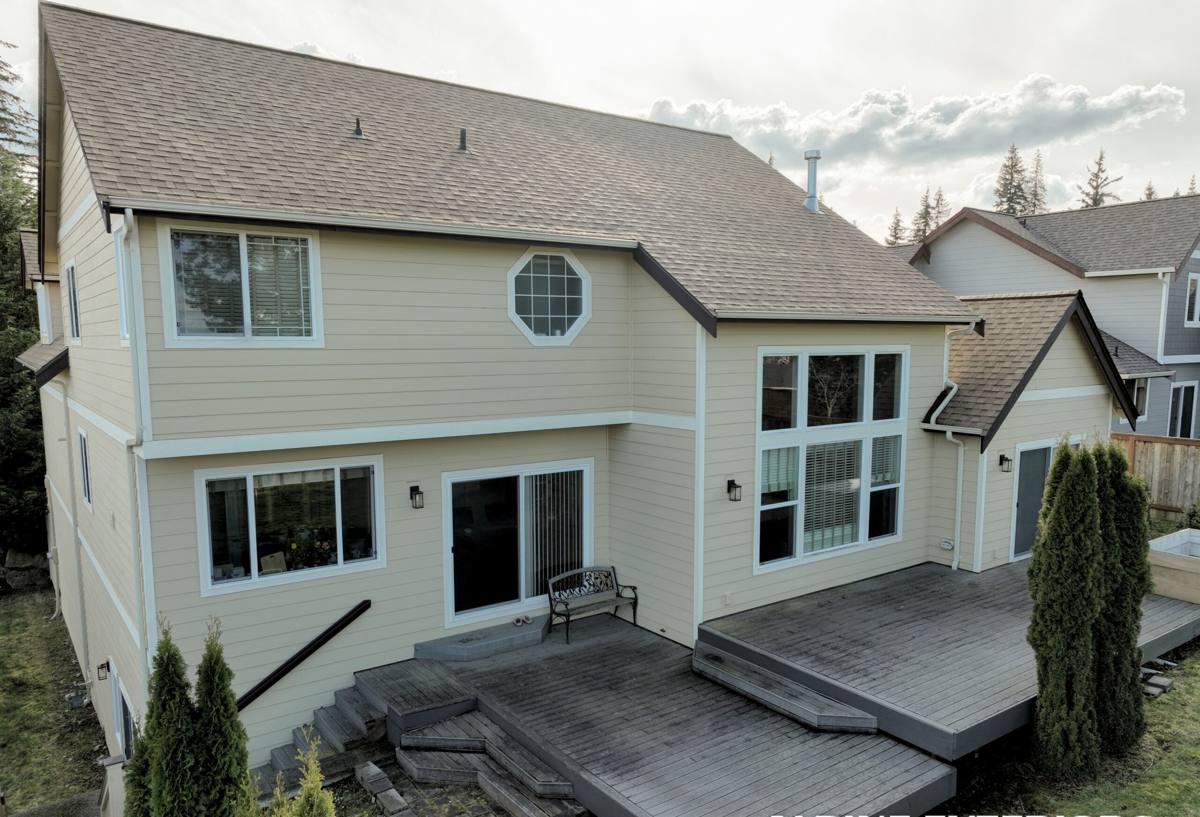
James Hardie siding is a fiber cement product — a blend of cement, sand, and cellulose fibers, engineered and pressed into planks, panels, or shingle profiles. For a climate like Bellingham's, the relevant facts are simple: it doesn't rot, it doesn't provide the organic material that mold and moss feed on the way raw wood does, and it doesn't swell or delaminate when it absorbs moisture the way some engineered wood products can. James Hardie also manufactures its HardieZone products in region-specific formulations, and the HZ5 line is engineered for the wetter, harsher climates found throughout the Pacific Northwest — which includes Whatcom County.
The factory-applied ColorPlus finish matters just as much as the substrate. It's baked on under controlled conditions, which gives it better adhesion and UV/color stability than a field-applied paint job, and it holds up better against the fading and chalking that salt air and constant UV-rain cycling can cause over time. For a Sehome home, that finish durability is the difference between repainting every several years and going a long stretch without touching the exterior at all.
The Moss Problem Is Bigger Than Cosmetic
Why Moss on Siding Actually Matters
Moss on a roof gets most of the attention, but moss and algae growth on siding is a real issue in shaded, moisture-heavy neighborhoods like Sehome. Beyond the green staining, moss holds moisture directly against the siding surface for extended periods. On wood-based products, that trapped moisture is exactly what accelerates rot at seams, butt joints, and fastener penetrations. It also keeps the surface below siding damp longer after every rain event, which is a problem when your rainy season runs most of the year.
How Fiber Cement Changes That Equation
Because James Hardie siding is cement-based rather than wood-based, moss and algae sitting on the surface aren't feeding on the material itself the way they would on cedar or an engineered wood product. That doesn't mean a shaded wall in Sehome will never need a gentle wash — it will, eventually, like any exterior surface under trees — but the consequences of neglecting it are far less severe. You're dealing with an appearance issue, not a structural one.
What a Correct Installation Actually Involves
James Hardie siding is only as good as the installation behind it. The product is engineered to perform for decades, but poor installation is the single biggest reason any siding job fails early — and in a wet climate, installation mistakes get exposed fast.
Flashing and the Water-Resistive Barrier
Everything starts with what's underneath the siding. Proper flashing at windows, doors, and roof-to-wall transitions, paired with a correctly lapped water-resistive barrier, is what actually keeps bulk water out of the wall assembly. The siding itself is a second line of defense, not the only one. In a neighborhood catching driving rain off the Sound, cutting corners here is what leads to hidden rot behind siding that looks fine from the curb.
Gaps, Clearances, and Fastening
James Hardie's own installation specifications call for specific gaps at butt joints, trim, and any place siding meets a dissimilar material, along with minimum clearance from the ground, roofline, and other horizontal surfaces. Skipping these gaps is one of the most common corner-cutting mistakes we see on other contractors' work — it looks fine on day one and causes wicking and paint failure within a few wet seasons. Fastener placement and type matter too; the wrong fastener or a poorly countersunk nail is a slow leak point waiting to happen.
Caulking, Sealing, and Finish Work
Correct caulking at joints and penetrations, plus proper field-touch-up of any cut edges with manufacturer-approved product, protects the parts of the installation where factory finish alone doesn't cover the material. This is detail work, and it's exactly the kind of step that gets rushed on a job priced too low or crewed too thin.
- Water-resistive barrier lapped correctly, shingle-style, with flashing integrated at every penetration
- Manufacturer-specified gaps maintained at butt joints, trim, and clearances to roofline, deck, and grade
- Corrosion-resistant fasteners, set to the correct depth — not overdriven, not proud
- Factory-cut and field-cut edges sealed or primed per James Hardie's written instructions
- Caulking used only where specified, with a product rated for the exposure
James Hardie Product Lines Worth Considering in Sehome
James Hardie makes several distinct profiles, and the right one depends on the home's existing architecture, its exposure, and the look the owner wants. We walk through these options during the estimate rather than defaulting to one product for every house.
| Product Line | Profile | Best Fit |
|---|---|---|
| HardiePlank | Horizontal lap siding | Most common choice; traditional and craftsman-style homes |
| HardieShingle | Staggered or straight-edge shingle panels | Homes wanting a cedar-shake look without the maintenance |
| HardiePanel | Vertical large-format panel | Modern facades, accent walls, gable ends |
| HardieTrim | Fascia, corner boards, and trim stock | Pairs with any of the above for a finished, consistent look |
For homes with heavier tree cover or north-facing exposure, we also talk through ColorPlus color selection — darker colors handle UV differently than lighter ones, and in a shaded lot that's worth weighing against how quickly moss or algae staining shows up visually.
Our Process, Start to Finish
- On-site estimate: We look at existing siding condition, wall assembly, trim details, and any visible moisture or rot issues before quoting anything.
- Tear-off and inspection: Once old siding comes off, we inspect sheathing and framing for hidden damage — common on older Sehome homes where siding has been up a long time.
- Repair and weather barrier: Any compromised sheathing gets addressed, and a new water-resistive barrier and flashing system goes on correctly before a single piece of Hardie touches the wall.
- Installation: Siding, trim, and any shingle or panel accents go up to manufacturer spec — gaps, fasteners, and flashing integration checked as we go, not just at the end.
- Finish work: Caulking, touch-up painting on cut edges, and trim detailing.
- Final walkthrough: We go over the finished job with the homeowner before calling it done.
What It Costs and Why
Every Sehome home is different, so we won't quote a number without seeing the house, but the factors that move a bid up or down are consistent from job to job.
| Factor | Why It Matters |
|---|---|
| Home size and number of stories | More square footage and taller walls mean more material and more labor, including access equipment |
| Siding profile mix | Combining lap siding with shingle accents or panel details adds labor complexity over a single profile |
| Condition behind existing siding | Hidden rot or sheathing damage found during tear-off adds repair work before new siding goes on |
| Trim and architectural detail | Bay windows, multiple gables, and dormers all add cutting and fitting time |
| Color selection | Standard ColorPlus colors versus premium or custom finishes can shift material cost |
Why We Only Install James Hardie
We get asked fairly often why we don't offer vinyl, LP SmartSide, or cedar as options. Each of those products has legitimate strengths — vinyl is inexpensive, LP SmartSide is engineered wood that's easier to install than solid lumber, and cedar has a natural look plenty of homeowners love. But in a climate like Bellingham's, we've made a professional call that those trade-offs aren't worth it on the homes we put our name on. Vinyl can warp and fade under UV and temperature swings, and it doesn't hold up structurally the way fiber cement does. Engineered wood products remain wood-based, meaning moisture management and edge-sealing become critical maintenance items in a climate that offers little dry season to catch up. Cedar is beautiful but demands ongoing staining, sealing, and vigilance against rot and insect damage — real upkeep that a lot of homeowners underestimate when they choose it. James Hardie's fiber cement composition, factory finish, and climate-specific HZ5 engineering line up with what Whatcom County's weather actually demands, which is why it's the only product we put on a wall.
Why Local Experience in Sehome Specifically Matters
A siding crew that already works in and around Sehome understands the practical realities of the neighborhood: mature street trees that limit staging and access, a mix of home ages that means older wall assemblies need to be inspected rather than assumed, and hillside lots where drainage and wind exposure vary block to block. That local familiarity also extends to the City of Bellingham's permitting process, which applies to exterior work here the same way it does anywhere else in the city. A contractor who's pulled permits and worked walls in this exact area isn't guessing at how a Sehome home is built — they've already seen it.
Signs Your Current Siding May Already Be Failing
- Soft or spongy spots when you press on the siding, especially near the bottom courses
- Paint that's peeling, bubbling, or needing repainting far more often than it used to
- Visible gaps, warping, or buckling in panels or planks
- Persistent moss or dark staining that doesn't wash off and keeps returning
- Rising energy bills that suggest the wall assembly behind the siding isn't performing
If any of that sounds familiar, it's worth getting a professional look before small problems turn into sheathing or framing repairs.
If you're weighing a siding project on a Sehome home, we're happy to take a look and walk you through what we're seeing — no pressure, no obligation. Use the form below to request a free estimate.