 Bellingham
 Sunnyland's Siding Has to Work Harder Than Most
Sunnyland is one of Bellingham's older, more established neighborhoods, and it shows in the best way — mature trees line the streets, yards have decades of growth, and the housing stock spans everything from early-1900s cottages to mid-century additions and newer infill. That character is part of why people love living there. It's also exactly why siding in Sunnyland tends to fail differently than siding out in a newer, more open subdivision.
Three things stack up against exterior walls here. First, Bellingham sits on Bellingham Bay, and even a few miles inland the air still carries salt and moisture that slowly breaks down finishes, fasteners, and any siding product with a weak moisture tolerance. Second, Whatcom County's weather pattern brings driving rain off the Pacific for much of the fall, winter, and spring — rain that doesn't just fall straight down, it gets pushed sideways into walls, especially on west- and south-facing elevations. Third, Sunnyland's tree canopy — one of its best features — also means more shade, more standing dampness, and a longer moss season than a home would see on an open lot with full sun exposure most of the day.
None of that makes Sunnyland a bad place to own a home. It just means the siding has to be chosen and installed with those three conditions in mind, not treated as an afterthought.
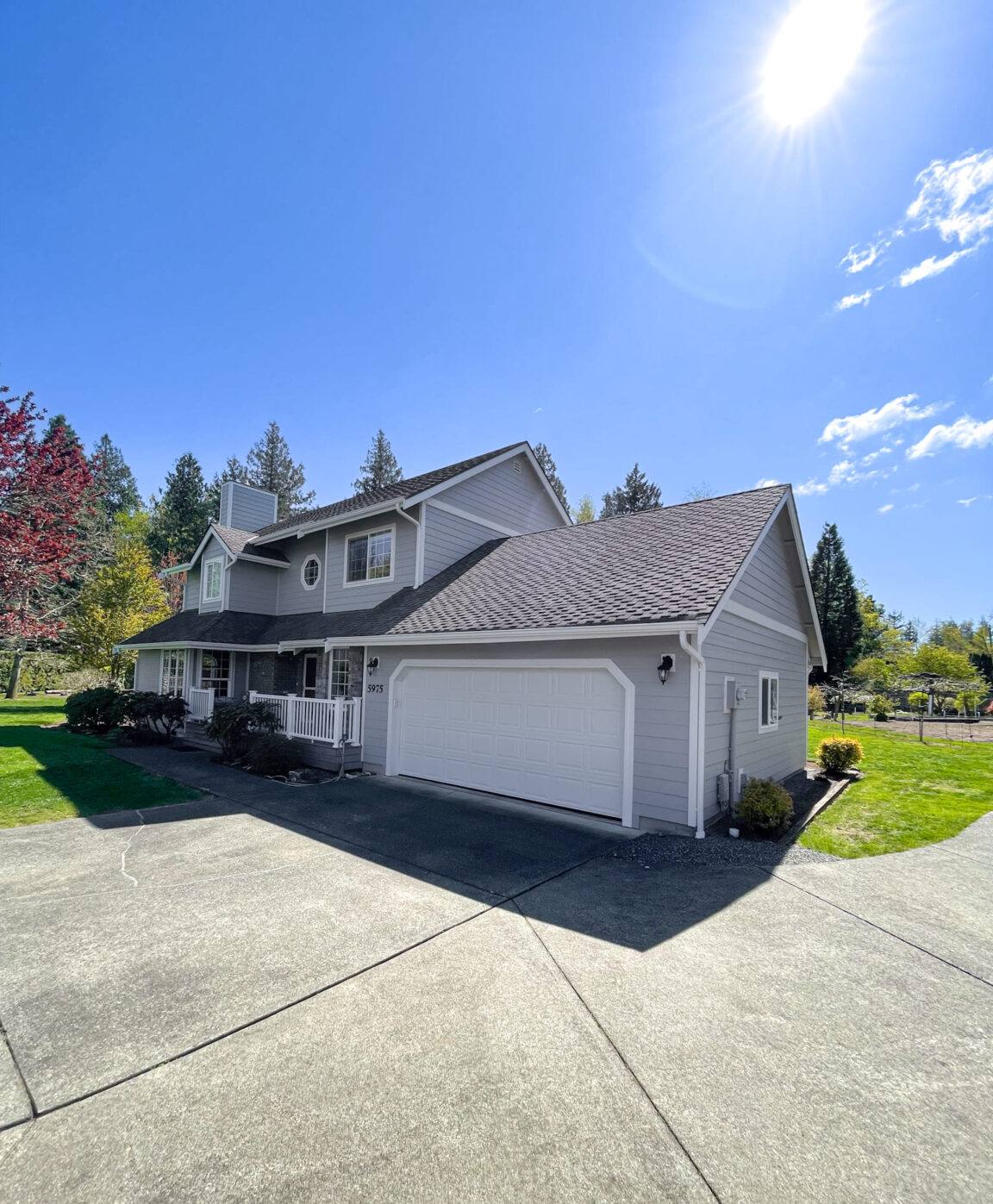
Signs Your Siding Is Telling You It's Done
Homeowners often wait too long to replace siding because the damage isn't dramatic — it's slow. By the time it's obvious from the street, moisture has usually been getting behind the wall for a while. Here's what we look for, and what you can check yourself:
- Soft or spongy spots when you press on the siding, especially near the bottom courses and around window trim
- Persistent moss or dark green-black staining that comes back within weeks of being cleaned off
- Paint that's bubbling, peeling, or needing repainting more often than every 7-10 years
- Visible warping, cupping, or gaps opening up between boards or panels
- Musty smell inside near exterior walls, or unexplained interior humidity
- Cracked or crumbling caulk joints around windows, doors, and corner trim
- Siding that's original to a home built before the 1990s and has never been replaced
If you're seeing two or more of these, especially on a shaded or north-facing wall, it's worth having it looked at before another wet season passes.
What a Correct Siding Replacement Actually Involves
Siding replacement is not just pulling old boards off and nailing new ones on. In a climate like Bellingham's, the parts nobody sees — the water-resistive barrier, the flashing, the fastening pattern — matter more than the finish coat, because that's what determines whether the wall stays dry for the next 30-plus years.
Tear-Off and Sheathing Inspection
Once the old siding comes off, the sheathing underneath gets inspected before anything new goes up. This is the point where hidden rot from years of driving rain and poor flashing usually shows up. Any soft or damaged sheathing gets repaired or replaced — covering it up with new siding and hoping it holds is how homeowners end up with the exact same problem five years later, just hidden again.
Water-Resistive Barrier and Flashing
A properly lapped weather-resistive barrier, correctly integrated flashing at every window, door, and roofline intersection, and properly sealed penetrations (hose bibs, vents, electrical) are what actually keep Bellingham's sideways rain out of the wall assembly. This is the step most likely to get rushed on a low-bid job, and it's the one that matters most in a marine climate.
Fastening, Clearances, and Ground Contact
Fiber cement siding has manufacturer-specified fastening patterns, clearances from grade, roof lines, and decks, and minimum gaps at trim — all of which exist specifically to keep moisture from wicking into the material. On tree-covered, damp lots like a lot of what you find in Sunnyland, we also pay close attention to clearance from shrubs and low branches that hold moisture against the wall and feed moss growth.
Why We Install Only James Hardie Fiber Cement
We get asked why we don't offer vinyl, LP SmartSide, cedar, or other fiber cement brands. It's not that those products don't have a place — it's that we standardized on one system we can stand behind fully, install to spec every time, and warranty with confidence in exactly the conditions Whatcom County throws at a wall.
| Material | How It Handles Moisture & Moss | Maintenance Burden | Long-Term Trade-Off |
|---|---|---|---|
| Vinyl | Doesn't rot, but seams and J-channels trap moisture behind the panel where it can't dry out or be inspected | Low, but cracks and fades over time, especially with UV and temperature swings | Can't be repainted to refresh color; damaged sections often don't match faded originals |
| LP SmartSide (engineered wood) | Treated for moisture resistance, but it's still wood-based — edges and cut ends need careful sealing and stay vulnerable | Moderate; repainting and caulk maintenance are non-negotiable | Warranty coverage often depends on strict, ongoing maintenance being documented |
| Cedar | Beautiful natural material, but absorbs moisture and is a known food source for moss and mildew in shaded, damp settings | High; regular refinishing, sealing, and moss treatment needed | Shortest realistic lifespan of the group in a wet, shaded climate without diligent upkeep |
| James Hardie fiber cement | Non-combustible, dimensionally stable, engineered specifically for wet climates (HZ10 product line) | Low; factory ColorPlus finish resists moss staining and holds up without repainting for years | Higher upfront material cost, but backed by a strong transferable warranty when installed to spec |
Hardie's HZ5 and HZ10 product lines exist specifically for the Pacific Northwest's combination of rain, humidity, and moss pressure. The factory-applied ColorPlus finish is baked on under controlled conditions, which is a big part of why it resists the streaking and staining that field-painted siding picks up fast under a tree canopy.
Our Process for Sunnyland Projects
- Walkthrough and assessment — we look at your current siding, trim, flashing, and any trouble spots (shaded walls, low branches, drainage issues) specific to your lot.
- Product and color selection — choosing the right Hardie plank profile, panel style, and ColorPlus color for your home and the neighborhood's character.
- Written estimate — a clear scope of work, so you know exactly what's being torn off, repaired, and replaced before anything starts.
- Tear-off and sheathing repair — old siding removed, sheathing inspected and repaired as needed before anything new goes up.
- Weather barrier, flashing, and installation — installed to Hardie's fastening and clearance specifications, not shortcuts.
- Trim, caulking, and final detailing — the finish work that determines how clean the job looks and how well it sheds water long-term.
- Site cleanup and walkthrough — nothing left behind, and we go over the finished work with you directly.
What Drives Cost on a Sunnyland Siding Job
Every home is different, so we don't quote a number until we've actually looked at yours — but these are the factors that most often move a project up or down in scope:
| Factor | Why It Matters |
|---|---|
| Home size and wall complexity | More corners, gables, and dormers mean more cutting, flashing, and labor time |
| Condition of existing sheathing | Rot found during tear-off adds repair work that can't be assessed until the old siding is off |
| Tree and access constraints | Mature trees common in Sunnyland can limit staging, ladder placement, and material handling |
| Trim, soffit, and fascia scope | Whether trim is replaced or reused affects both cost and how well the finished job sheds water |
| Siding profile and panel choice | Lap plank, panel, and shingle-style Hardie products differ in material and labor cost |
| Number of stories and roof pitch | Taller walls and steeper rooflines require more equipment and time to work safely |
Why a Crew That Already Works Sunnyland Makes a Difference
A siding crew that's worked other homes in your neighborhood already knows things a crew from out of the area has to figure out on the fly: how Bellingham's building department handles permitting for full siding replacement, how older Sunnyland homes were typically framed and sheathed, and where moisture tends to collect on lots with heavy tree cover and narrow side yards. That local knowledge shows up in fewer surprises mid-project and a finished job that fits the look of an established, tree-lined street rather than looking out of place on it.
It also means we're not guessing at how Whatcom County's specific mix of salt air, driving rain, and moss pressure behaves over a full year — we've seen it on homes like yours, in your neighborhood, through more than one wet season.
Keeping New Siding Looking Right After Installation
Hardie fiber cement with a ColorPlus finish is low-maintenance, not no-maintenance. A few habits go a long way in a shaded, damp neighborhood like Sunnyland:
- Rinse siding once or twice a year, especially on shaded or north-facing walls where moss takes hold first
- Keep shrubs and low tree branches trimmed back from exterior walls to improve airflow and drying time
- Check and clear gutters before the fall rains start, so water isn't overflowing directly onto siding below
- Recaulk trim joints if you notice gaps opening up, rather than waiting until water gets behind them
- Address any soft spots or staining early — small repairs are far cheaper than a section replacement
If you're seeing early signs of trouble on your current siding, or you're simply ready to stop fighting moss and repainting every few years, we're happy to take a look and walk you through what replacement would actually involve for your specific home. Reach out for a free, no-pressure estimate using the form below.