 Bellingham
 Windows Built for South Hill's Particular Exposure
South Hill sits up above the flats of Bellingham, which means most homes here catch more wind and more direct weather than houses tucked into lower, more sheltered parts of the city. That elevation is part of why people love living up here — the views are real — but it also means window assemblies take a harder hit from wind-driven rain, and homes closer to the water pick up salt-laden air off Bellingham Bay that slowly works on metal hardware and unprotected finishes. Add in Whatcom County's long gray stretch of fall and winter, where humidity sits high for months at a time, and you've got a climate that will find every weak point in a window system eventually.
Energy-efficient windows aren't just about a lower power bill in South Hill — though that matters. They're about keeping moisture out of the wall cavity, keeping frames from swelling or rotting, and keeping the glass from fogging or icing on cold, damp mornings. A window that's rated efficient on paper but installed wrong will still leak, still condensate, and still cost you in the long run.
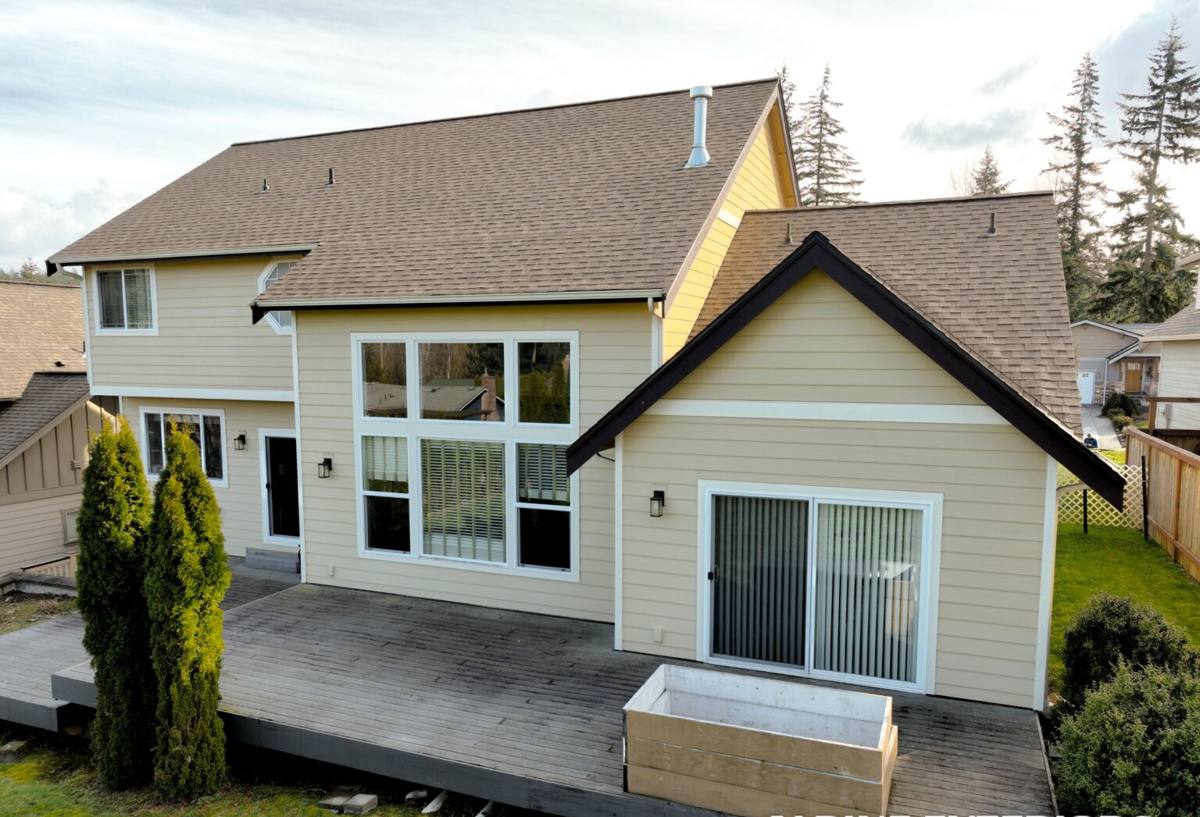
What This Climate Actually Does to Windows
Driving rain and wind exposure
Hillside exposure means rain doesn't just fall on South Hill homes, it's often pushed sideways into window assemblies during winter storms. Older window installs — especially anything original to a house built before modern flashing standards were common — rely on caulk alone to keep that water out. Caulk fails. Once it does, water tracks behind the trim and into the framing, and by the time you see a stain inside, the sheathing has usually been wet for a while.
Salt air and hardware corrosion
Homes with any exposure toward the bay pick up salt in the air, even a few miles inland, especially on windier days. Salt accelerates corrosion on aluminum cladding, steel reinforcement inside vinyl frames, and cheaper hinge and lock hardware. It also breaks down some finishes faster than a manufacturer's warranty documentation assumes for an inland climate.
Moss, mildew, and the long wet season
Whatcom County's moss season isn't a two-week thing — it's most of the year. Moss and mildew don't just grow on roofs; they take hold in window sills, tracks, and any wood trim that stays damp because water isn't shedding away from the house properly. That growth holds moisture against the frame, which is exactly the condition that leads to soft, rotting wood over a few seasons.
Condensation and indoor humidity
Single-pane and older double-pane windows in this climate fog up and sometimes ice over on the inside during cold snaps. That's condensation forming because the glass surface is too cold relative to indoor humidity — a sign the window isn't insulating well, and over time that moisture can damage sills and surrounding drywall.
What a Correct Energy-Efficient Window Job Involves
The window unit itself is maybe half the job. The other half is everything around it — and in a climate like this, that half is what determines whether the install still performs in ten years.
- Removing the old window carefully to expose the rough opening without damaging surrounding siding or trim
- Inspecting the sheathing and framing underneath for rot, soft spots, or existing moisture damage before anything new goes in
- Installing proper flashing — sill pan flashing at minimum, integrated with the building's weather-resistive barrier, not just caulked over the top
- Setting the window plumb, level, and square, then securing it per manufacturer fastening specs
- Sealing and insulating the gap between the frame and rough opening with appropriate low-expansion foam or backer rod, not just caulk
- Installing exterior trim and sealant details that shed water away from the opening, not toward it
- Confirming proper operation, weep hole function, and weatherstripping fit before calling the job done
Skip the flashing step or seal over a rotten sill instead of replacing it, and you've got a new window that will show the same water problems in a few years — just hidden behind a fresh frame.
Choosing the Right Window for a South Hill Home
Frame material trade-offs
Vinyl frames are the most common choice for good reason — they don't corrode, they handle moisture well, and modern multi-chambered vinyl performs solidly in this climate at a reasonable cost. Fiberglass frames cost more but flex less with temperature swings and hold paint if you want a custom color. We're cautious about bare aluminum frames on exposed or bay-facing walls in this region — aluminum conducts heat and cold efficiently, which is the opposite of what you want, and it's more exposed to the corrosion issues salt air causes over time. That's a performance trade-off, not a knock on any manufacturer.
Glass packages that make sense here
Double-pane with a low-E coating and argon gas fill is the baseline we'd recommend for most South Hill homes — it balances cost against real performance in a marine climate. Triple-pane adds more insulation value and can be worth it on north- or wind-exposed walls, but it adds weight and cost, and for many homes here the return doesn't always justify it over a good double-pane unit. We'll walk through what makes sense for your specific exposure rather than upselling a package by default.
Hardware and finish
Given the salt air factor, we pay attention to hardware finish and cladding quality, not just the glass rating. A window with a great U-factor but corner-cutting hardware is a callback waiting to happen in this environment.
Comparing Common Window Options for This Climate
| Frame Type | Moisture/Salt Resistance | Insulation Performance | Typical Fit for South Hill |
|---|---|---|---|
| Vinyl, multi-chamber | Strong — won't corrode or rot | Good, improves with more chambers | Best all-around value for most homes |
| Fiberglass | Strong, minimal expansion/contraction | Very good | Worth it for exposed walls or custom color needs |
| Wood, clad exterior | Good if cladding is intact; core is moisture-sensitive if breached | Very good | Best for historic-style homes wanting an interior wood look |
| Bare aluminum | Weaker — prone to corrosion near the bay | Weaker, conducts temperature | Not our default recommendation for this area |
Why Local Install Experience Matters More Than the Product Label
Two crews can install the exact same window model with very different results. What separates a job that lasts from one that doesn't is whether the installer understands how wind-driven rain moves on a hillside lot, how to flash an opening so water sheds instead of pools, and how fast rot sets in when Whatcom County's wet season sits on a poorly sealed frame. A crew that works this specific area regularly has already seen what fails here and builds the install to avoid it, rather than following a generic install sheet written for a drier climate.
We also know that South Hill has a mix of older housing stock alongside newer construction, which means rough openings, trim details, and existing moisture conditions vary a lot house to house. There's rarely a one-size install here — every opening gets inspected on its own.
Our Process for South Hill Window Projects
- On-site assessment of current windows, framing condition, and specific exposure (wind, rain direction, sun, proximity to the bay)
- Straightforward written estimate covering product options, install scope, and timeline
- Careful removal and opening inspection, with any rot or damage flagged and discussed before covering it back up
- Proper flashing, insulation, and sealing installed to manufacturer and industry standard, not shortcuts
- Final walkthrough confirming operation, sealing, and trim finish before we call it complete
Signs It's Time to Replace, Not Patch
- Condensation forming between the panes (a sign the seal has failed and the window can't be repaired, only replaced)
- Soft or spongy wood at the sill or surrounding trim
- Persistent moss or dark mildew staining in the window tracks that comes back after cleaning
- Drafts you can feel near the frame even with the window fully latched
- Hardware that's corroded, stiff, or no longer locks properly
- Noticeably higher heating costs compared to similar homes nearby
What Affects Cost
Costs vary by opening size, frame material, glass package, and how much of the surrounding trim and flashing needs to be rebuilt versus simply reinstalled. Homes with existing moisture damage from old, failed installs typically cost more to correct properly than homes where the openings are in good shape and it's a straightforward swap. We'd rather walk you through actual numbers for your home during an on-site look than throw out a broad range that doesn't reflect your specific project.
If your South Hill home has drafty windows, foggy glass, or trim that's starting to show its age, we're happy to take a look and give you an honest read on what's going on — no pressure, no obligation. Use the form below to request a free estimate.