 Bellingham
 Sunnyland's Climate Is Harder on Siding Than Most Homeowners Realize
Sunnyland is one of Bellingham's established neighborhoods, and like most of Whatcom County, it sits at the intersection of a few weather patterns that don't play nice with exterior building materials. Bellingham Bay sends salt-laden air inland on a regular basis. Winter storms roll off the Pacific and dump driving, wind-blown rain that hits siding sideways instead of straight down. And the region's mild, wet winters combined with mature tree cover mean a long moss and algae season that can run from fall through spring. Individually, any one of those factors is manageable. Together, over years, they're what separates siding that looks good for two decades from siding that starts failing in five.
Most siding failures we see in Whatcom County aren't dramatic. They're slow — a little swelling at a butt joint, a little color fade on the sun-exposed side, a little green film creeping up from the ground on the shaded side. By the time it's obvious, the damage is usually already into the substrate. That's the case for treating siding material choice and installation quality as a climate decision for this neighborhood, not just a cosmetic one.
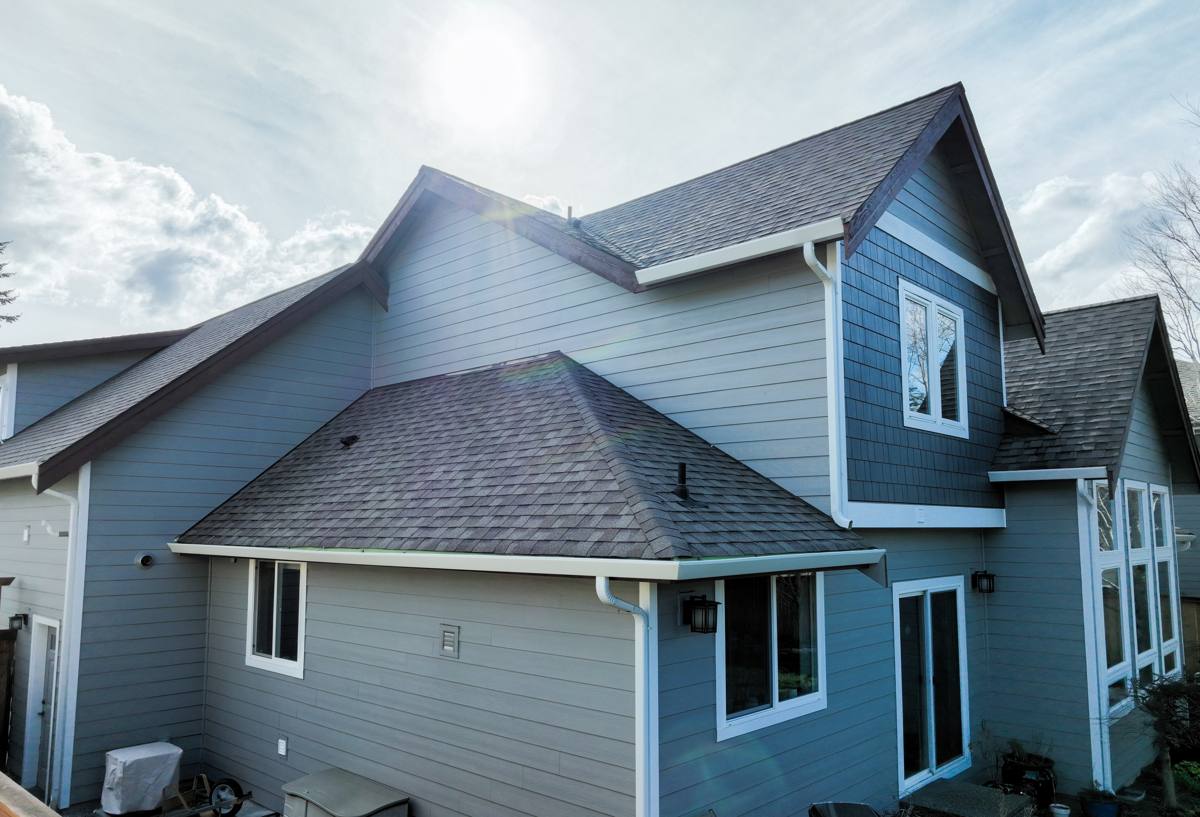
What Sunnyland Homes Need From Their Siding
Resistance to Salt Air
Homes closer to Bellingham Bay deal with airborne salt that accelerates corrosion on fasteners and metal trim and slowly breaks down materials that aren't built to handle it. Untreated or lower-grade materials can chalk, pit, or corrode faster in this environment than the same product would inland. Siding, flashing, and fastener choices all need to account for it.
Standing Up to Driving Rain
Wind-driven rain doesn't just wet the surface of a wall — it gets pushed into laps, joints, and penetrations that would stay dry in a calmer climate. That means the water-resistive barrier behind the siding, the flashing details around windows and doors, and the way panels are lapped and gapped all matter as much as the siding material itself. A great product installed with sloppy water management will still leak.
Surviving a Long Moss Season
Shaded, moisture-holding surfaces in this part of Washington grow moss and algae readily, especially on north-facing walls and anywhere tree canopy blocks sun and airflow. Wood-based siding gives moss and mold something to feed on; fiber cement doesn't. That single difference has a real impact on how much upkeep a home needs and how long a finish lasts before it needs attention.
Why We Install Only James Hardie in This Neighborhood
We made a standing decision as a company to install James Hardie fiber cement siding exclusively — we don't install vinyl, LP SmartSide, cedar, primed spruce, Cemplank, or Allura. That's not a marketing position; it's a response to what actually holds up in Whatcom County's climate over the long haul.
- Non-combustible material — fiber cement doesn't burn, which matters increasingly as wildfire smoke and dry-season risk become part of Pacific Northwest summers.
- Engineered for the region — James Hardie makes climate-specific HZ product lines, and the versions specified for the Pacific Northwest are engineered for high-moisture, high-humidity conditions rather than a one-size-fits-all formula.
- ColorPlus factory finish — a baked-on finish applied and cured under factory conditions, backed by its own finish warranty, holds color and resists the fading and chalking that field-applied paint struggles with under regular sun and salt exposure.
- Doesn't feed moss or rot — as a cement-based product, it doesn't provide the organic material that wood siding does, which matters directly in a neighborhood with a long moss season.
- Transferable warranty — a strong, transferable manufacturer warranty that adds real value if the home is sold, which matters in a market where siding condition affects resale.
We're upfront that other products get some things right — vinyl is inexpensive, cedar looks the way a lot of homeowners want a Pacific Northwest home to look. But over the 30-plus year window a homeowner actually cares about, we've found Hardie is the product that holds up to this specific climate with the least maintenance burden, and that's the standard we've chosen to build our business on.
What a Correct James Hardie Installation Involves
The siding product is only part of the equation. A huge share of the siding failures we're called to diagnose in this area trace back to installation shortcuts, not the material itself. Manufacturer specifications exist for a reason, and in a climate like Sunnyland's, skipping them shows up faster than it would somewhere drier.
- A continuous, correctly lapped water-resistive barrier behind the siding — not just housewrap stapled up quickly
- Proper flashing at every window, door, and roof-to-wall intersection, integrated with the barrier so water sheds outward, not behind the siding
- Correct fastener type, spacing, and penetration depth per Hardie's published installation specs — this is one of the most common shortcuts we see, and it directly affects both structural performance and warranty coverage
- Proper clearance and gapping at the ground, roofline, and butt joints so panels can drain and the material isn't left sitting in standing water
- Factory-cut or properly sealed field cuts, since exposed raw edges are a common entry point for moisture
- Caulking only where Hardie's specifications call for it, done with a product rated for the application — over-caulking can trap moisture just as easily as under-caulking lets it in
None of this is exotic. It's discipline — following the manufacturer's installation manual instead of treating siding as a quick wrap-and-nail job. It's also exactly what a warranty claim looks at if something goes wrong down the line.
Our Process for a Sunnyland Siding Project
- On-site assessment. We look at the home's exposure — how much direct salt air it gets, how much shade and moisture it holds, where past problem areas are — before we talk product or scope.
- Tear-off and sheathing inspection. Once the old siding is off, we inspect the sheathing and framing underneath for water damage or rot, which is common to find on older homes in this climate and needs to be addressed before new siding goes on, not covered up.
- Water management first. We install the water-resistive barrier and flashing system before a single piece of Hardie siding goes up. This is the step that determines whether the wall stays dry for the next 30 years.
- Installation to manufacturer spec. Fasteners, gapping, lapping, and trim details follow James Hardie's published requirements — not shortcuts, not "close enough."
- Final walkthrough and cleanup. We review the finished work with the homeowner and leave the site clean.
Why a Crew That Already Works Sunnyland Matters
Siding work in Bellingham isn't identical to siding work in a drier inland climate, and it isn't identical from one Whatcom County neighborhood to the next either. A crew that regularly works Sunnyland and the surrounding Bellingham neighborhoods has already seen how the local exposure to salt air, tree cover, and driving rain plays out on real homes — which walls tend to hold moss, which details tend to leak first, which older homes in the area tend to have sheathing issues once the siding comes off. That's knowledge that shows up as fewer surprises and fewer callbacks, not as a sales pitch.
It also means faster response if something needs a look after the job is done — inspections, warranty questions, or just a homeowner wanting an honest opinion on a soft spot they noticed. Working locally isn't a convenience feature; it's part of doing the job right over the long run.
What Affects the Cost of a Sunnyland Hardie Siding Project
Every home is different, so we don't quote pricing without seeing the house, but these are the main factors that move the number:
| Factor | Why It Matters |
|---|---|
| Tear-off vs. new construction | Removing and disposing of existing siding, and repairing any sheathing damage found underneath, adds labor beyond a straightforward install |
| Home size and wall complexity | More corners, dormers, and roofline intersections mean more flashing detail work and cut waste |
| Siding profile and finish | Lap siding, shingle-style panels, and trim/accent choices carry different material and labor costs |
| Extent of moisture or rot damage | Homes with prior water intrusion may need sheathing or framing repair before new siding can go on |
| Trim and detail work | Window and door trim, fascia, and accent bands add both material and precision labor time |
Caring for Your New Siding Through Whatcom County Winters
James Hardie siding is low-maintenance, not zero-maintenance. A little seasonal attention goes a long way toward getting the full lifespan out of it in this climate.
- Rinse the exterior gently once or twice a year, focusing on shaded and north-facing walls where moss and algae are most likely to start
- Keep gutters clear so overflow isn't running down the siding face during heavy rain events
- Trim back tree branches and shrubs that hold moisture against the wall or block airflow and sunlight
- Check caulking at trim and penetrations periodically, and have any cracked or missing caulk addressed before the wet season
- Have any impact damage or visible gaps looked at promptly — small issues are easy to fix, and delaying lets moisture get behind the panel
Get a Straight Answer for Your Home
If you're weighing a siding replacement in Sunnyland, we're happy to take a look at your home, walk you through what we're seeing, and give you a straightforward, no-pressure estimate. Use the form below to get started.